Haupt Caroline, Hofmann Tommy, Wittig Sabine, Kostmann Susann, Politis Argyris, Schmidt Carla
Interdisciplinary research center HALOmem, Martin Luther University Halle-Wittenberg.
Department of Chemistry, Kings College London.
J Vis Exp. 2017 Nov 28(129):56747. doi: 10.3791/56747.
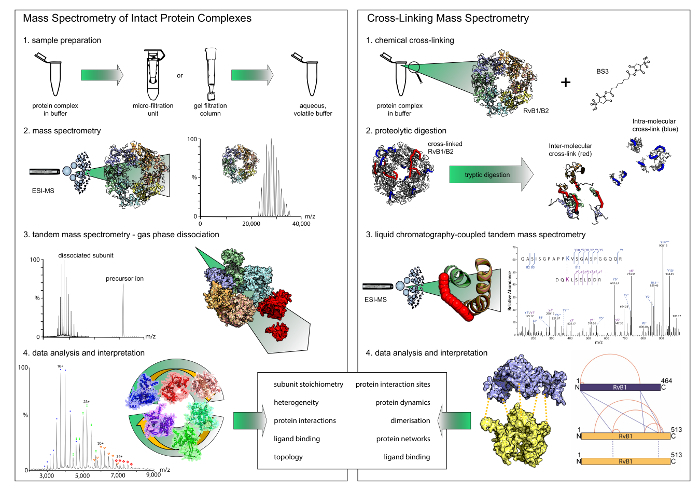
Proteins interact with their ligands to form active and dynamic assemblies which carry out various cellular functions. Elucidating these interactions is therefore fundamental for the understanding of cellular processes. However, many protein complexes are dynamic assemblies and are not accessible by conventional structural techniques. Mass spectrometry contributes to the structural investigation of these assemblies, and particularly the combination of various mass spectrometric techniques delivers valuable insights into their structural arrangement. In this article, we describe the application and combination of two complementary mass spectrometric techniques, namely chemical cross-linking coupled with mass spectrometry and native mass spectrometry. Chemical cross-linking involves the covalent linkage of amino acids in close proximity by using chemical reagents. After digestion with proteases, cross-linked di-peptides are identified by mass spectrometry and protein interactions sites are uncovered. Native mass spectrometry on the other hand is the analysis of intact protein assemblies in the gas phase of a mass spectrometer. It reveals protein stoichiometries as well as protein and ligand interactions. Both techniques therefore deliver complementary information on the structure of protein-ligand assemblies and their combination proved powerful in previous studies.
蛋白质与其配体相互作用形成具有活性和动态性的聚集体,这些聚集体执行各种细胞功能。因此,阐明这些相互作用对于理解细胞过程至关重要。然而,许多蛋白质复合物是动态聚集体,传统结构技术无法对其进行研究。质谱有助于对这些聚集体进行结构研究,特别是各种质谱技术的结合为其结构排列提供了有价值的见解。在本文中,我们描述了两种互补质谱技术的应用和结合,即化学交联结合质谱和天然质谱。化学交联是通过使用化学试剂使相邻的氨基酸发生共价连接。用蛋白酶消化后,通过质谱鉴定交联的二肽,并揭示蛋白质相互作用位点。另一方面,天然质谱是在质谱仪的气相中对完整蛋白质聚集体进行分析。它揭示了蛋白质的化学计量以及蛋白质与配体的相互作用。因此,这两种技术都提供了关于蛋白质-配体聚集体结构的互补信息,并且它们的结合在先前的研究中已证明具有强大的作用。