Department of Restorative Dentistry, School of Dentistry, Oregon Health & Science University, 2730 S.W. Moody Ave., Portland, OR 97201-5042, United States.
School of Medicine, University of Alabama, 1720 2nd Avenue South, Birmingham, AL 35294-0007, United States.
J Dent. 2018 Mar;70:67-73. doi: 10.1016/j.jdent.2017.12.014. Epub 2017 Dec 28.
The objective of this study was to determine which patient traits, behaviors, external tooth and/or crack characteristics correlate with the types of symptoms that teeth with visible cracks exhibit, namely pain on biting, pain due to cold stimuli, or spontaneous pain.
Dentists in the National Dental Practice-Based Research Network enrolled a convenience sample of subjects each of whom had a single, vital posterior tooth with at least one observable external crack (cracked teeth); 2858 cracked teeth from 209 practitioners were enrolled. Data were collected at the patient-, tooth-, and crack-level. Generalized estimating equations were used to obtain significant (p < .05) independent odds ratios (OR) associated with teeth that were painful for 10 outcomes based on types of pain and combinations thereof.
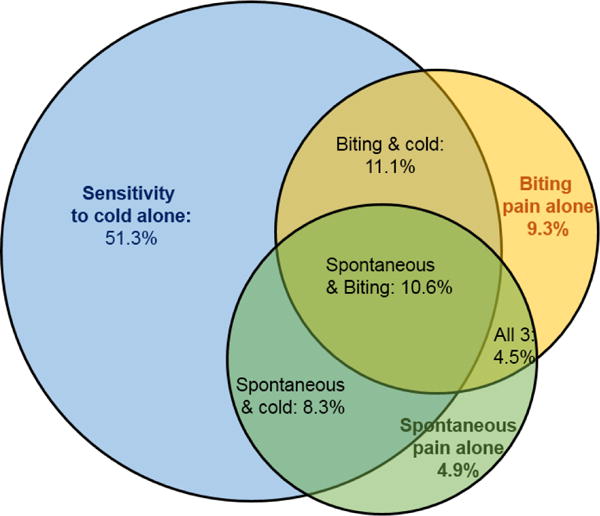
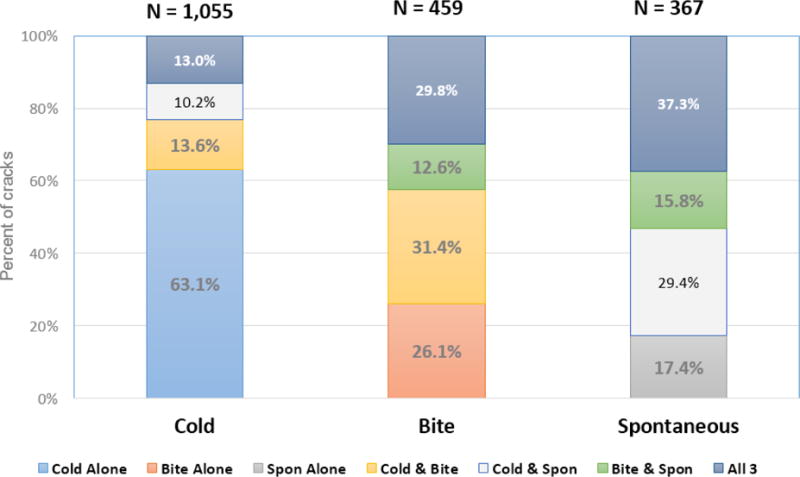
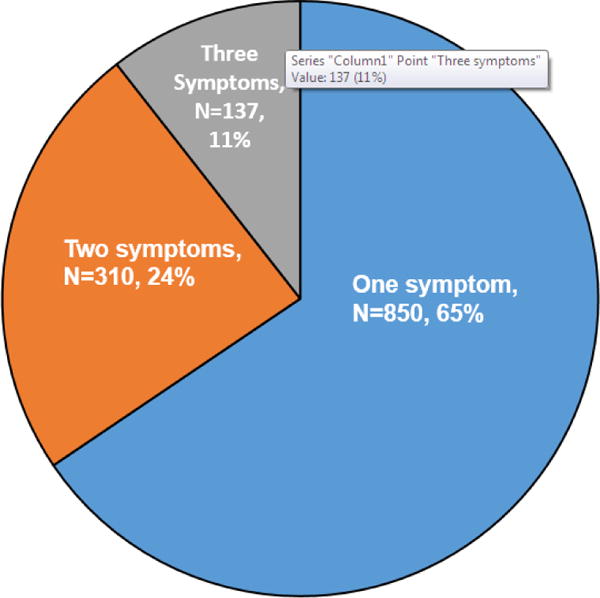
Overall, 45% of cracked teeth had one or more symptoms. Pain to cold was the most common symptom, which occurred in 37% of cracked teeth. Pain on biting (16%) and spontaneous pain (11%) were less common. Sixty-five percent of symptomatic cracked teeth had only one type of symptom, of these 78% were painful only to cold. No patient-, tooth- or crack-level characteristic was significantly associated with pain to cold alone. Positive associations for various combinations of pain symptoms were present with cracks that: (1) were on molars; (2) were in occlusion; (3) had a wear facet through enamel; (4) had caries; (5) were evident on a radiograph; (6) ran in more than one direction; (7) blocked transilluminated light; (8) connected with another crack; (9) extended onto the root; (10) extended in more than one direction; or (11) were on the distal surface. Persons who were <65 yo or who clench, grind, or press their teeth together also were more likely to have pain symptoms. Pain was less likely in teeth with stained cracks or exposed roots, or in non-Hispanic whites.
Although pain to cold was the most commonly noted pain associated with symptomatic cracked teeth, no patient-, tooth- or crack-level characteristic was significantly associated with pain to cold alone. Characteristics were only associated with pain on biting and/or spontaneous pain with or without pain to cold.
Although often considered the most reliable diagnosis for a cracked tooth, pain on biting is not the most common symptom of a tooth with a visible crack, but rather pain to cold.
本研究旨在确定哪些患者特征、行为、外部牙和/或裂纹特征与具有可见裂纹的牙齿表现出的症状类型相关,即咬合疼痛、冷刺激引起的疼痛或自发性疼痛。
国家牙科实践基础研究网络中的牙医招募了一个便利样本的受试者,每个受试者都有一颗单一的、有活力的后牙,至少有一个可观察到的外部裂纹(裂纹牙);共有 209 名从业者的 2858 颗裂纹牙被纳入研究。数据在患者、牙齿和裂纹水平上收集。使用广义估计方程获得与基于疼痛类型和组合的 10 个结果相关的具有统计学意义的(p <.05)独立优势比(OR)。
总体而言,45%的裂纹牙有一个或多个症状。冷刺激痛是最常见的症状,发生在 37%的裂纹牙中。咬合痛(16%)和自发性疼痛(11%)则不太常见。65%的有症状的裂纹牙只有一种类型的症状,其中 78%仅对冷刺激敏感。在患者、牙齿或裂纹水平上没有特征与单独的冷刺激痛显著相关。在存在各种疼痛症状组合的情况下,阳性关联与以下特征相关:(1)磨牙;(2)咬合接触;(3)牙釉质上有磨损面;(4)有龋齿;(5)在射线片上可见;(6)向多个方向延伸;(7)阻挡透光线;(8)与另一个裂纹相连;(9)延伸到根方;(10)向多个方向延伸;或(11)位于远中面。年龄<65 岁或有磨牙、紧咬牙或压牙习惯的人也更有可能出现疼痛症状。牙齿有染色裂纹或暴露根、或为非西班牙裔白人时,疼痛的可能性较小。
尽管冷刺激痛是与有症状的裂纹牙相关的最常见疼痛,但没有患者、牙齿或裂纹水平上的特征与单独的冷刺激痛显著相关。这些特征仅与咬合痛和/或自发性疼痛相关,无论是否伴有冷刺激痛。
尽管咬合痛通常被认为是裂纹牙最可靠的诊断,但它不是具有可见裂纹的牙齿的最常见症状,而是冷刺激痛。