Ni Jianzhao, Xu Liang, Lin Yunzhi, Lai Danlin, Huang Xiaohong
Department of Stomatology, The First Affiliated Hospital, Fujian Medical University, Fuzhou, China.
Front Bioeng Biotechnol. 2023 Aug 15;11:1222060. doi: 10.3389/fbioe.2023.1222060. eCollection 2023.
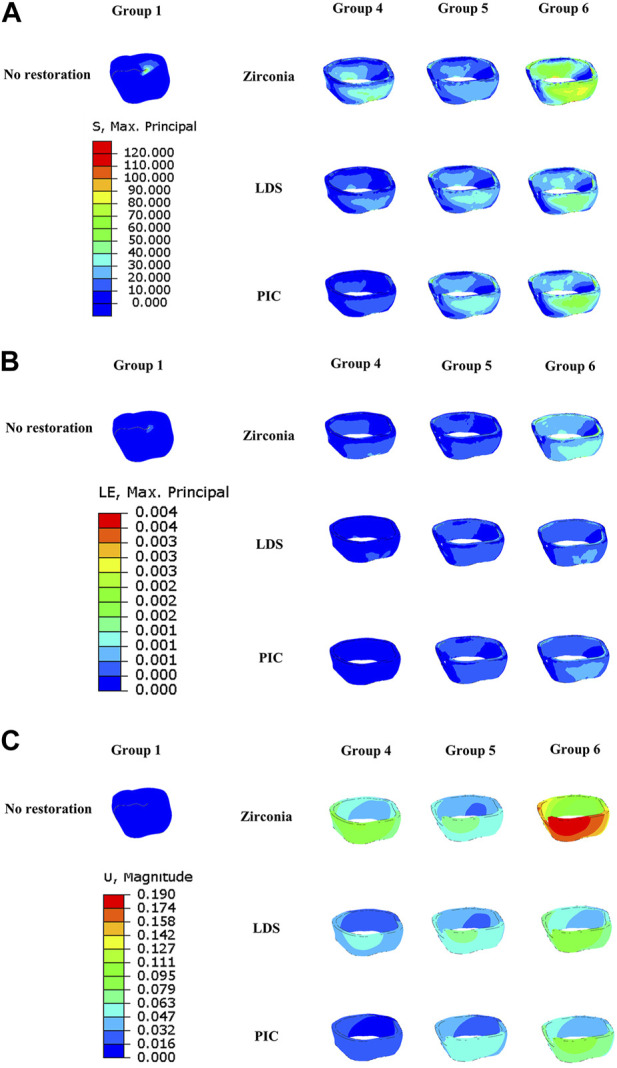
This study aims to investigate the biomechanical properties of fracture resistance in cracked teeth using five different full-coverage restorations made of three different materials. A 3D model of a mandibular first molar was created to design five different full-coverage repair models: crown, crown with composite resin filling inside, occlusal veneer, occlusal veneer with composite resin filling inside and onlay. These repair models were fabricated using three different materials, namely, zirconia, lithium disilicate (LDS), and a hybrid polymer-infiltrated ceramic network material (PIC). In total, 15 repair models were tested using the extended finite element method (XFEM), with an occlusal load of 5000 N applied slowly to the occlusal surface of the restoration. The analysis of stress distribution in the restoration and dentin crack line was conducted to measure and record the crack initial load on the restoration and dentin. The results showed that restorations on the occlusal surface significantly improved crack resistance, with zirconia exhibiting superior fracture resistance among the materials tested. Restorations of crown with composite resin filling inside demonstrated the highest resistance to fracture, while occlusal veneers showed the lowest. MPS concentration was observed at the interface between the restoration and dentin and at the root bifurcation, with the highest values at the top of crack development. Dentin covered by oxidized restorations had the highest displacement, while PIC restorations exhibited the lowest. Pulp analysis revealed selective MPS concentration and strain patterns in models with zirconia restorations and onlay, with pronounced pulp displacement in zirconia restorations and onlay. Enamel analysis indicated larger MPS values and displacements in zirconia restoration models and onlay, with higher strain in onlay. Restoration played a crucial role in protecting the tooth, with crack propagation initial loads in dentin surpassing restorations in experimental groups. This study confirms that full-coverage restorations significantly increased the fracture resistance of cracked teeth, with zirconia restorations significantly protecting the underlying cracked tooth. Elimination of fracture lines in the restoration design can improve fracture resistance in cracked teeth. The findings have implications for dental prosthetic design and clinical practice.
本研究旨在使用由三种不同材料制成的五种不同全冠修复体,研究有裂纹牙齿的抗折生物力学性能。创建了下颌第一磨牙的三维模型,以设计五种不同的全冠修复模型:全冠、内部有复合树脂充填的全冠、咬合贴面、内部和外部均有复合树脂充填的咬合贴面以及高嵌体。这些修复模型使用三种不同材料制作,即氧化锆、二硅酸锂(LDS)和一种混合聚合物渗透陶瓷网络材料(PIC)。总共使用扩展有限元方法(XFEM)测试了15个修复模型,在修复体的咬合面上缓慢施加5000 N的咬合载荷。对修复体和牙本质裂纹线中的应力分布进行分析,以测量和记录修复体和牙本质上的裂纹初始载荷。结果表明,咬合面修复体显著提高了抗裂性,在测试材料中氧化锆表现出卓越的抗折性。内部有复合树脂充填的全冠修复体表现出最高的抗折性,而咬合贴面的抗折性最低。在修复体与牙本质的界面以及牙根分叉处观察到MPS浓度,在裂纹发展顶端处的值最高。被氧化修复体覆盖的牙本质位移最大,而PIC修复体的位移最小。牙髓分析显示,在有氧化锆修复体和高嵌体的模型中存在选择性MPS浓度和应变模式,氧化锆修复体和高嵌体中的牙髓位移明显。釉质分析表明,氧化锆修复体模型和高嵌体中的MPS值和位移更大,高嵌体中的应变更高。修复体在保护牙齿方面起着关键作用,实验组牙本质中的裂纹扩展初始载荷超过了修复体。本研究证实,全冠修复体显著提高了有裂纹牙齿的抗折性,氧化锆修复体显著保护了下方的有裂纹牙齿。在修复设计中消除裂纹线可提高有裂纹牙齿的抗折性。这些发现对牙科修复设计和临床实践具有启示意义。