Gan Wei, Yi Yong, Fu Yipeng, Huang Jinlong, Lu Zhufeng, Jing Chuyu, Fan Jia, Zhou Jian, Qiu Shuangjian
Liver Cancer Institute, Zhongshan Hospital and Shanghai Medical School, Fudan University, Key Laboratory for Carcinogenesis & Cancer Invasion, The Chinese Ministry of Education, Shanghai, China.
Department of Anesthesiology, Zhongshan Hospital, Fudan University, Shanghai, China.
J Cancer. 2018 Jan 1;9(1):148-156. doi: 10.7150/jca.22246. eCollection 2018.
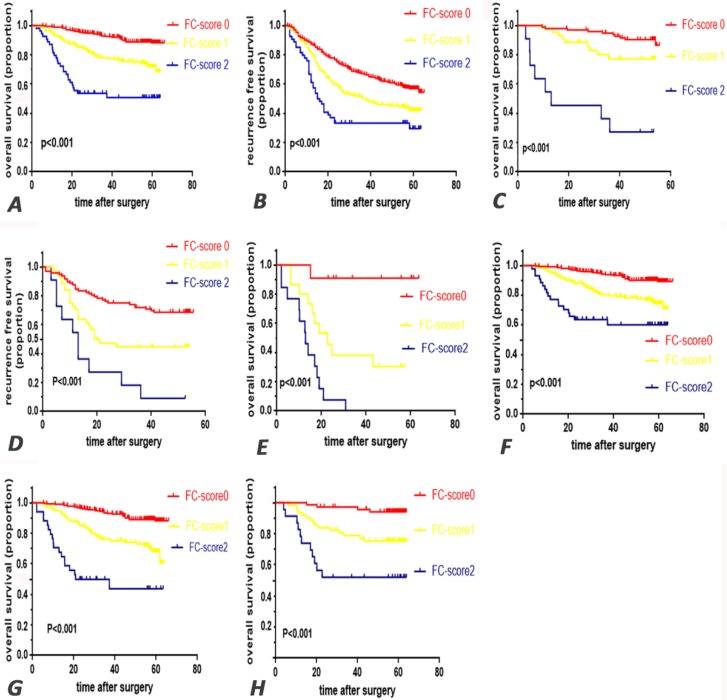
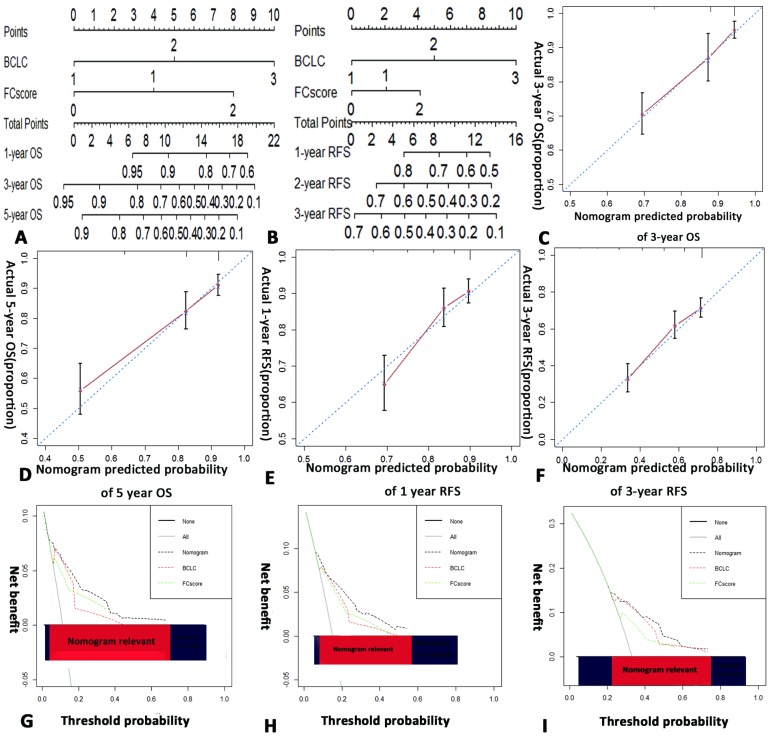
While curative resection is the established strategy for Hepatocellular carcinoma (HCC) patients, the prognosis still remains poor, and the efficiency of existing prediction models is unsatisfactory. Therefore, we aimed to develop a credible and easy-to-use prognostic index for patients with HCC undergoing curative therapy. : A total of 768 patients with HCC, who underwent curative resection from December 2010 to June 2012 in Zhongshan Hospital, were divided into a training cohort with 616 patients and a validating cohort of 152 patients at a ratio of 4 to 1 by random allocation. Then, a retrospective cohort study was conducted to identify effective prognostic indexes. : FC-score, which incorporates fibrinogen and C-reactive protein, was established. In the multivariate analysis for OS and RFS, FC-score has shown to be a significant independent prognostic index in both the training cohort and validation cohort. Furthermore, the C-index of the FC-score for OS and RFS were 0.698 and 0.594 respectively, which were superior to other inflammation systems such as IBI, IBS, and GPS. Then, we developed a novel nomogram, which integrated FC-score into the conventional BCLC staging system. This new nomogram gave rise to a new C-index of 0.746 (95%CI: 0.743-0.749) for OS, and 0.654 (95%CI: 0.652-0.656) for RFS. The calibration curve and decision curve analysis indicated that our nomogram was highly consistent between predicted and actual observations. FC-score represents a novel, convenient, reliable, and accurate prognostic predictor for both OS and RFS in HCC patients undergoing curative therapy.
虽然根治性切除是肝细胞癌(HCC)患者的既定治疗策略,但其预后仍然很差,且现有预测模型的效率并不理想。因此,我们旨在为接受根治性治疗的HCC患者开发一种可靠且易于使用的预后指数。:2010年12月至2012年6月在中山医院接受根治性切除的768例HCC患者,通过随机分配以4比1的比例分为一个有616例患者的训练队列和一个有152例患者的验证队列。然后,进行回顾性队列研究以确定有效的预后指标。:建立了包含纤维蛋白原和C反应蛋白的FC评分。在总生存期(OS)和无复发生存期(RFS)的多变量分析中,FC评分在训练队列和验证队列中均显示为显著的独立预后指标。此外,FC评分的OS和RFS的C指数分别为0.698和0.594,优于其他炎症系统,如炎症指数(IBI)、炎症负担评分(IBS)和格拉斯哥预后评分(GPS)。然后,我们开发了一种新的列线图,将FC评分纳入传统的巴塞罗那临床肝癌(BCLC)分期系统。这个新的列线图使OS的新C指数为0.746(95%置信区间:0.743 - 0.749),RFS的新C指数为0.654(95%置信区间:0.652 - 0.656)。校准曲线和决策曲线分析表明,我们的列线图在预测和实际观察之间高度一致。FC评分是接受根治性治疗的HCC患者OS和RFS的一种新颖、便捷、可靠且准确的预后预测指标。