Ranjbar Reza, Behzadi Payam, Najafi Ali, Roudi Raheleh
Molecular Biology Research Center, Baqiyatallah University of Medical Sciences, Tehran, Iran.
Department of Microbiology, College of Basic Sciences, Shahr-e-Qods Branch, Islamic Azad University, Tehran, Iran.
Open Microbiol J. 2017 Nov 30;11:330-338. doi: 10.2174/1874285801711010330. eCollection 2017.
A rapid, accurate, flexible and reliable diagnostic method may significantly decrease the costs of diagnosis and treatment. Designing an appropriate microarray chip reduces noises and probable biases in the final result.
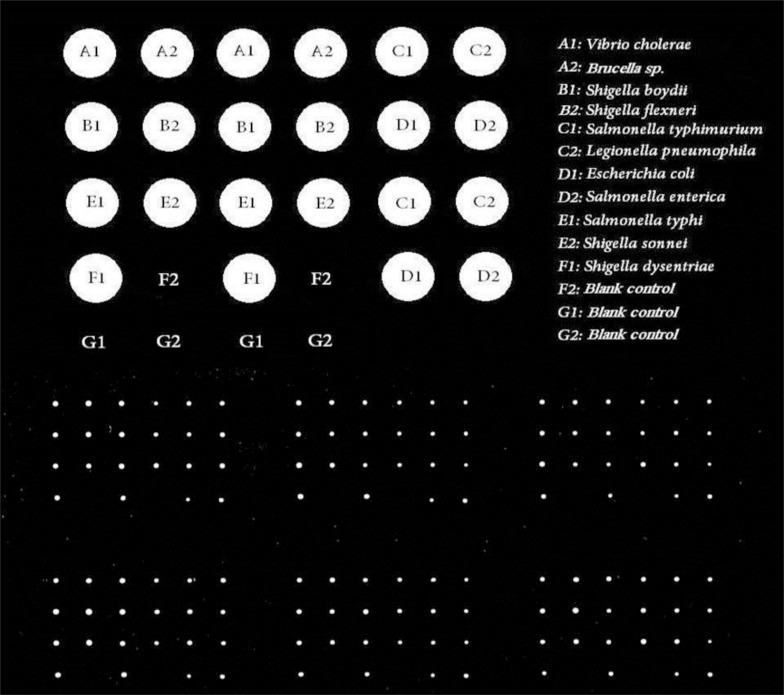
The aim of this study was to design and construct a DNA Microarray Chip for a rapid detection and identification of 10 important bacterial agents.
In the present survey, 10 unique genomic regions relating to 10 pathogenic bacterial agents including and were selected for designing specific long oligo microarray probes. For this reason, the in-silico operations including utilization of the NCBI RefSeq database, Servers of PanSeq and Gview, AlleleID 7.7 and Oligo Analyzer 3.1 was done. On the other hand, the part of the study comprised stages of robotic microarray chip probe spotting, bacterial DNAs extraction and DNA labeling, hybridization and microarray chip scanning. In wet lab section, different tools and apparatus such as Nexterion® Slide E, Qarray spotter, NimbleGen kit, TrayMix S4, and Innoscan 710 were used.
A DNA microarray chip including 10 long oligo microarray probes was designed and constructed for detection and identification of 10 pathogenic bacteria.
The DNA microarray chip was capable to identify all 10 bacterial agents tested simultaneously. The presence of a professional bioinformatician as a probe designer is needed to design appropriate multifunctional microarray probes to increase the accuracy of the outcomes.
一种快速、准确、灵活且可靠的诊断方法可显著降低诊断和治疗成本。设计合适的微阵列芯片可减少最终结果中的噪声和可能的偏差。
本研究旨在设计并构建一种用于快速检测和鉴定10种重要细菌病原体的DNA微阵列芯片。
在本次研究中,选择了与包括[具体细菌名称未给出]等10种致病细菌病原体相关的10个独特基因组区域,用于设计特异性长寡核苷酸微阵列探针。为此,进行了包括利用NCBI RefSeq数据库、PanSeq和Gview服务器、AlleleID 7.7和Oligo Analyzer 3.1等的电子计算机操作。另一方面,研究的实验部分包括机器人微阵列芯片探针点样、细菌DNA提取和DNA标记、杂交以及微阵列芯片扫描等阶段。在湿实验室部分,使用了不同的工具和仪器,如Nexterion® Slide E、Qarray点样仪、NimbleGen试剂盒、TrayMix S4和Innoscan 710。
设计并构建了一种包含10个长寡核苷酸微阵列探针的DNA微阵列芯片,用于检测和鉴定10种致病细菌。
该DNA微阵列芯片能够同时鉴定所有测试的10种细菌病原体。需要有专业的生物信息学家作为探针设计者来设计合适的多功能微阵列探针,以提高结果的准确性。