Mauland Karen Klepsland, Ju Zhenlin, Tangen Ingvild Løberg, Berg Anna, Kalland Karl-Henning, Øyan Anne Margrete, Bjørge Line, Westin Shannon N, Krakstad Camilla, Trovik Jone, Mills Gordon B, Hoivik Erling A, Johanna Werner Henrica Maria
Centre for Cancer Biomarkers CCBIO, Department of Clinical Science (K2), University of Bergen, Bergen, Norway.
Department of Obstetrics and Gynecology, Haukeland University Hospital, Bergen, Norway.
Oncotarget. 2017 Oct 31;8(63):106989-107001. doi: 10.18632/oncotarget.22203. eCollection 2017 Dec 5.
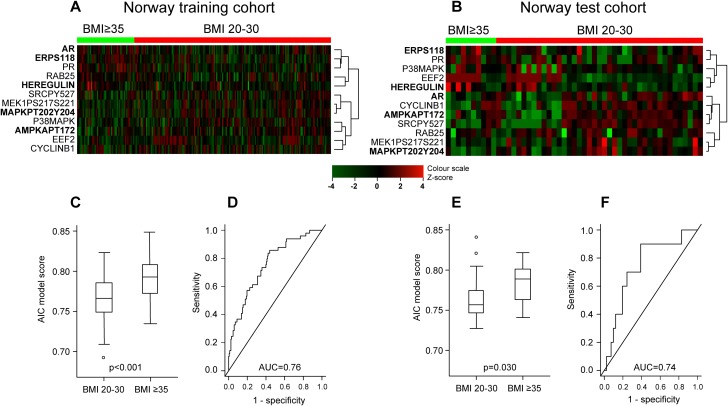
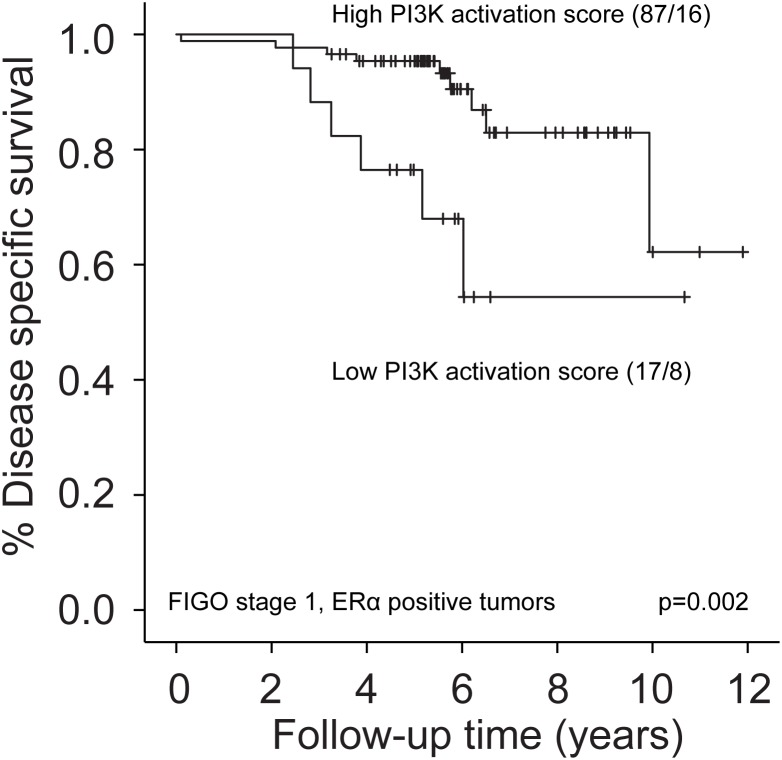
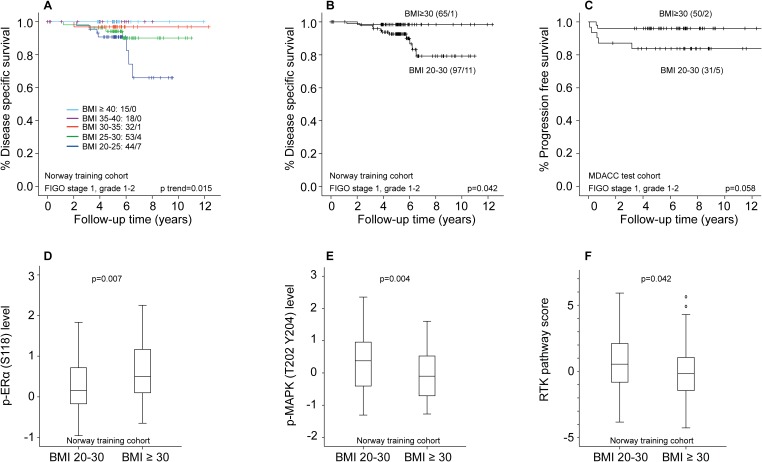
Endometrial cancer development is strongly linked to obesity, but knowledge regarding the influence of excess weight on endometrial tumor signaling pathways remains scarce. We therefore analyzed reverse phase protein array (RPPA) data for obesity-related protein expression patterns, using one training (n=272) and two test cohorts (n=68; n=178) of well-annotated samples from women treated for endometrioid endometrial cancer. Gene expression profiling and immunohistochemistry were used for cross-platform validation. Body mass index (BMI) was significantly correlated with progesterone receptor (PR) expression and a hormone receptor protein signature, across all cohorts. In two of the cohorts, BMI was negatively correlated with RTK- and MAPK-pathway activation, particularly phosphorylated MAPK T202 Y204 (p-MAPK) level. Using stepwise selection modelling, a BMI-associated protein signature, including phosphorylated estrogen receptor α S118 (p-ERα) and p-MAPK, was identified. In the subset of FIGO stage 1, grade 1-2 tumors, obese patients (BMI≥30) had better survival compared to non-obese patients in the two cohorts with longest follow-up time (p=0.042, p=0.058). Non-obese patients had higher p-MAPK levels, whereas obese patients had higher p-ERα levels and enrichment of gene signatures related to estrogen signaling, inflammation, immune signaling and hypoxia. In subgroup analysis of non-obese patients with FIGO stage 1 tumors, low PI3K-activation was associated with reduced survival (p=0.002, training cohort). In conclusion, increasing BMI is associated with increased PR and p-ERα levels and reduced MAPK signaling, both in all patients and in subsets with predicted excellent prognosis. The MAPK-pathway represents a potential therapeutic target in non-obese patients with low stage and low grade tumors.
子宫内膜癌的发生与肥胖密切相关,但关于超重对子宫内膜肿瘤信号通路影响的知识仍然匮乏。因此,我们分析了反相蛋白质阵列(RPPA)数据,以了解肥胖相关蛋白表达模式,使用了一个训练队列(n = 272)和两个测试队列(n = 68;n = 178),这些样本来自接受子宫内膜样子宫内膜癌治疗的女性,且注释详尽。基因表达谱分析和免疫组化用于跨平台验证。在所有队列中,体重指数(BMI)与孕激素受体(PR)表达及激素受体蛋白特征显著相关。在其中两个队列中,BMI与RTK和MAPK信号通路激活呈负相关,尤其是磷酸化的MAPK T202 Y204(p-MAPK)水平。通过逐步选择建模,确定了一个与BMI相关的蛋白特征,包括磷酸化的雌激素受体α S118(p-ERα)和p-MAPK。在国际妇产科联盟(FIGO)1期、1 - 2级肿瘤亚组中,在随访时间最长的两个队列中,肥胖患者(BMI≥30)的生存率高于非肥胖患者(p = 0.042,p = 0.058)。非肥胖患者的p-MAPK水平较高,而肥胖患者的p-ERα水平较高,且与雌激素信号、炎症、免疫信号和缺氧相关的基因特征富集。在FIGO 1期肿瘤的非肥胖患者亚组分析中,低PI3K激活与生存率降低相关(p = 0.002,训练队列)。总之,在所有患者以及预测预后良好的亚组中,BMI升高与PR和p-ERα水平升高以及MAPK信号传导降低相关。MAPK信号通路是低分期、低级别肿瘤的非肥胖患者的潜在治疗靶点。