Schori Christian, Agbaga Martin-Paul, Brush Richard S, Ayyagari Radha, Grimm Christian, Samardzija Marijana
Lab for Retinal Cell Biology, Department of Ophthalmology, University of Zurich, Zurich, Switzerland.
Center for Integrative Human Physiology (ZIHP), University of Zurich, Zurich, Switzerland.
PLoS One. 2018 Jan 2;13(1):e0190514. doi: 10.1371/journal.pone.0190514. eCollection 2018.
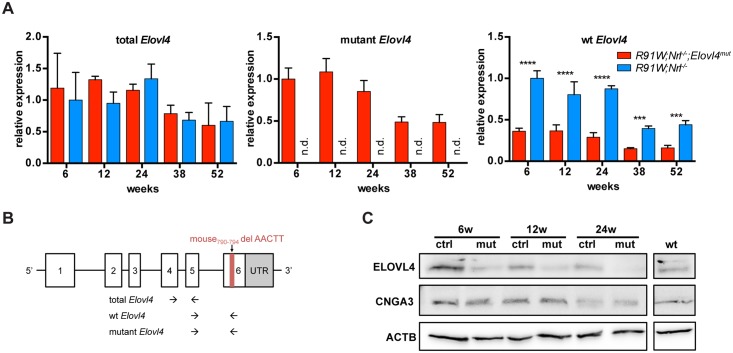
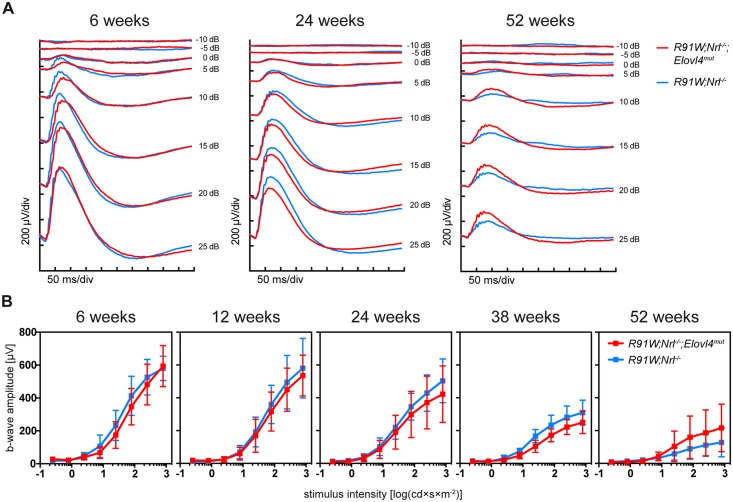
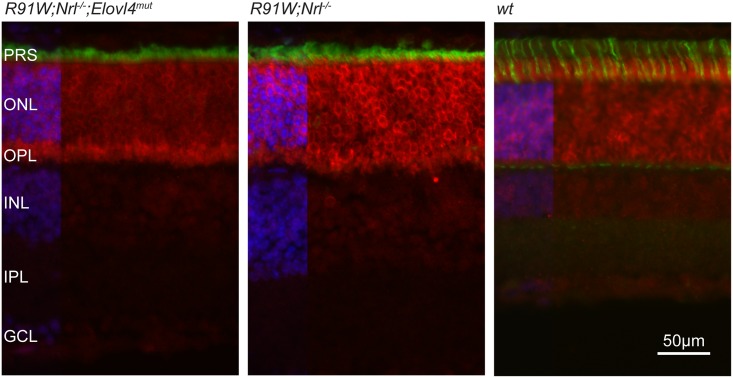
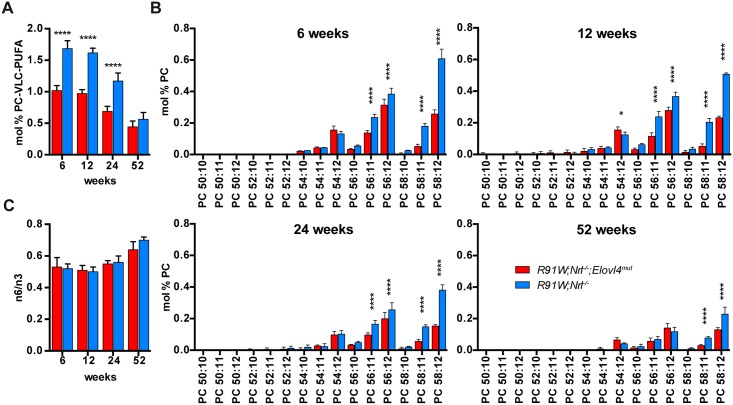
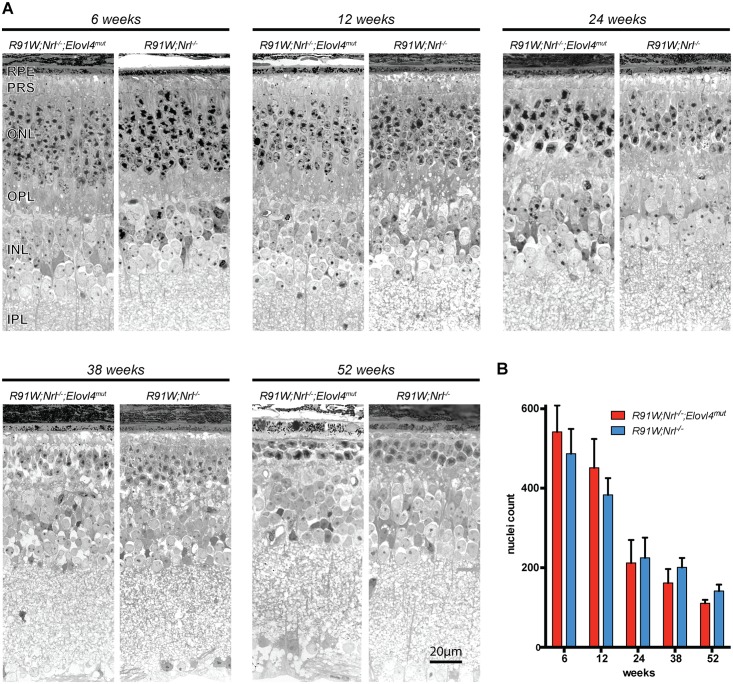
Mutations in the elongation of very long chain fatty acid 4 (ELOVL4) gene cause Stargardt macular dystrophy 3 (STGD3), a rare, juvenile-onset, autosomal dominant form of macular degeneration. Although several mouse models have already been generated to investigate the link between the three identified disease-causing mutations in the ELOVL4 gene, none of these models recapitulates the early-onset cone photoreceptor cell death observed in the macula of STGD3 patients. To address this specifically, we investigated the effect of mutant ELOVL4 in a mouse model with an all-cone retina. Hence, we bred mice carrying the heterozygously mutated Elovl4 gene on the R91W;Nrl-/- all-cone background and analyzed the retinal lipid composition, morphology, and function over the course of 1 year. We observed a reduction of total phosphatidylcholine-containing very long chain-polyunsaturated fatty acids (PC-VLC-PUFAs) by 39% in the R91W;Nrl-/-;Elovl4 mice already at 6 weeks of age with a pronounced decline of the longest forms of PC-VLC-PUFAs. Total levels of shorter-chain fatty acids (< C26) remained unaffected. However, this reduction in PC-VLC-PUFA content in the all-cone retina had no impact on morphology or function and did not accelerate retinal degeneration in the R91W;Nrl-/-;Elovl4 mice. Taken together, mutations in the ELOVL4 gene lead to cone degeneration in humans, whereas mouse models expressing the mutant Elovl4 show predominant rod degeneration. The lack of a phenotype in the all-cone retina expressing the mutant form of the protein supports the view that aberrant function of ELOVL4 is especially detrimental for rods in mice and suggests a more subtle role of VLC-PUFAs for cone maintenance and survival.
超长链脂肪酸延长酶4(ELOVL4)基因突变会导致3型斯特格黄斑营养不良(STGD3),这是一种罕见的、青少年发病的常染色体显性黄斑变性形式。尽管已经构建了几种小鼠模型来研究ELOVL4基因中已确定的三种致病突变之间的联系,但这些模型均未重现STGD3患者黄斑中观察到的早发性视锥光感受器细胞死亡。为了专门解决这个问题,我们在全视锥视网膜的小鼠模型中研究了突变型ELOVL4的作用。因此,我们在R91W;Nrl-/-全视锥背景上培育携带杂合突变Elovl4基因的小鼠,并在1年的时间里分析了视网膜脂质组成、形态和功能。我们观察到,R91W;Nrl-/-;Elovl4小鼠在6周龄时,总含磷脂酰胆碱的超长链多不饱和脂肪酸(PC-VLC-PUFAs)减少了39%,其中最长形式的PC-VLC-PUFAs显著下降。较短链脂肪酸(< C26)的总水平未受影响。然而,全视锥视网膜中PC-VLC-PUFA含量的这种减少对形态或功能没有影响,也没有加速R91W;Nrl-/-;Elovl4小鼠的视网膜变性。综上所述,ELOVL4基因突变会导致人类视锥细胞变性,而表达突变型Elovl4的小鼠模型则主要表现为视杆细胞变性。在表达该蛋白突变形式的全视锥视网膜中缺乏表型,支持了ELOVL4异常功能对小鼠视杆细胞特别有害的观点,并表明VLC-PUFAs对视锥细胞维持和存活的作用更为微妙。