Department of Nuclear Medicine and Molecular Imaging, University of Groningen, University Medical Center Groningen, Hanzeplein 1, Internal Postcode: EB50, 9700 RB, Groningen, The Netherlands.
Department of Cardiology, Catharina Hospital, Michelangelolaan 2, EJ, Eindhoven, The Netherlands.
Eur Heart J Cardiovasc Imaging. 2018 Oct 1;19(10):1179-1187. doi: 10.1093/ehjci/jex331.
To evaluate the prognostic value of quantitative myocardial perfusion imaging with positron emission tomography (PET) for adverse cardiovascular outcomes in patients with known or suspected coronary artery disease (CAD).
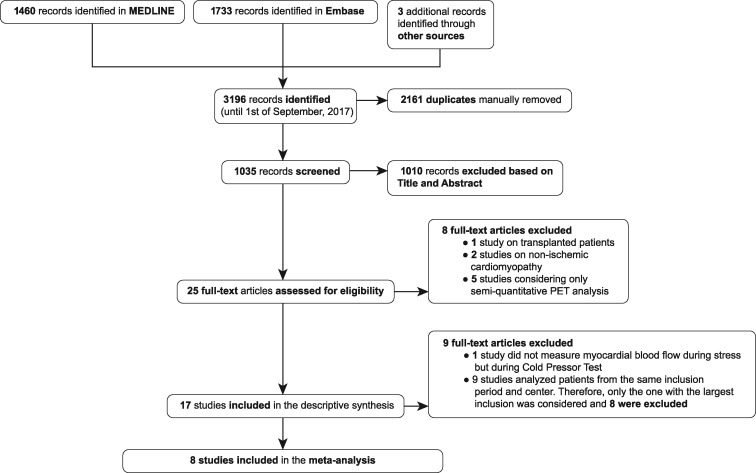
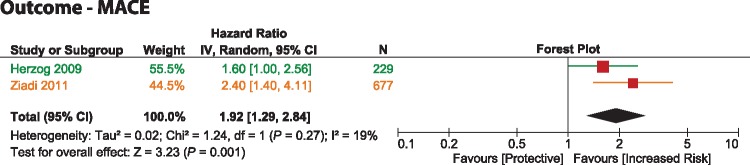
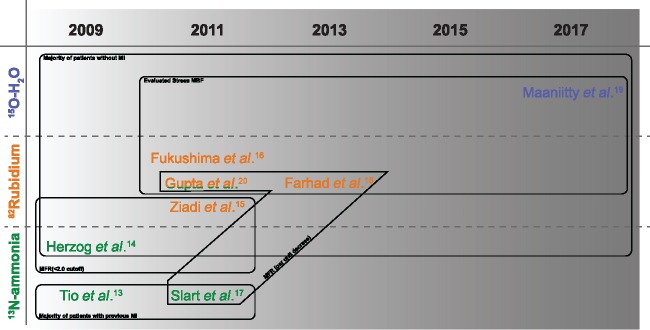
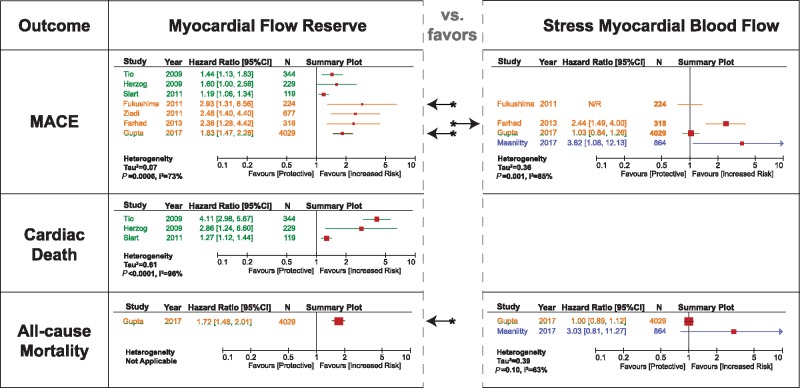
A search in MEDLINE and Embase was conducted for studies that evaluated (i) myocardial perfusion in absolute terms with PET, (ii) prognostic value for the development of major adverse cardiovascular events (MACE), cardiac death, and/or all-cause mortality, and (iii) patients with known or suspected CAD. Studies were divided according to the radiotracer utilized and their included population (patients with and without previous infarction). Comprehensive description and a selected instance of pooling were performed. Eight studies (n = 6804) were analysed and documented clear variability in population, quantitative PET variables operationalization [stress myocardial blood flow (sMBF) and flow reserve (MFR)], statistical covariate structure, follow-up, and radiotracer utilized. MFR was independently associated with MACE in eight studies [range of adjusted hazard ratios (HRs): 1.19-2.93]. The pooling instance demonstrated that MFR significantly associates with the development of MACEs (HR: 1.92 [1.29, 2.84]; P = 0.001). sMBF was only associated with MACE in two studies that evaluated it, and only one study documented sMBF as a better predictor than MFR.
This systematic review demonstrates the prognostic value of quantitative myocardial perfusion evaluated with PET, in the form of MFR and sMBF, for the development of major adverse cardiovascular outcomes in populations with known or suspected CAD. In the qualitative comparison, MFR seems to outperform sMBF as an independent prognostic factor. Evidence is still lacking for assessing quantitative PET for the occurrence of cardiac death and all-cause mortality. There is clear heterogeneity in predictor operationalization and study performances.
评估正电子发射断层扫描(PET)定量心肌灌注成像对已知或疑似冠心病(CAD)患者不良心血管结局的预后价值。
在 MEDLINE 和 Embase 中进行了检索,以评估(i)使用 PET 进行绝对心肌灌注,(ii)对主要不良心血管事件(MACE)、心脏死亡和/或全因死亡率发展的预后价值,以及(iii)具有已知或疑似 CAD 的患者的研究。根据所使用的放射性示踪剂及其纳入的人群(有和无既往梗死的患者)对研究进行了分类。进行了全面描述和选择实例的汇总。分析了 8 项研究(n=6804),并记录了人群、定量 PET 变量操作化[应激心肌血流(sMBF)和血流储备(MFR)]、统计协变量结构、随访和放射性示踪剂利用方面的明显差异。在八项研究中,MFR 与 MACE 独立相关[调整后的危险比(HR)范围:1.19-2.93]。汇总实例表明,MFR 与 MACE 的发生显著相关(HR:1.92[1.29,2.84];P=0.001)。只有两项评估 sMBF 的研究表明 sMBF 与 MACE 相关,只有一项研究记录 sMBF 作为比 MFR 更好的预测因子。
本系统评价证明了使用 PET 评估定量心肌灌注(以 MFR 和 sMBF 的形式)对已知或疑似 CAD 人群中主要不良心血管结局发展的预后价值。在定性比较中,MFR 似乎作为独立的预后因素优于 sMBF。目前仍缺乏用于评估定量 PET 发生心脏死亡和全因死亡率的证据。预测因子操作化和研究表现存在明显的异质性。