Department of Psychiatry & Behavioral Sciences, Medical University of South Carolina, 67 President St., Charleston, SC 29425, USA.
National Center for Posttraumatic Stress Disorder, Veterans Affairs Medical Center (116D), 215 North Main Street, White River Junction, VT 05009, USA; Geisel School of Medicine at Dartmouth, Department of Psychiatry, 1 Rope Ferry Road, Hanover, NH 03755, USA.
J Psychiatr Res. 2018 Mar;98:64-69. doi: 10.1016/j.jpsychires.2017.12.014. Epub 2017 Dec 26.
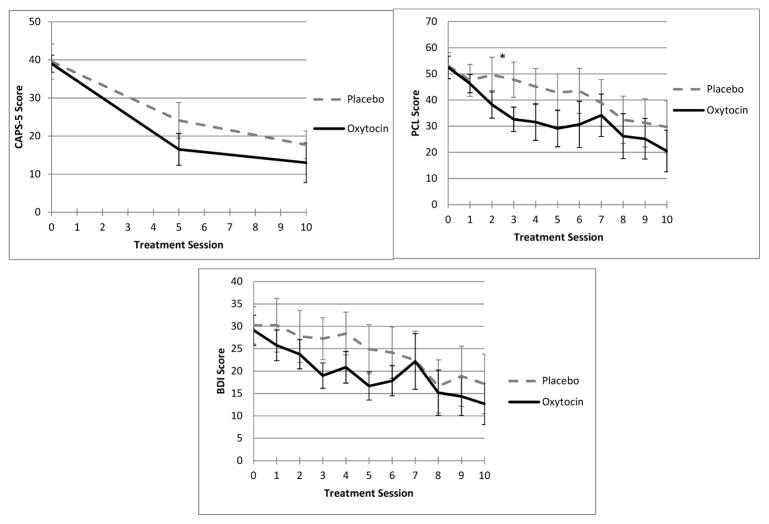
Posttraumatic stress disorder (PTSD) is a chronic, debilitating condition for which Prolonged Exposure (PE) therapy is highly efficacious. However, for some individuals, premature dropout and residual PTSD symptoms remain obstacles. The neuropeptide oxytocin is a promising candidate to enhance PE due to its ability to enhance 1) prosocial cognition and behavior, which are theorized to promote positive working alliance, and 2) extinction learning, which is the central mechanism of action underlying successful PE treatment. Despite a robust theoretical rationale, no studies to date have combined evidence-based psychotherapy for PTSD with oxytocin. This randomized, placebo-controlled, double-blind pilot trial examined the feasibility, safety, and preliminary efficacy of augmenting PE with oxytocin. Participants were 17 individuals with diverse index traumas. Participants self-administered intranasal oxytocin (40 IU) or matching placebo 45 min prior to each weekly PE therapy session. One adverse event occurred in the placebo group and three individuals dropped out (17.6%; 2 oxytocin group and 1 placebo group). The oxytocin group demonstrated lower PTSD and depression symptoms during PE, and had higher working alliance scores, although these differences did not reach statistical significance. Although preliminary, the findings support the feasibility of oxytocin combined with PE. Adequately powered studies are necessary to determine whether oxytocin enhances PE treatment outcomes and to examine potential mechanisms, such as accelerating extinction learning, enhancing early response, and preventing premature dropout. NCT03238924.
创伤后应激障碍(PTSD)是一种慢性、使人衰弱的疾病,延长暴露(PE)疗法对此非常有效。然而,对于一些人来说,过早退出和残留的 PTSD 症状仍然是障碍。神经肽催产素是一种很有前途的候选药物,可以增强 PE,因为它能够增强 1)亲社会认知和行为,这被认为可以促进积极的工作联盟,以及 2)消退学习,这是成功的 PE 治疗的核心作用机制。尽管有强有力的理论依据,但迄今为止没有研究将基于循证的 PTSD 心理治疗与催产素结合起来。这项随机、安慰剂对照、双盲试验研究了用催产素增强 PE 的可行性、安全性和初步疗效。参与者是 17 名有不同创伤史的个体。参与者在每周一次的 PE 治疗前 45 分钟自行鼻内给予催产素(40IU)或匹配的安慰剂。安慰剂组发生 1 例不良事件,3 名参与者退出(17.6%;2 名催产素组和 1 名安慰剂组)。在 PE 期间,催产素组的 PTSD 和抑郁症状较低,工作联盟评分较高,尽管这些差异没有达到统计学意义。尽管初步研究结果支持催产素与 PE 联合应用的可行性。需要进行足够规模的研究,以确定催产素是否能增强 PE 的治疗效果,并研究潜在的机制,如加速消退学习、增强早期反应和预防过早退出。NCT03238924。