Department of Radiation Medicine, Faculty of Preventive Medicine, The Fourth Military Medical University, Changle West Road 169, Xi'an 710032, China.
Department of Radiation Biology, Faculty of Preventive Medicine, The Fourth Military Medical University, Changle West Road 169, Xi'an 710032, China.
Int J Environ Res Public Health. 2017 Dec 23;15(1):17. doi: 10.3390/ijerph15010017.
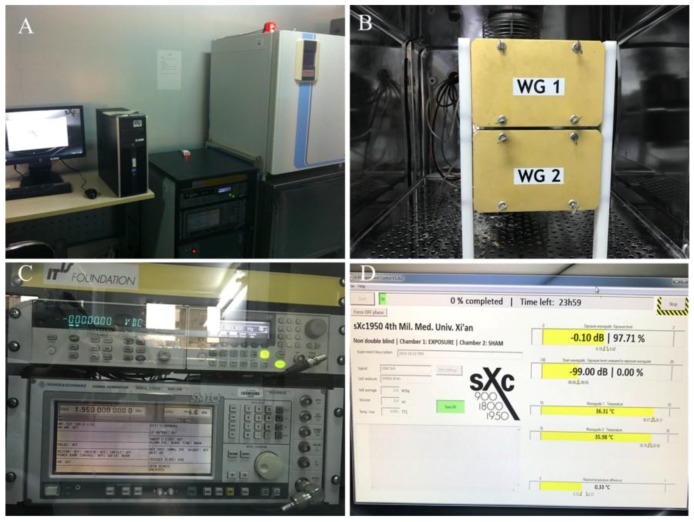
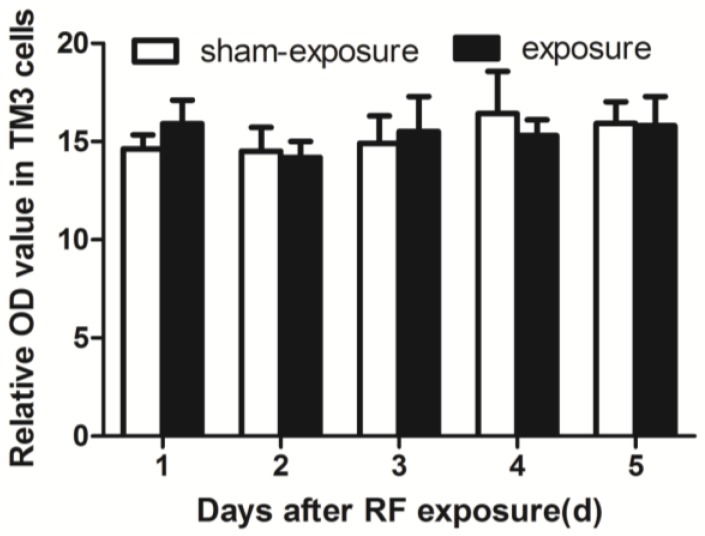
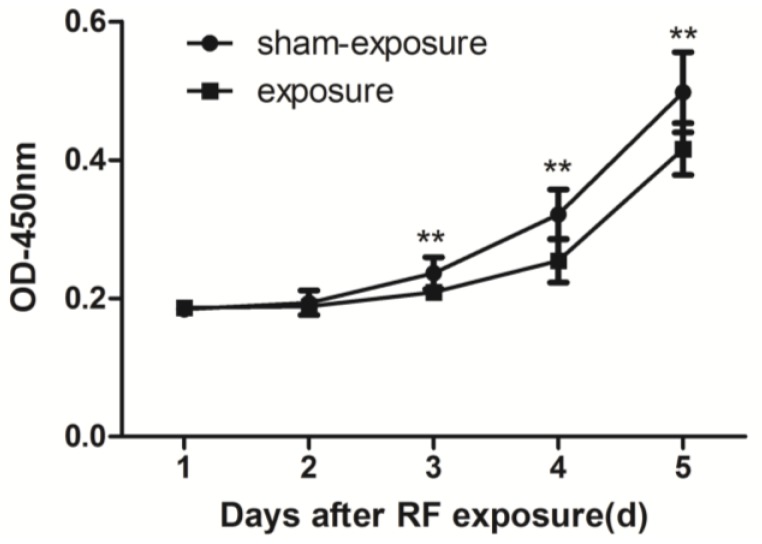
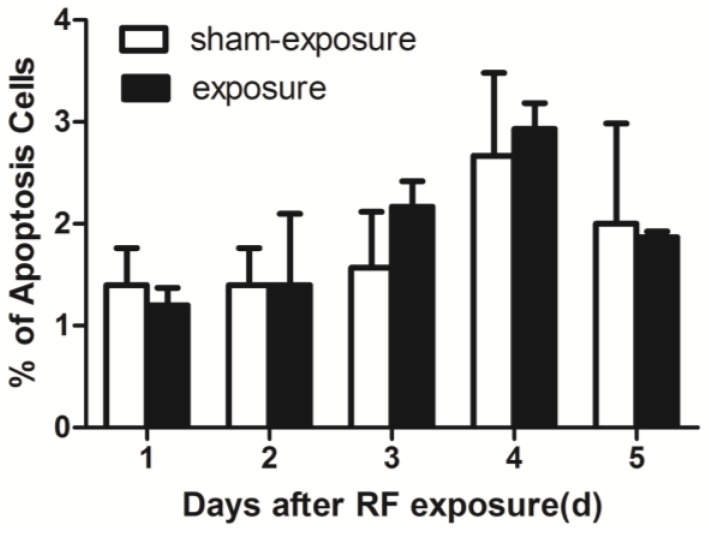
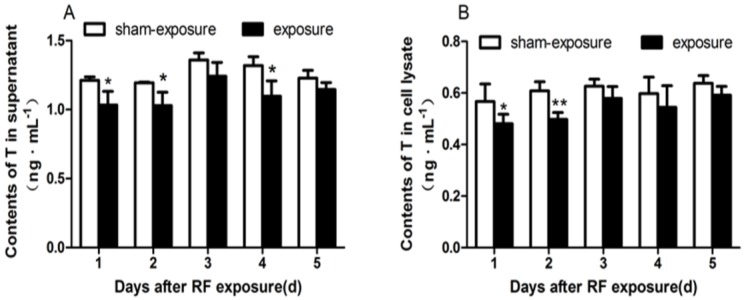
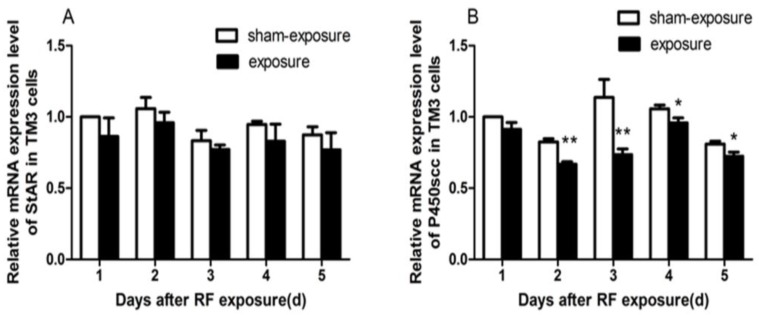
More studies that are focused on the bioeffects of radio-frequency (RF) electromagnetic radiation that is generated from the communication devices, but there were few reports with confirmed results about the bioeffects of RF radiation on reproductive cells. To explore the effects of 1950 MHz RF electromagnetic radiation (EMR) on mouse Leydig (TM3) cells. TM3 cells were irradiated or sham-irradiated continuously for 24 h by the specific absorption rate (SAR) 3 W/kg radiation. At 0, 1, 2, 3, 4, and 5 days after irradiation, cell proliferation was detected by cell counting kit-8 (CCK-8) method, cell cycle distribution, percentage of apoptosis, and cellular reactive oxygen species (ROS) were examined by flow cytometry, Testosterone level was measured using enzyme-linked immunosorbent assay (ELISA) assay, messenger ribonucleic acid (mRNA) expression level of steroidogenic acute regulatory protein (StAR) and P450scc in TM3 cells was detected by real-time polymerase chain reaction (PCR). After being irradiated for 24 h, cell proliferation obviously decreased and cell cycle distribution, secretion capacity of Testosterone, and P450scc mRNA level were reduced. While cell apoptosis, ROS, and StAR mRNA level did not change significantly. The current results indicated that 24 h of exposure at 1950 MHz 3 W/kg radiation could cause some adverse effects on TM3 cells proliferation and Testosterone secretion, further studies about the biological effects in the reproductive system that are induced by RF radiation are also needed.
更多研究集中在来自通信设备的射频(RF)电磁辐射的生物效应上,但关于 RF 辐射对生殖细胞的生物效应的确认结果报告较少。为了探讨 1950MHz RF 电磁辐射(EMR)对小鼠 Leydig(TM3)细胞的影响。TM3 细胞以特定吸收率(SAR)3W/kg 连续辐射 24h 或假照射。在照射后 0、1、2、3、4 和 5 天,通过细胞计数试剂盒-8(CCK-8)法检测细胞增殖,通过流式细胞术检测细胞周期分布、凋亡百分比和细胞内活性氧(ROS),采用酶联免疫吸附测定法(ELISA)检测 TM3 细胞中睾酮水平,采用实时聚合酶链反应(PCR)检测类固醇急性调节蛋白(StAR)和 P450scc 的信使核糖核酸(mRNA)表达水平。照射 24h 后,细胞增殖明显减少,细胞周期分布、睾酮分泌能力和 P450scc mRNA 水平降低,而细胞凋亡、ROS 和 StAR mRNA 水平无明显变化。目前的结果表明,1950MHz、3W/kg 辐射暴露 24h 可能对 TM3 细胞增殖和睾酮分泌产生一些不良影响,还需要进一步研究 RF 辐射对生殖系统的生物学效应。