Department of Life Sciences, National Central University, Jung-Li, Taoyuan, Taiwan.
Institute of Cellular and System Medicine, National Health Research Institutes, Miaoli, Taiwan.
J Biomed Sci. 2018 Jan 2;25(1):1. doi: 10.1186/s12929-017-0402-4.
Atherosclerosis occurs in arterial curvatures and branches, where the flow is disturbed with low and oscillatory shear stress (OSS). The remodeling and alterations of extracellular matrices (ECMs) and their composition is the critical step in atherogenesis. In this study, we investigated the effects of different ECM proteins on the regulation of mechanotransduction in vascular endothelial cells (ECs) in response to OSS.
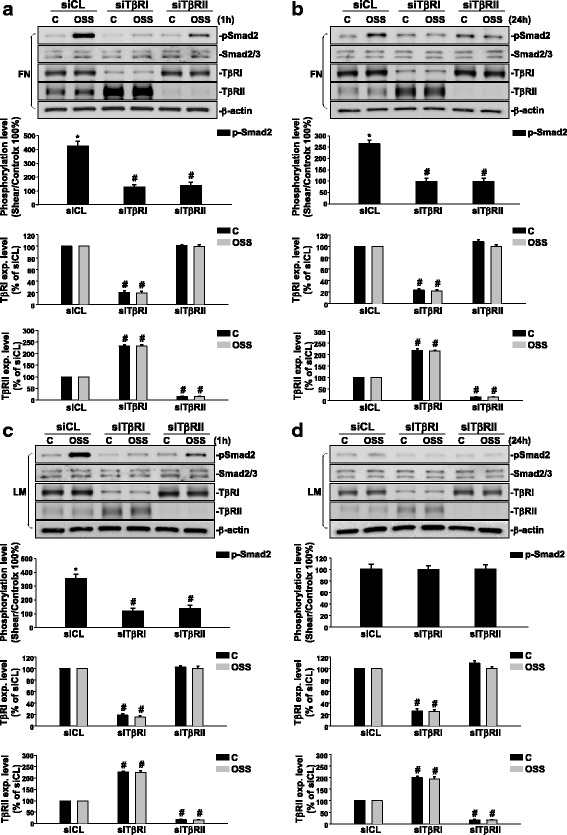
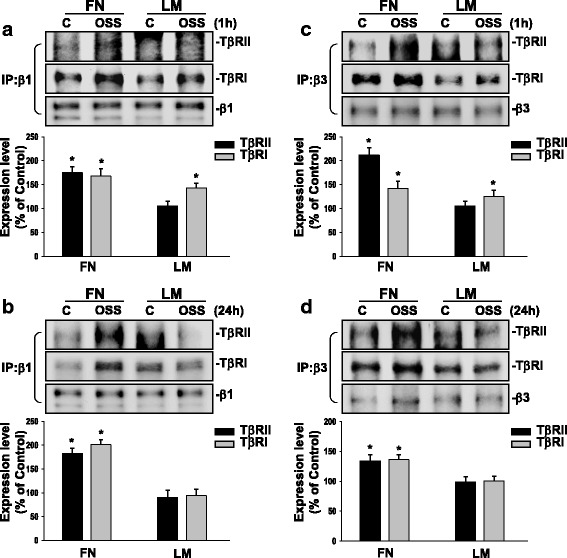
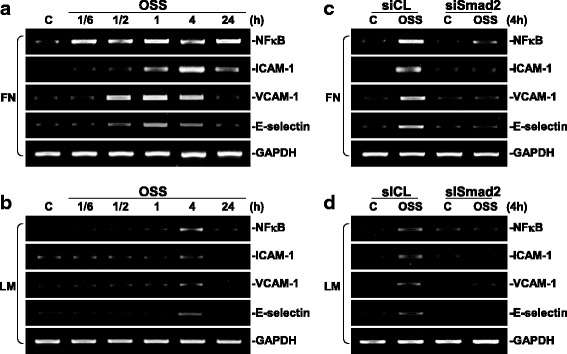
Through the experiments ranging from in vitro cell culture studies on effects of OSS on molecular signaling to in vivo examinations on clinical specimens from patients with coronary artery disease (CAD), we elucidated the roles of integrins and different ECMs, i.e., fibronectin (FN) and laminin (LM), in transforming growth factor (TGF)-β receptor (TβR)-mediated Smad2 activation and nuclear factor-κB (NF-κB) signaling in ECs in response to OSS and hence atherogenesis.
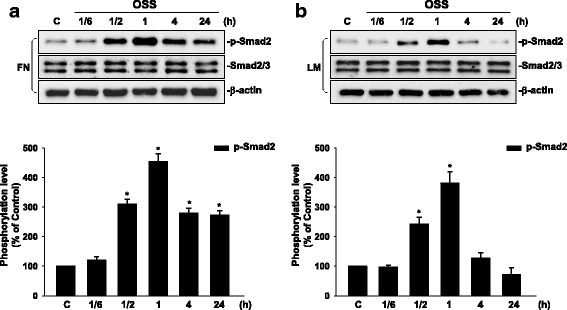
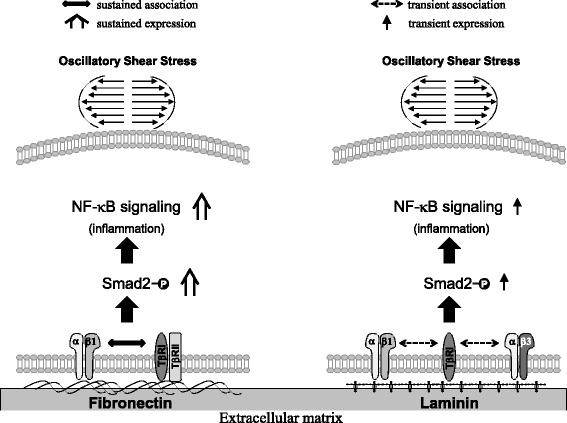
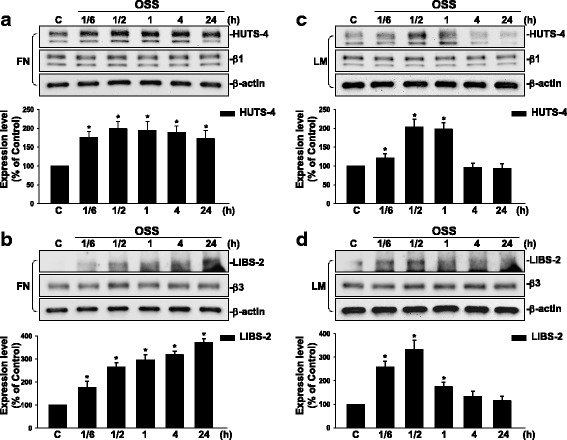
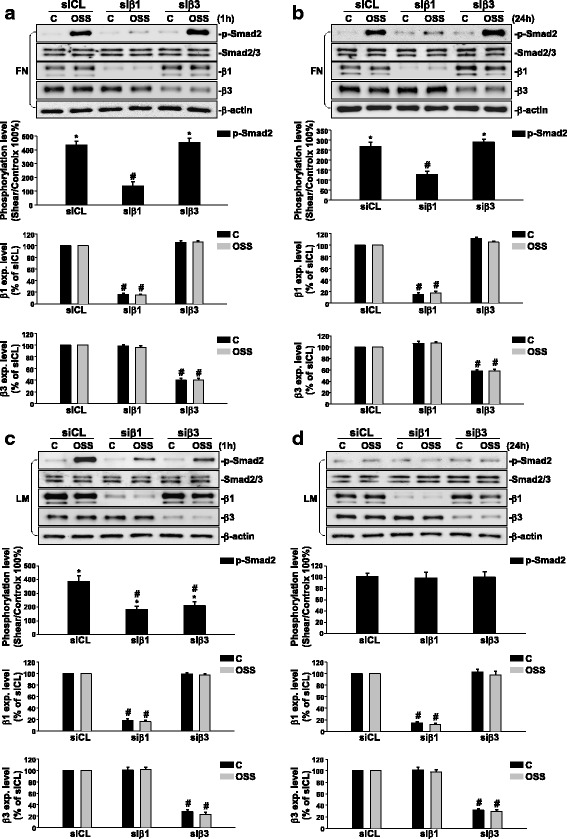
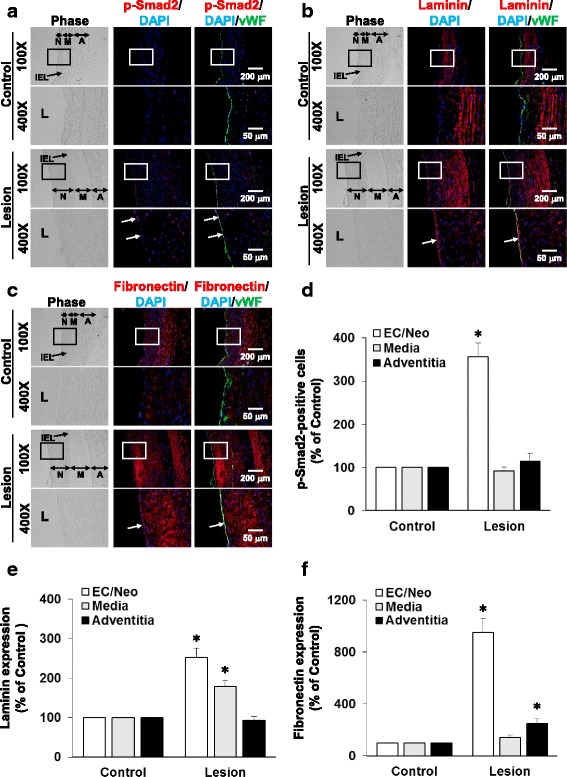
OSS at 0.5±12 dynes/cm induces sustained increases in the association of types I and II TβRs with β1 and β3 integrins in ECs grown on FN, but it only transient increases in ECs grown on LM. OSS induces a sustained activation of Smad2 in ECs on FN, but only a transient activation of Smad2 in ECs on LM. OSS-activation of Smad2 in ECs on FN regulates downstream NF-κB signaling and pro-inflammatory gene expression through the activation of β1 integrin and its association with TβRs. In contrast, OSS induces transient activations of β1 and β3 integrins in ECs on LM, which associate with type I TβR to regulate Smad2 phosphorylation, resulting in transient induction of NF-κB and pro-inflammatory gene expression. In vivo investigations on diseased human coronary arteries from CAD patients revealed that Smad2 is highly activated in ECs of atherosclerotic lesions, which is accompanied by the concomitant increase of FN rather than LM in the EC layer and neointimal region of atherosclerotic lesions.
Our findings provide new insights into the mechanisms of how OSS regulates Smad2 signaling and pro-inflammatory genes through the complex signaling networks of integrins, TβRs, and ECMs, thus illustrating the molecular basis of regional pro-inflammatory activation within disturbed flow regions in the arterial tree.
动脉弯曲和分支处会发生动脉粥样硬化,此处的血流受到低切变和振荡剪切应力(OSS)的干扰。细胞外基质(ECM)的重塑和改变及其组成是动脉粥样硬化发生的关键步骤。在这项研究中,我们研究了不同 ECM 蛋白对血管内皮细胞(EC)对 OSS 做出机械转导反应的调节作用。
通过体外细胞培养实验,研究 OSS 对分子信号的影响,以及对患有冠状动脉疾病(CAD)的患者临床标本的体内检测,我们阐明了整合素和不同的 ECM(纤连蛋白(FN)和层粘连蛋白(LM))在转化生长因子(TGF)-β受体(TβR)介导的 Smad2 激活和核因子-κB(NF-κB)信号转导中的作用,从而在 EC 对 OSS 及动脉粥样硬化的反应中。
0.5±12 达因/平方厘米的 OSS 诱导在 FN 上生长的 EC 中 I 型和 II 型 TβR 与 β1 和 β3 整合素的持续增加,但在 LM 上生长的 EC 中仅短暂增加。OSS 诱导 FN 上生长的 EC 中 Smad2 的持续激活,但仅在 LM 上生长的 EC 中 Smad2 的短暂激活。FN 上的 OSS 激活 Smad2 调节下游 NF-κB 信号和促炎基因表达,通过激活β1 整合素及其与 TβR 的关联。相反,OSS 诱导 LM 上生长的 EC 中β1 和β3 整合素的短暂激活,其与 I 型 TβR 结合以调节 Smad2 磷酸化,导致 NF-κB 和促炎基因表达的短暂诱导。对 CAD 患者患病人类冠状动脉的体内研究表明,在动脉粥样硬化病变的 EC 中 Smad2 高度激活,这伴随着 EC 层和动脉粥样硬化病变的新生内膜区域中 FN 的同时增加而不是 LM 的增加。
我们的研究结果为 OSS 通过整合素、TβR 和 ECM 的复杂信号网络调节 Smad2 信号和促炎基因的机制提供了新的见解,从而说明了动脉树中血流紊乱区域内局部促炎激活的分子基础。