Casey Rebecca Mary, Hampton Lee McCalla, Anya Blanche-Philomene Melanga, Gacic-Dobo Marta, Diallo Mamadou Saliou, Wallace Aaron Stuart
Epidemic Intelligence Service, Centers for Disease Control and Prevention, Atlanta, USA.
Global Immunization Division, Centers for Disease Control and Prevention, Atlanta, U.S.A.
Pan Afr Med J. 2017 Jun 21;27(Suppl 3):5. doi: 10.11604/pamj.supp.2017.27.3.12114. eCollection 2017.
In 2010, the Global Vaccine Action Plan called on all countries to reach and sustain 90% national coverage and 80% coverage in all districts for the third dose of diphtheria-tetanus-pertussis vaccine (DTP3) by 2015 and for all vaccines in national immunization schedules by 2020. The aims of this study are to analyze recent trends in national vaccination coverage in the World Health Organization African Region andto assess how these trends differ by country income category.
We compared national vaccination coverage estimates for DTP3 and the first dose of measles-containing vaccine (MCV) obtained from the World Health Organization (WHO)/United Nations Children's Fund (UNICEF) joint estimates of national immunization coverage for all African Region countries. Using United Nations (UN) population estimates of surviving infants and country income category for the corresponding year, we calculated population-weighted average vaccination coverage by country income category (i.e., low, lower middle, and upper middle-income) for the years 2000, 2005, 2010 and 2015.
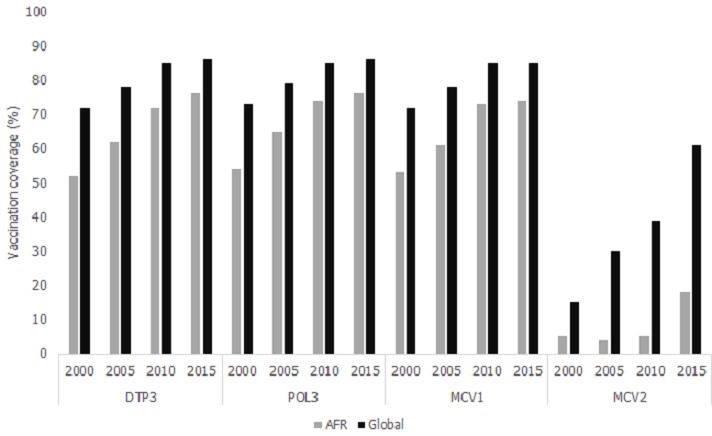
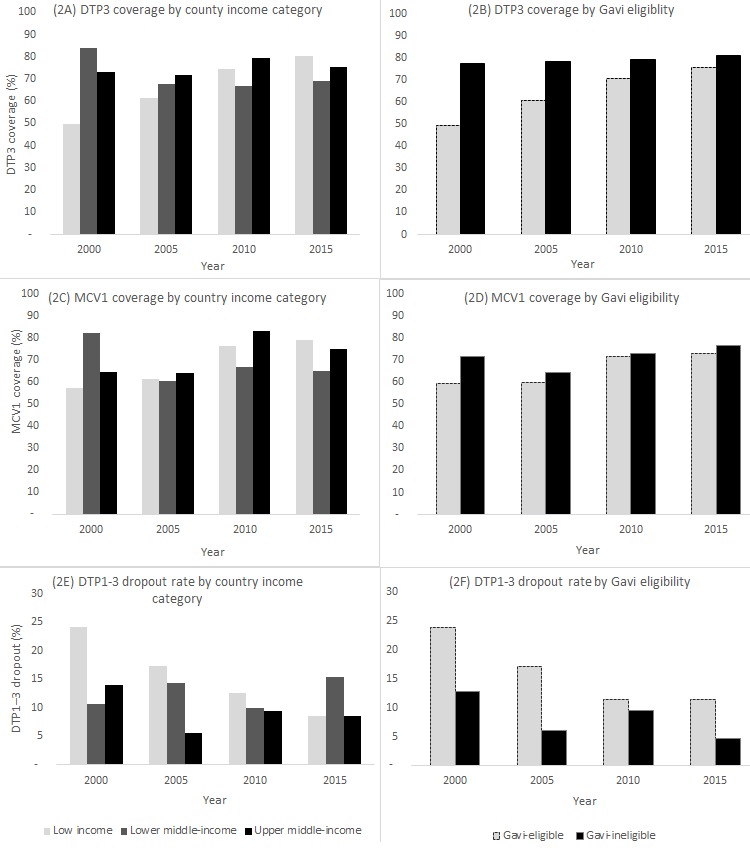
DTP3 coverage in the African Region increased from 52% in 2000 to 76% in 2015,and MCV1 coverage increased from 53% to 74% during the same period, but with considerable differences among countries. Thirty-six African Region countries were low income in 2000 with an average DTP3 coverage of 50% while 26 were low income in 2015 with an average coverage of 80%. Five countries were lower middle-income in 2000 with an average DTP3 coverage of 84% while 12 were lower middle-income in 2015 with an average coverage of 69%. Five countries were upper middle-income in 2000 with an average DTP3 coverage of 73% and eight were upper middle-income in 2015 with an average coverage of 76%.
Disparities in vaccination coverage by country persist in the African Region, with countries that were lower middle-income having the lowest coverage on average in 2015. Monitoring and addressing these disparities is essential for meeting global immunization targets.
2010年,《全球疫苗行动计划》呼吁所有国家到2015年实现并维持白喉-破伤风-百日咳三联疫苗(DTP3)第三剂的国家覆盖率达到90%以及所有地区覆盖率达到80%,到2020年实现国家免疫规划中所有疫苗的这一目标。本研究的目的是分析世界卫生组织非洲区域国家疫苗接种覆盖率的近期趋势,并评估这些趋势在不同国家收入类别之间的差异。
我们比较了从世界卫生组织(WHO)/联合国儿童基金会(UNICEF)对所有非洲区域国家国家免疫接种覆盖率的联合估计中获得的DTP3和含麻疹疫苗第一剂(MCV1)的国家疫苗接种覆盖率估计值。利用联合国(UN)对存活婴儿的人口估计以及相应年份的国家收入类别,我们计算了2000年、2005年、2010年和2015年按国家收入类别(即低收入、中低收入和中高收入)加权的平均疫苗接种覆盖率。
非洲区域的DTP3覆盖率从2000年的52%提高到2015年的76%,同期MCV1覆盖率从53%提高到74%,但各国之间存在显著差异。2000年有36个非洲区域国家为低收入国家,DTP3平均覆盖率为50%,而2015年有26个低收入国家,平均覆盖率为80%。2000年有5个国家为中低收入国家,DTP3平均覆盖率为84%,而2015年有12个中低收入国家,平均覆盖率为69%。2000年有5个国家为中高收入国家,DTP3平均覆盖率为73%,2015年有8个中高收入国家,平均覆盖率为76%。
非洲区域各国在疫苗接种覆盖率方面的差距依然存在,2015年中低收入国家的平均覆盖率最低。监测和解决这些差距对于实现全球免疫目标至关重要。