Laping Nicholas J, DeMartino Michael P, Cottom Joshua E, Axten Jeffrey M, Emery John G, Guss Jeffrey H, Burman Miriam, Foley James J, Cheung Mui, Oliff Allen, Kumar Sanjay
New Targets Incubator and.
PTS-Biological Sciences, GlaxoSmithKline, King of Prussia, PA.
Blood Adv. 2017 Dec 8;1(26):2553-2562. doi: 10.1182/bloodadvances.2017010611. eCollection 2017 Dec 12.
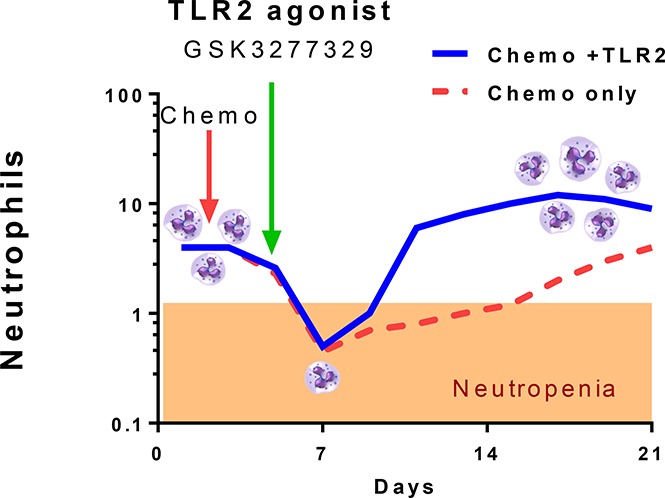
Neutropenia is a common consequence of radiation and chemotherapy in cancer patients. The resulting immunocompromised patients become highly susceptible to potentially life-threatening infections. Granulocyte colony-stimulating factor (G-CSF) is known to stimulate neutrophil production and is widely used as a treatment of chemotherapy-induced neutropenia. A small-molecule G-CSF secretagogue without a requirement for refrigerated supply chain would offer a more convenient and cost-effective treatment of chemotherapy-induced neutropenia. Bacterial lipopeptides activate innate immune responses through Toll-like receptor 2 (TLR2) and induce the release of cytokines, including G-CSF, from macrophages, monocytes, and endothelial. PamCSK is a synthetic lipopeptide that effectively mimics bacterial lipoproteins known to activate TLR2 receptor signaling through the TLR2/6 heterodimer. Substrate-based drug design led to the discovery of GSK3277329, which stimulated the release of G-CSF in activated THP-1 cells, peripheral blood mononuclear cells, and human umbilical vein endothelial cells. When administered subcutaneously to cynomolgus monkeys (s), GSK3277329 caused systemic elevation of G-CSF and interleukin-6 (IL-6), but not IL-1β or tumor necrosis factor α, indicating a selective cytokine-stimulation profile. Repeat daily injections of GSK3277329 in healthy monkeys also raised circulating neutrophils above the normal range over a 1-week treatment period. More importantly, repeated daily injections of GSK3277329 over a 2-week period restored neutrophil loss in monkeys given chemotherapy treatment (cyclophosphamide, Cytoxan). These data demonstrate preclinical in vivo proof of concept that TLR2 agonism can drive both G-CSF induction and subsequent neutrophil elevation in the cynomolgus monkey and could be a therapeutic strategy for the treatment of chemotherapy-induced neutropenia.
中性粒细胞减少是癌症患者放疗和化疗的常见后果。由此导致免疫功能受损的患者极易受到潜在的危及生命的感染。已知粒细胞集落刺激因子(G-CSF)可刺激中性粒细胞生成,并广泛用于治疗化疗引起的中性粒细胞减少。一种无需冷藏供应链的小分子G-CSF促分泌剂将为化疗引起的中性粒细胞减少提供更方便且具成本效益的治疗方法。细菌脂肽通过Toll样受体2(TLR2)激活先天免疫反应,并诱导巨噬细胞、单核细胞和内皮细胞释放包括G-CSF在内的细胞因子。PamCSK是一种合成脂肽,可有效模拟已知通过TLR2/6异二聚体激活TLR2受体信号的细菌脂蛋白。基于底物的药物设计促成了GSK3277329的发现,该药物可刺激活化的THP-1细胞、外周血单核细胞和人脐静脉内皮细胞释放G-CSF。当皮下注射给食蟹猴时,GSK3277329会引起G-CSF和白细胞介素-6(IL-6)的全身升高,但不会引起IL-1β或肿瘤坏死因子α升高,表明其具有选择性细胞因子刺激谱。在健康猴子中每日重复注射GSK3277329,在为期1周的治疗期内也会使循环中性粒细胞升高至正常范围以上。更重要的是,在为期2周的时间内每日重复注射GSK3277329可恢复接受化疗(环磷酰胺,癌得星)的猴子的中性粒细胞损失。这些数据证明了临床前体内概念验证,即TLR2激动作用可驱动食蟹猴体内G-CSF的诱导及随后的中性粒细胞升高,并且可能是治疗化疗引起的中性粒细胞减少的一种治疗策略。