Reina-Castillón Judith, Pujol Roser, López-Sánchez Marcos, Rodríguez-Santiago Benjamín, Aza-Carmona Miriam, González Juan Ramón, Casado José Antonio, Bueren Juan Antonio, Sevilla Julián, Badel Isabel, Català Albert, Beléndez Cristina, Dasí María Ángeles, Díaz de Heredia Cristina, Soulier Jean, Schindler Detlev, Pérez-Jurado Luis Alberto, Surrallés Jordi
Department of Experimental and Health Sciences, Universitat Pompeu Fabra, Barcelona, Spain.
Hospital del Mar Research Institute, Barcelona, Spain.
Blood Adv. 2017 Jan 23;1(5):319-329. doi: 10.1182/bloodadvances.2016000943. eCollection 2017 Jan 24.
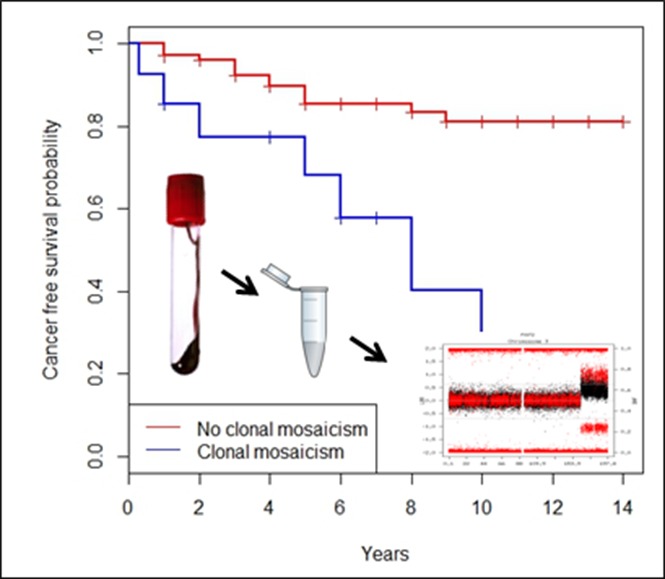
Detectable clonal mosaicism for large chromosomal events has been associated with aging and an increased risk of hematological and some solid cancers. We hypothesized that genetic cancer predisposition disorders, such as Fanconi anemia (FA), could manifest a high rate of chromosomal mosaic events (CMEs) in peripheral blood, which could be used as early biomarkers of cancer risk. We studied the prevalence of CMEs by single-nucleotide polymorphism (SNP) array in 130 FA patients' blood DNA and their impact on cancer risk. We detected 51 CMEs (4.4-159 Mb in size) in 16 out of 130 patients (12.3%), of which 9 had multiple CMEs. The most frequent events were gains at 3q (n = 6) and 1q (n = 5), both previously associated with leukemia, as well as rearrangements with breakpoint clustering within the major histocompatibility complex locus ( = 7.3 × 10). Compared with 15 743 age-matched population controls, FA patients had a 126 to 140 times higher risk of detectable CMEs in blood ( < 2.2 × 10). Prevalent and incident hematologic and solid cancers were more common in CME carriers (odds ratio [OR] = 11.6, 95% confidence interval [CI] = 3.4-39.3, = 2.8 × 10), leading to poorer prognosis. The age-adjusted hazard risk (HR) of having cancer was almost 5 times higher in FA individuals with CMEs than in those without CMEs. Regarding survival, the HR of dying was 4 times higher in FA individuals having CMEs (HR = 4.0, 95% CI = 2.0-7.9, = 5.7 × 10). Therefore, our data suggest that molecular karyotyping with SNP arrays in easy-to-obtain blood samples could be used for better monitoring of bone marrow clonal events, cancer risk, and overall survival of FA patients.
可检测到的大型染色体事件的克隆性镶嵌现象与衰老以及血液系统癌症和某些实体癌风险增加有关。我们推测,遗传性癌症易感疾病,如范可尼贫血(FA),在外周血中可能表现出较高频率的染色体镶嵌事件(CMEs),这可作为癌症风险的早期生物标志物。我们通过单核苷酸多态性(SNP)阵列研究了130例FA患者血液DNA中CMEs的发生率及其对癌症风险的影响。我们在130例患者中的16例(12.3%)检测到51个CMEs(大小为4.4 - 159 Mb),其中9例有多个CMEs。最常见的事件是3q(n = 6)和1q(n = 5)的增益,这两者之前都与白血病有关,以及主要组织相容性复合体基因座内具有断点聚集的重排( = 7.3 × 10)。与15743名年龄匹配的人群对照相比,FA患者血液中可检测到CMEs的风险高126至140倍( < 2.2 × 10)。CME携带者中普遍存在的和新发的血液系统癌症和实体癌更为常见(优势比[OR] = 11.6,95%置信区间[CI] = 3.4 - 39.3, = 2.8 × 10),导致预后较差。有CMEs的FA个体患癌的年龄调整后风险比(HR)几乎是没有CMEs的个体的5倍。关于生存率,有CMEs的FA个体死亡的HR高4倍(HR = 4.0,95% CI = 2.0 - 7.9, = 5.7 × 10)。因此,我们的数据表明,利用SNP阵列对易于获取的血液样本进行分子核型分析可用于更好地监测FA患者的骨髓克隆事件、癌症风险和总体生存率。