Wu Wei, Biber Patrick, Bethel Matthew
Division of Coastal Sciences School of Ocean Science and Technology The University of Southern Mississippi Ocean Springs MS USA.
Louisiana Sea Grant College Program Louisiana State University Baton Rouge LA USA.
Ecol Evol. 2017 Nov 12;7(24):10890-10903. doi: 10.1002/ece3.3550. eCollection 2017 Dec.
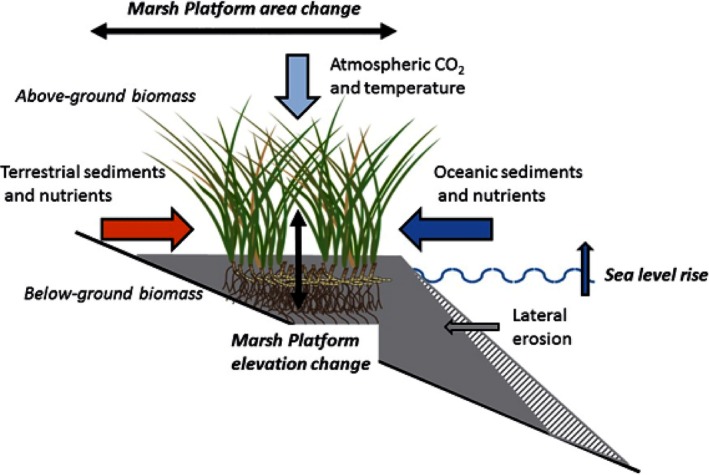
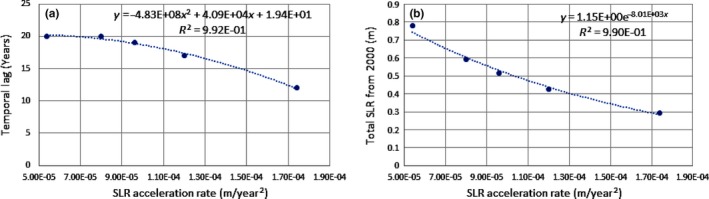
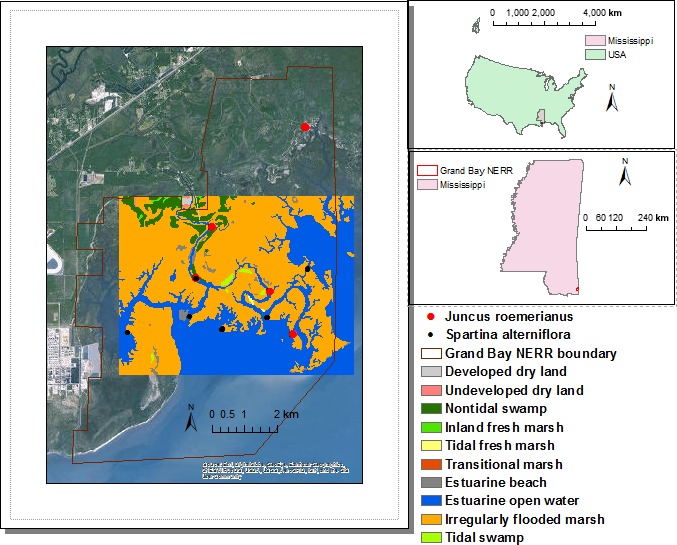
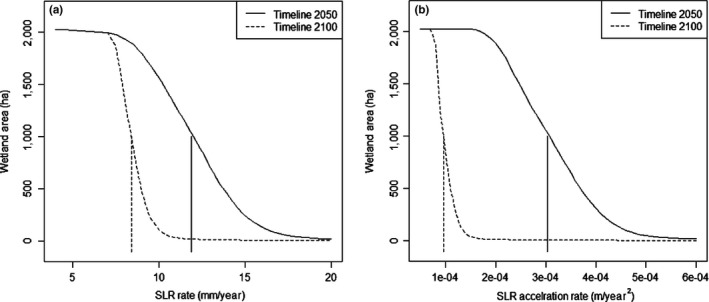
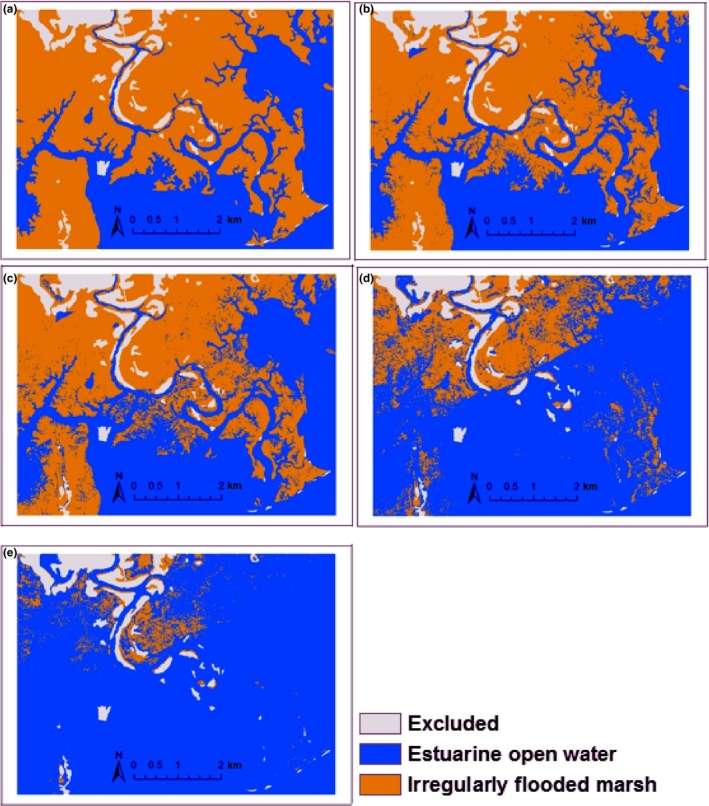
Feedbacks among inundation, sediment trapping, and vegetation productivity help maintain coastal wetlands facing sea-level rise (SLR). However, when the SLR rate exceeds a threshold, coastal wetlands can collapse. Understanding the threshold helps address key challenges in ecology-nonlinear response of ecosystems to environmental change, promotes communication between ecologists and resource managers, and facilitates decision-making in climate change policies. We studied the threshold of SLR rate and developed a new threshold of SLR acceleration rate on sustainability of coastal wetlands as SLR is likely to accelerate due to enhanced anthropogenic forces. Deriving these two thresholds depends on the temporal scale, the interaction of SLR with other environmental factors, and landscape metrics, which have not been fully accounted for before this study. We chose a representative marine-dominated estuary in the northern Gulf of Mexico, Grand Bay in Mississippi, to test the concept of SLR thresholds. We developed a mechanistic model to simulate wetland change and then derived the SLR thresholds for Grand Bay. The model results show that the threshold of SLR rate in Grand Bay is 11.9 mm/year for 2050, and it drops to 8.4 mm/year for 2100 using total wetland area as a landscape metric. The corresponding SLR acceleration rate thresholds are 3.02 × 10 m/year and 9.62 × 10 m/year for 2050 and 2100, respectively. The newly developed SLR acceleration rate threshold can help quantify the temporal lag before the rapid decline in wetland area becomes evident after the SLR rate threshold is exceeded, and cumulative SLR a wetland can adapt to under the SLR acceleration scenarios. Based on the thresholds, SLR that will adversely impact the coastal wetlands in Grand Bay by 2100 will fall within the likely range of SLR under a high warming scenario (RCP8.5), highlighting the need to avoid RCP8.5 to preserve these marshes.
洪水淹没、沉积物截留和植被生产力之间的反馈有助于维持面临海平面上升(SLR)的沿海湿地。然而,当海平面上升速率超过阈值时,沿海湿地可能会崩溃。了解该阈值有助于应对生态学中的关键挑战——生态系统对环境变化的非线性响应,促进生态学家与资源管理者之间的沟通,并推动气候变化政策的决策制定。由于人为因素增强,海平面上升可能会加速,因此我们研究了海平面上升速率的阈值,并针对沿海湿地的可持续性制定了新的海平面上升加速度阈值。得出这两个阈值取决于时间尺度、海平面上升与其他环境因素的相互作用以及景观指标,而在本研究之前这些因素尚未得到充分考虑。我们选择了墨西哥湾北部一个具有代表性的以海洋为主的河口——密西西比州的格兰德湾,来测试海平面上升阈值的概念。我们开发了一个机理模型来模拟湿地变化,然后得出格兰德湾的海平面上升阈值。模型结果表明,以总湿地面积作为景观指标时,格兰德湾2050年的海平面上升速率阈值为11.9毫米/年,到2100年降至8.4毫米/年。2050年和2100年相应的海平面上升加速度阈值分别为3.02×10米/年和9.62×10米/年。新制定的海平面上升加速度阈值有助于量化在超过海平面上升速率阈值后湿地面积迅速下降变得明显之前的时间滞后,以及在海平面上升加速度情景下湿地能够适应的累积海平面上升量。基于这些阈值,到2100年将对格兰德湾沿海湿地产生不利影响的海平面上升将处于高变暖情景(RCP8.5)下可能的海平面上升范围内,这突出表明需要避免RCP8.5以保护这些湿地。