Institut National de la Recherche Scientifique (INRS)-Institut Armand-Frappier, 531 Boulevard des Prairies, Laval, H7V 1B7 QC, Canada.
Viruses. 2017 Dec 30;10(1):12. doi: 10.3390/v10010012.
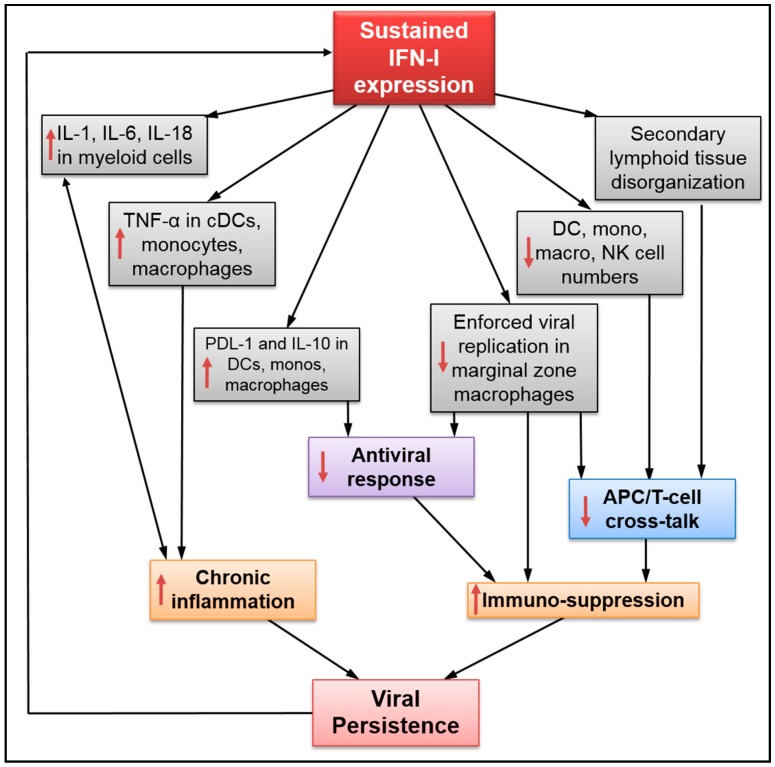
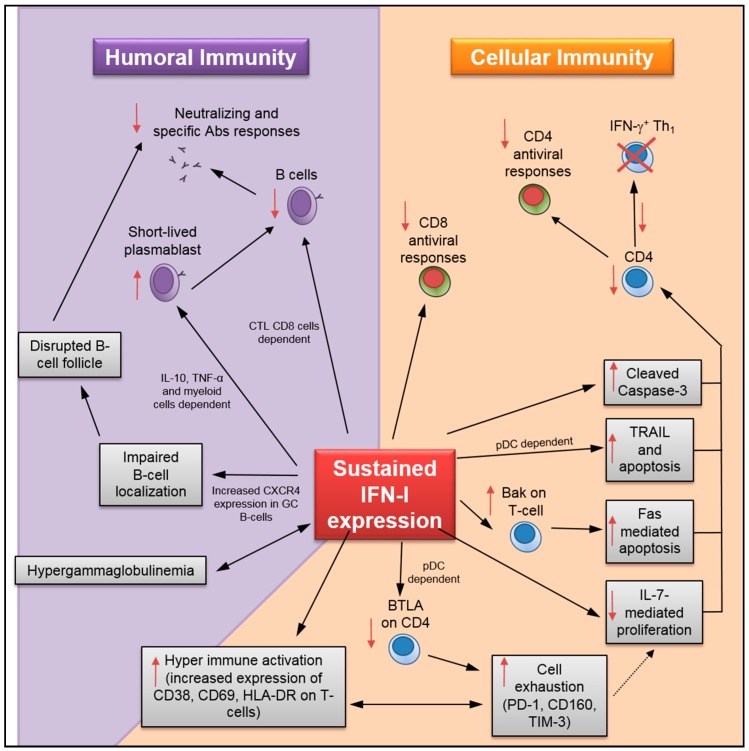
Type I interferons (IFN-I) are one of the primary immune defenses against viruses. Similar to all other molecular mechanisms that are central to eliciting protective immune responses, IFN-I expression is subject to homeostatic controls that regulate cytokine levels upon clearing the infection. However, in the case of established persistent viral infection, sustained elevation of IFN-I expression bears deleterious effects to the host and is today considered as the major driver of inflammation and immunosuppression. In fact, numerous emerging studies place sustained IFN-I expression as a common nexus in the pathogenesis of multiple chronic diseases including persistent infections with the human immunodeficiency virus type 1 (HIV-1), simian immunodeficiency virus (SIV), as well as the rodent-borne lymphocytic choriomeningitis virus clone 13 (LCMV clone 13). In this review, we highlight recent studies illustrating the molecular dysregulation and resultant cellular dysfunction in both innate and adaptive immune responses driven by sustained IFN-I expression. Here, we place particular emphasis on the efficacy of IFN-I receptor (IFNR) blockade towards improving immune responses against viral infections given the emerging therapeutic approach of blocking IFNR using neutralizing antibodies (Abs) in chronically infected patients.
I 型干扰素 (IFN-I) 是人体抵御病毒的主要免疫防御机制之一。与其他所有对引发保护性免疫反应至关重要的分子机制一样,IFN-I 的表达受到体内平衡控制,即在清除感染后调节细胞因子水平。然而,在已确立的持续性病毒感染的情况下,IFN-I 的持续升高对宿主具有有害影响,目前被认为是炎症和免疫抑制的主要驱动因素。事实上,大量新出现的研究表明,持续性 IFN-I 表达是多种慢性疾病发病机制的共同枢纽,包括人类免疫缺陷病毒 1 (HIV-1)、猴免疫缺陷病毒 (SIV) 的持续性感染,以及鼠源性淋巴细胞性脉络丛脑膜炎病毒克隆 13 (LCMV 克隆 13)。在这篇综述中,我们强调了最近的研究,这些研究阐明了由持续性 IFN-I 表达驱动的固有和适应性免疫反应中的分子失调和由此产生的细胞功能障碍。在这里,我们特别强调了 IFN-I 受体 (IFNR) 阻断在改善病毒感染免疫反应方面的功效,因为使用中和抗体 (Abs) 阻断 IFNR 是慢性感染患者的一种新兴治疗方法。