Castellanos-Cosano Lizett, Corcuera-Flores José-Ramón, Mesa-Cabrera María, Cabrera-Domínguez José, Torres-Lagares Daniel, Machuca-Portillo Guillermo
Associate Professor, Department of Stomatology, School of Dentistry, University of Seville, Seville, Spain.
Master Special Care Dentistry, Department of Stomatology, School of Dentistry, University of Seville, Seville, Spain.
J Clin Exp Dent. 2017 Nov 1;9(11):e1371-e1374. doi: 10.4317/jced.54356. eCollection 2017 Nov.
Paranoid schizophrenia is a mental illness that involves no observable anatomical alteration. Main characteristic affects the personality of the individual, as well as areas of his own psychology.
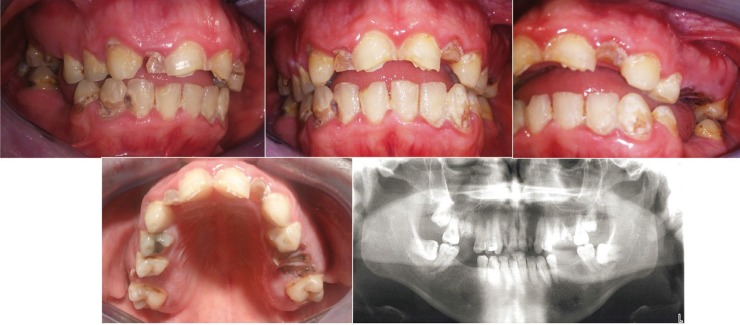
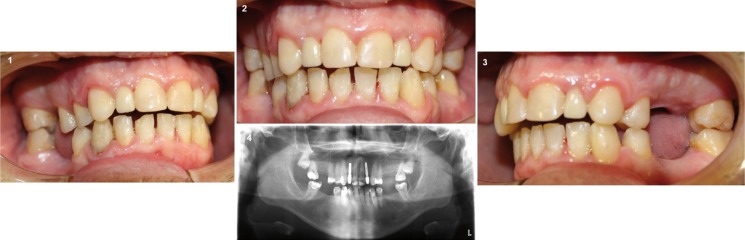
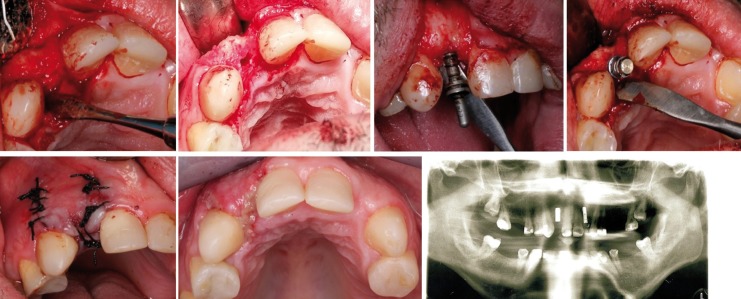
A 33-year-old man with paranoid schizophrenia and obsessive-compulsive disorder in treatment with Haloperidol, Oxcarbazepine, Olanzapine and Seroquel is presented. Dental exploration showed widespread decay mostly cervical with numerous root fragments, agenesis of lateral incisors, impacted wisdom teeth, missing teeth and malocclusion. Treatment plan included restoration of teeth decay, extractions of root fragments and implant-supported prostheses in bilateral upper lateral incisors for aesthetics reason. A previous consultation with a psychiatric specialist was performed and no contraindication were observed. A preliminary radiological examination was performed previous dental treatment and implant placement. Due to patient refusal to replace dental abscenses with implants, inform consent was signed up from his parents. After local anesthesia, first implant was placed at upper right lateral positions (Straumann Bone Level Ø 3.3 mm, length 10 mm). Two weeks later a second implant was placed at upper left lateral position (Straumann Bone Level Ø 3.3 mm, length 12 mm). The patient showed no postoperative complications. After implant placement, the patient attended scheduled review appointments. The prosthesis was placed after a 3-month period of osseointegration.
Implant placement can be considered a suitable option for people with mental disorders. A previous consultation with psychiatric specialists for conducting a good patient management is necessaire. Paranoid schizophrenia, obsessive-compulsive disorder, dental implants.
偏执型精神分裂症是一种无明显解剖结构改变的精神疾病。其主要特征影响个体的人格以及自身心理的多个方面。
介绍了一名33岁患有偏执型精神分裂症和强迫症的男性,正在接受氟哌啶醇、奥卡西平、奥氮平和喹硫平治疗。口腔检查发现广泛龋坏,主要位于颈部,有大量牙根碎片,侧切牙先天缺失,智齿阻生,牙齿缺失和错牙合畸形。治疗计划包括修复龋坏牙齿,拔除牙根碎片,并出于美观原因在双侧上颌侧切牙植入种植体支持的假体。此前已咨询精神科专家,未观察到禁忌证。在进行牙科治疗和种植体植入之前进行了初步的放射学检查。由于患者拒绝用种植体修复牙齿缺失,其父母签署了知情同意书。局部麻醉后,在上颌右侧位置植入第一枚种植体(士卓曼骨水平型,直径3.3mm,长度10mm)。两周后,在上颌左侧位置植入第二枚种植体(士卓曼骨水平型,直径3.3mm,长度12mm)。患者未出现术后并发症。种植体植入后,患者按计划复诊。在骨整合3个月后植入假体。
对于患有精神障碍的人,种植体植入可被视为一种合适的选择。事先咨询精神科专家对于做好患者管理是必要的。偏执型精神分裂症、强迫症、牙种植体。