a Department of Medical Sciences, Clinical Diabetes and Metabolism , Uppsala University , Sweden.
b Department of Medical Sciences, Molecular Epidemiology and Science for Life Laboratory , Uppsala University , Sweden.
Ups J Med Sci. 2017 Nov;122(4):234-242. doi: 10.1080/03009734.2017.1405127. Epub 2018 Jan 5.
To assess practical implications of genotype-based recall (GBR) studies, an increasingly popular approach for in-depth characterization of genotype-phenotype relationships.
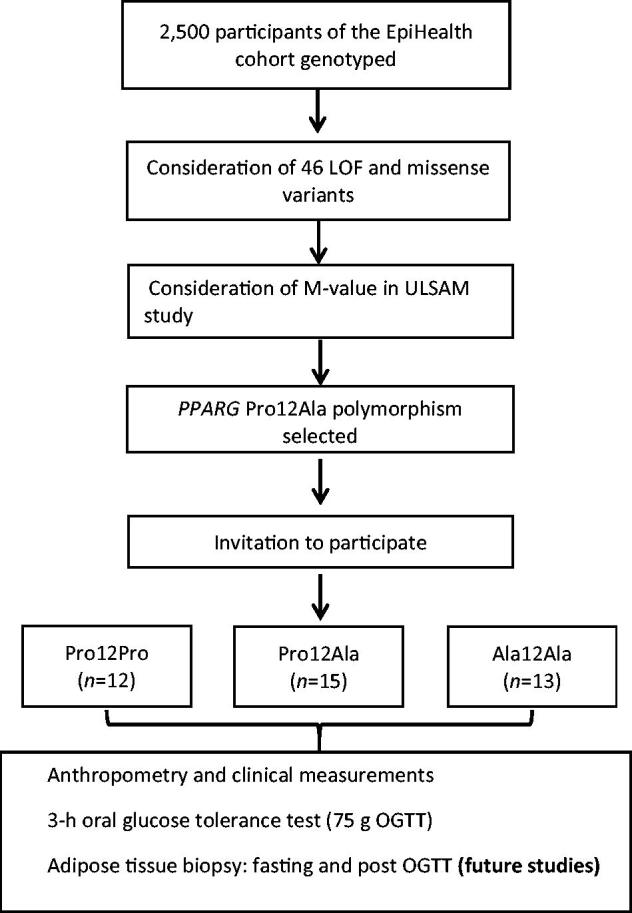
We genotyped 2500 participants from the Swedish EpiHealth cohort and considered loss-of-function and missense variants in genes with relation to cardiometabolic traits as the basis for our GBR study. Therefore, we focused on carriers and non-carriers of the PPARG Pro12Ala (rs1801282) variant, as it is a relatively common variant with a minor allele frequency (MAF) of 0.14. It has also been shown to affect ligand binding and transcription, and carriage of the minor allele (Ala12) is associated with a reduced risk of type 2 diabetes. We re-invited 39 Pro12Pro, 34 Pro12Ala, and 30 Ala12Ala carriers and performed detailed anthropometric and serological assessments.
The participation rates in the GBR study were 31%, 44%, and 40%, and accordingly we included 12, 15, and 13 individuals with Pro12Pro, Pro12Ala, and Ala12Ala variants, respectively. There were no differences in anthropometric or metabolic variables among the different genotype groups.
Our report highlights that from a practical perspective, GBR can be used to study genotype-phenotype relationships. This approach can prove to be a valuable tool for follow-up findings from large-scale genetic discovery studies by undertaking detailed phenotyping procedures that might not be feasible in large studies. However, our study also illustrates the need for a larger pool of genotyped or sequenced individuals to allow for selection of rare variants with larger effects that can be examined in a GBR study of the present size.
评估基于基因型的召回(GBR)研究的实际意义,这是一种越来越流行的深入研究基因型-表型关系的方法。
我们对来自瑞典 EpiHealth 队列的 2500 名参与者进行了基因分型,并将与心脏代谢特征相关的基因中的功能丧失和错义变体作为我们 GBR 研究的基础。因此,我们专注于携带和不携带 PPARG Pro12Ala(rs1801282)变体的个体,因为它是一种相对常见的变体,其次要等位基因频率(MAF)为 0.14。它还被证明会影响配体结合和转录,并且携带较小的等位基因(Ala12)与 2 型糖尿病的风险降低有关。我们重新邀请了 39 名 Pro12Pro、34 名 Pro12Ala 和 30 名 Ala12Ala 携带者,并进行了详细的人体测量学和血清学评估。
GBR 研究的参与率分别为 31%、44%和 40%,因此我们分别纳入了 12 名、15 名和 13 名携带 Pro12Pro、Pro12Ala 和 Ala12Ala 变体的个体。在不同基因型组之间,人体测量学或代谢变量没有差异。
我们的报告强调,从实际角度来看,GBR 可用于研究基因型-表型关系。这种方法可以通过进行详细的表型分析,成为大型遗传发现研究后续发现的有价值的工具,而这些分析在大型研究中可能不可行。然而,我们的研究还说明了需要更大的基因分型或测序个体池,以便选择可以在当前规模的 GBR 研究中进行检查的具有更大影响的罕见变体。