Pinto Nuno, Duarte Marta, Gonçalves Helena, Silva Ricardo, Gama Jorge, Pato Maria Vaz
CICS-Health Sciences Research Centre, Faculty of Health Sciences, University of Beira Interior, Covilhã, Portugal.
Dr. Lopes Dias School of Health - Polytechnic Institute of Castelo Branco, Castelo Branco, Portugal.
PLoS One. 2018 Jan 5;13(1):e0190693. doi: 10.1371/journal.pone.0190693. eCollection 2018.
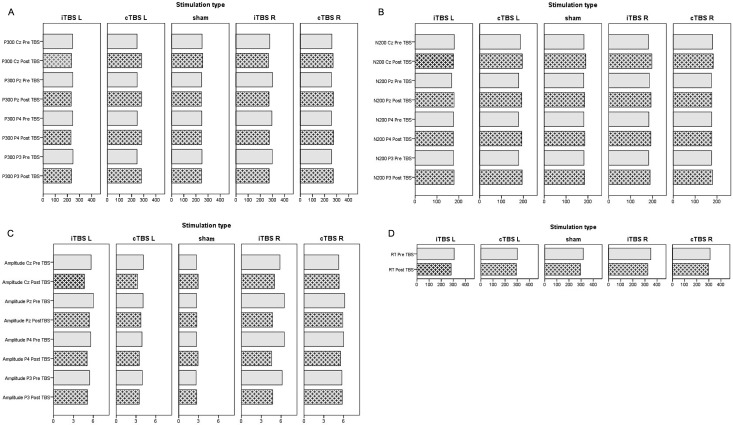
Theta-burst stimulation (TBS) can be a non-invasive technique to modulate cognitive functions, with promising therapeutic potential, but with some contradictory results. Event related potentials are used as a marker of brain deterioration and can be used to evaluate TBS-related cognitive performance, but its use remains scant. This study aimed to study bilateral inhibitory and excitatory TBS effects upon neurocognitive performance of young healthy volunteers, using the auditory P300' results. Using a double-blind sham-controlled study, 51 healthy volunteers were randomly assigned to five different groups, two submitted to either excitatory (iTBS) or inhibitory (cTBS) stimulation over the left dorsolateral pre-frontal cortex (DLPFC), two other actively stimulated the right DLPFC and finally a sham stimulation group. An oddball based auditory P300 was performed just before a single session of iTBS, cTBS or sham stimulation and repeated immediately after. P300 mean latency comparison between the pre- and post-TBS stimulation stages revealed significantly faster post stimulation latencies only when iTBS was performed on the left hemisphere (p = 0.003). Right and left hemisphere cTBS significantly delayed P300 latency (right p = 0.026; left p = 0.000). Multiple comparisons for N200 showed slower latencies after iTBS over the right hemisphere. No significant difference was found in amplitude variation. TBS appears to effectively influence neural networking involved in P300 formation, but effects seem distinct for iTBS vs cTBS and for the right or the left hemisphere. P300 evoked potentials can be an effective and practical tool to evaluate transcranial magnetic stimulation related outcomes.
theta 爆发刺激(TBS)是一种可调节认知功能的非侵入性技术,具有潜在的治疗前景,但也存在一些相互矛盾的结果。事件相关电位被用作脑功能衰退的标志物,可用于评估与TBS相关的认知表现,但其应用仍然较少。本研究旨在利用听觉P300结果,研究双侧抑制性和兴奋性TBS对年轻健康志愿者神经认知表现的影响。采用双盲假对照研究,将51名健康志愿者随机分为五组,其中两组分别接受左侧背外侧前额叶皮质(DLPFC)的兴奋性(iTBS)或抑制性(cTBS)刺激,另外两组分别接受右侧DLPFC的主动刺激,最后一组为假刺激组。在单次iTBS、cTBS或假刺激前及刺激后立即进行基于oddball的听觉P300测试。TBS刺激前后阶段的P300平均潜伏期比较显示,仅当左侧半球进行iTBS时,刺激后潜伏期显著加快(p = 0.003)。右侧和左侧半球的cTBS均显著延迟了P300潜伏期(右侧p = 0.026;左侧p = 0.000)。N200的多重比较显示,右侧半球iTBS后潜伏期减慢。在振幅变化方面未发现显著差异。TBS似乎能有效影响参与P300形成的神经网络,但iTBS与cTBS以及右侧或左侧半球的影响似乎有所不同。P300诱发电位可作为评估经颅磁刺激相关结果的有效实用工具。