• 文献检索
  • 文档翻译
  • 深度研究
  • 学术资讯
  • Suppr Zotero 插件Zotero 插件
  • 邀请有礼
  • 套餐&价格
  • 历史记录
应用&插件
Suppr Zotero 插件Zotero 插件浏览器插件Mac 客户端Windows 客户端微信小程序
定价
高级版会员购买积分包购买API积分包
服务
文献检索文档翻译深度研究API 文档MCP 服务
关于我们
关于 Suppr公司介绍联系我们用户协议隐私条款
关注我们

Suppr 超能文献

核心技术专利:CN118964589B侵权必究
粤ICP备2023148730 号-1Suppr @ 2026

文献检索

告别复杂PubMed语法,用中文像聊天一样搜索,搜遍4000万医学文献。AI智能推荐,让科研检索更轻松。

立即免费搜索

文件翻译

保留排版,准确专业,支持PDF/Word/PPT等文件格式,支持 12+语言互译。

免费翻译文档

深度研究

AI帮你快速写综述,25分钟生成高质量综述,智能提取关键信息,辅助科研写作。

立即免费体验

现代亚洲牛的线粒体DNA单倍群P:亚洲原牛的遗传遗产?

The mtDNA haplogroup P of modern Asian cattle: A genetic legacy of Asian aurochs?

作者信息

Noda Aoi, Yonesaka Riku, Sasazaki Shinji, Mannen Hideyuki

机构信息

Laboratory of Animal Breeding and Genetics, Graduate School of Agricultural Science, Kobe University, Kobe, Japan.

出版信息

PLoS One. 2018 Jan 5;13(1):e0190937. doi: 10.1371/journal.pone.0190937. eCollection 2018.

DOI:10.1371/journal.pone.0190937
PMID:29304129
原文链接:https://pmc.ncbi.nlm.nih.gov/articles/PMC5755918/
Abstract

BACKGROUND

Aurochs (Bos primigenius) were distributed throughout large parts of Eurasia and Northern Africa during the late Pleistocene and the early Holocene, and all modern cattle are derived from the aurochs. Although the mtDNA haplogroups of most modern cattle belong to haplogroups T and I, several additional haplogroups (P, Q, R, C and E) have been identified in modern cattle and aurochs. Haplogroup P was the most common haplogroup in European aurochs, but so far, it has been identified in only three of >3,000 submitted haplotypes of modern Asian cattle.

METHODOLOGY

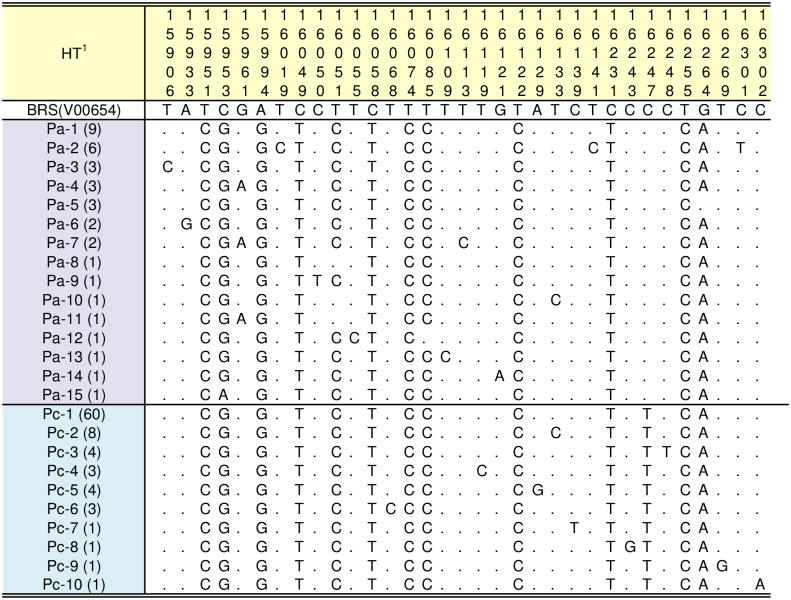
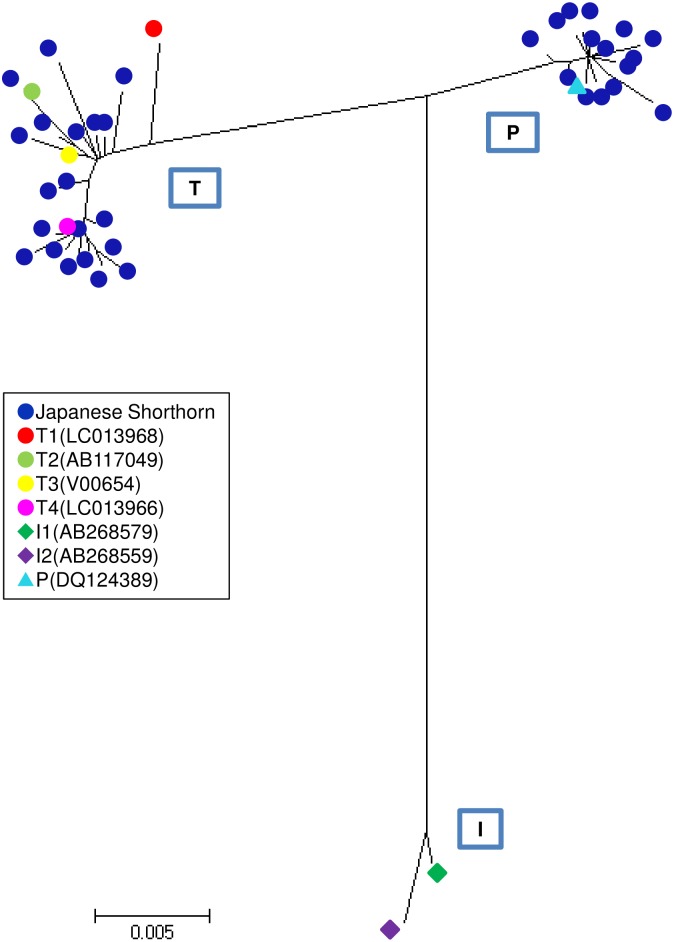
We sequenced the complete mtDNA D-loop region of 181 Japanese Shorthorn cattle and analyzed these together with representative bovine mtDNA sequences. The haplotype P of Japanese Shorthorn cattle was analyzed along with that of 36 previously published European aurochs and three modern Asian cattle sequences using the hypervariable 410 bp of the D-loop region.

CONCLUSIONS

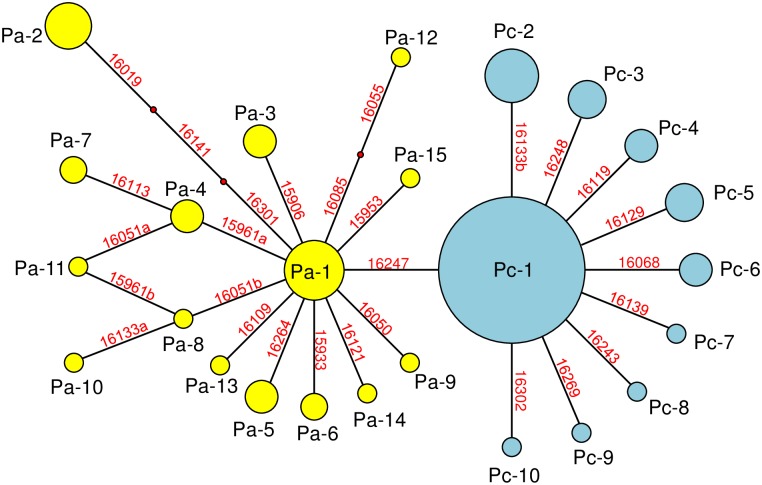
We detected the mtDNA haplogroup P in Japanese Shorthorn cattle with an extremely high frequency (83/181). Phylogenetic networks revealed two main clusters, designated as Pa for haplogroup P in European aurochs and Pc in modern Asian cattle. We also report the genetic diversity of haplogroup P compared with the sequences of extinct aurochs. No shared haplotypes are observed between the European aurochs and the modern Asian cattle. This finding suggests the possibility of local and secondary introgression events of haplogroup P in northeast Asian cattle, and will contribute to a better understanding of its origin and genetic diversity.

摘要

背景

原牛(Bos primigenius)在更新世晚期和全新世早期分布于欧亚大陆大部分地区和北非,所有现代牛都起源于原牛。尽管大多数现代牛的线粒体DNA单倍群属于单倍群T和I,但在现代牛和原牛中还鉴定出了几个其他单倍群(P、Q、R、C和E)。单倍群P是欧洲原牛中最常见的单倍群,但到目前为止,在超过3000个提交的现代亚洲牛单倍型中仅在三个中被鉴定出来。

方法

我们对181头日本短角牛的完整线粒体DNA D环区域进行了测序,并与代表性的牛线粒体DNA序列一起进行分析。利用D环区域410 bp的高变区,对日本短角牛的单倍型P与36个先前发表的欧洲原牛和三个现代亚洲牛序列的单倍型P进行了分析。

结论

我们在日本短角牛中检测到线粒体DNA单倍群P的频率极高(83/181)。系统发育网络揭示了两个主要聚类,分别指定为欧洲原牛单倍群P的Pa和现代亚洲牛的Pc。我们还报告了与已灭绝原牛序列相比单倍群P的遗传多样性。在欧洲原牛和现代亚洲牛之间未观察到共享单倍型。这一发现表明东北亚牛中存在单倍群P的局部和二次渗入事件的可能性,并将有助于更好地理解其起源和遗传多样性。
https://cdn.ncbi.nlm.nih.gov/pmc/blobs/6aff/5755918/21b638fdc127/pone.0190937.g003.jpg
https://cdn.ncbi.nlm.nih.gov/pmc/blobs/6aff/5755918/cf1788adf989/pone.0190937.g001.jpg
https://cdn.ncbi.nlm.nih.gov/pmc/blobs/6aff/5755918/2c27e64974b0/pone.0190937.g002.jpg
https://cdn.ncbi.nlm.nih.gov/pmc/blobs/6aff/5755918/21b638fdc127/pone.0190937.g003.jpg
https://cdn.ncbi.nlm.nih.gov/pmc/blobs/6aff/5755918/cf1788adf989/pone.0190937.g001.jpg
https://cdn.ncbi.nlm.nih.gov/pmc/blobs/6aff/5755918/2c27e64974b0/pone.0190937.g002.jpg
https://cdn.ncbi.nlm.nih.gov/pmc/blobs/6aff/5755918/21b638fdc127/pone.0190937.g003.jpg

相似文献

1
The mtDNA haplogroup P of modern Asian cattle: A genetic legacy of Asian aurochs?现代亚洲牛的线粒体DNA单倍群P:亚洲原牛的遗传遗产?
PLoS One. 2018 Jan 5;13(1):e0190937. doi: 10.1371/journal.pone.0190937. eCollection 2018.
2
Cattle mitogenome variation reveals a post-glacial expansion of haplogroup P and an early incorporation into northeast Asian domestic herds.牛线粒体基因组变异揭示了 P 单倍群在冰期后的扩张以及其早期融入东北亚家牛群体。
Sci Rep. 2020 Nov 30;10(1):20842. doi: 10.1038/s41598-020-78040-8.
3
Mitochondrial DNA analysis shows a Near Eastern Neolithic origin for domestic cattle and no indication of domestication of European aurochs.线粒体DNA分析表明,家养牛起源于近东新石器时代,没有迹象显示欧洲原牛被驯化。
Proc Biol Sci. 2007 Jun 7;274(1616):1377-85. doi: 10.1098/rspb.2007.0020.
4
The enigmatic origin of bovine mtDNA haplogroup R: sporadic interbreeding or an independent event of Bos primigenius domestication in Italy?牛线粒体 DNA 单倍群 R 的神秘起源:偶然的杂交还是意大利野牛驯化的独立事件?
PLoS One. 2010 Dec 28;5(12):e15760. doi: 10.1371/journal.pone.0015760.
5
Cytochrome b sequences of ancient cattle and wild ox support phylogenetic complexity in the ancient and modern bovine populations.古代牛和野生牛的细胞色素 b 序列支持古代和现代牛群的系统发育复杂性。
Anim Genet. 2009 Oct;40(5):694-700. doi: 10.1111/j.1365-2052.2009.01905.x. Epub 2009 May 6.
6
Complete mitochondrial genome of wild aurochs (Bos primigenius) reconstructed from ancient DNA.从古代DNA重建的野生原牛(Bos primigenius)完整线粒体基因组。
Pol J Vet Sci. 2013;16(2):265-73. doi: 10.2478/pjvs-2013-0037.
7
Origin and spread of Bos taurus: new clues from mitochondrial genomes belonging to haplogroup T1.牛的起源和传播:来自属于 T1 单倍群的线粒体基因组的新线索。
PLoS One. 2012;7(6):e38601. doi: 10.1371/journal.pone.0038601. Epub 2012 Jun 7.
8
The complete mitochondrial genome of an 11,450-year-old aurochsen (Bos primigenius) from Central Italy.来自意大利中部的一头 11450 年前的欧洲野牛(Bos primigenius)的完整线粒体基因组。
BMC Evol Biol. 2011 Jan 31;11:32. doi: 10.1186/1471-2148-11-32.
9
A complete mitochondrial genome sequence from a mesolithic wild aurochs (Bos primigenius).来自中石器时代野生原牛(Bos primigenius)的完整线粒体基因组序列。
PLoS One. 2010 Feb 17;5(2):e9255. doi: 10.1371/journal.pone.0009255.
10
Incorporation of aurochs into a cattle herd in Neolithic Europe: single event or breeding?新石器时代欧洲将原牛引入牛群:单一事件还是繁殖行为?
Sci Rep. 2014 Jul 23;4:5798. doi: 10.1038/srep05798.

引用本文的文献

1
Chromosome-level genome assembly of Korean native cattle and pangenome graph of 14 Bos taurus assemblies.韩国本土牛的染色体水平基因组组装和 14 个牛属组装的泛基因组图谱。
Sci Data. 2023 Aug 23;10(1):560. doi: 10.1038/s41597-023-02453-z.
2
Legacies of domestication, Neolithic diffusion and trade between Indian subcontinent and Island Southeast Asia shape maternal genetic diversity of Andaman cattle.驯化、新石器时代扩散和印度次大陆与东南亚岛屿之间的贸易的遗产塑造了安达曼牛的母系遗传多样性。
PLoS One. 2022 Dec 9;17(12):e0278681. doi: 10.1371/journal.pone.0278681. eCollection 2022.
3
Human and Animal Fascioliasis: Origins and Worldwide Evolving Scenario.

本文引用的文献

1
Low mitochondrial DNA diversity of Japanese Polled and Kuchinoshima feral cattle.日本无角牛和口之岛野生牛的线粒体DNA多样性较低。
Anim Sci J. 2017 May;88(5):739-744. doi: 10.1111/asj.12716. Epub 2016 Sep 28.
2
Mitogenomes from Egyptian Cattle Breeds: New Clues on the Origin of Haplogroup Q and the Early Spread of Bos taurus from the Near East.埃及牛品种的线粒体基因组:关于单倍群Q起源及牛从近东地区早期传播的新线索
PLoS One. 2015 Oct 29;10(10):e0141170. doi: 10.1371/journal.pone.0141170. eCollection 2015.
3
Genetic structure and relationships of 16 Asian and European cattle populations using DigiTag2 assay.
人体和动物片形吸虫病:起源与全球演变态势。
Clin Microbiol Rev. 2022 Dec 21;35(4):e0008819. doi: 10.1128/cmr.00088-19. Epub 2022 Dec 5.
4
Diversity of Mitochondrial DNA Haplogroups and Their Association with Bovine Antral Follicle Count.线粒体DNA单倍群的多样性及其与牛窦卵泡计数的关联
Animals (Basel). 2022 Sep 8;12(18):2350. doi: 10.3390/ani12182350.
5
Coincidence of low genetic diversity and increasing population size in wild gaur populations in the Khao Phaeng Ma Non-Hunting Area, Thailand: A challenge for conservation management under human-wildlife conflict.在泰国考艾彭丁非狩猎区,野生野牛种群的遗传多样性低与种群数量增加相巧合:人类与野生动物冲突下保护管理的挑战。
PLoS One. 2022 Aug 30;17(8):e0273731. doi: 10.1371/journal.pone.0273731. eCollection 2022.
6
Mitochondrial Whole D-Loop Variability in Polish Draft Horses of Sztumski Subtype.什图姆斯基亚型波兰挽马线粒体全D环变异性
Animals (Basel). 2022 Jul 22;12(15):1870. doi: 10.3390/ani12151870.
7
High-Level Gene Flow Restricts Genetic Differentiation in Dairy Cattle Populations in Thailand: Insights from Large-Scale Mt D-Loop Sequencing.高水平基因流限制泰国奶牛群体的遗传分化:来自大规模线粒体D环测序的见解
Animals (Basel). 2021 Jun 4;11(6):1680. doi: 10.3390/ani11061680.
8
Mitochondrial genomes from modern and ancient Turano-Mongolian cattle reveal an ancient diversity of taurine maternal lineages in East Asia.现代和古代图兰-蒙古牛的线粒体基因组揭示了东亚有古老的原始牛母系多样性。
Heredity (Edinb). 2021 Jun;126(6):1000-1008. doi: 10.1038/s41437-021-00428-7. Epub 2021 Mar 29.
9
Cattle mitogenome variation reveals a post-glacial expansion of haplogroup P and an early incorporation into northeast Asian domestic herds.牛线粒体基因组变异揭示了 P 单倍群在冰期后的扩张以及其早期融入东北亚家牛群体。
Sci Rep. 2020 Nov 30;10(1):20842. doi: 10.1038/s41598-020-78040-8.
利用DigiTag2检测分析16个亚洲和欧洲牛群的遗传结构及亲缘关系
Anim Sci J. 2016 Feb;87(2):190-6. doi: 10.1111/asj.12416. Epub 2015 Aug 11.
4
Morphological and genetic evidence for early Holocene cattle management in northeastern China.中国东北地区全新世早期牛类管理的形态学和遗传学证据。
Nat Commun. 2013;4:2755. doi: 10.1038/ncomms3755.
5
MEGA6: Molecular Evolutionary Genetics Analysis version 6.0.MEGA6:分子进化遗传学分析版本 6.0。
Mol Biol Evol. 2013 Dec;30(12):2725-9. doi: 10.1093/molbev/mst197. Epub 2013 Oct 16.
6
Complete mitochondrial genome of wild aurochs (Bos primigenius) reconstructed from ancient DNA.从古代DNA重建的野生原牛(Bos primigenius)完整线粒体基因组。
Pol J Vet Sci. 2013;16(2):265-73. doi: 10.2478/pjvs-2013-0037.
7
Genetic diversity and structure in Asian native goat analyzed by newly developed SNP markers.利用新开发的 SNP 标记分析亚洲本地山羊的遗传多样性和结构。
Anim Sci J. 2013 Aug;84(8):579-84. doi: 10.1111/asj.12039. Epub 2013 Feb 26.
8
Origin and spread of Bos taurus: new clues from mitochondrial genomes belonging to haplogroup T1.牛的起源和传播:来自属于 T1 单倍群的线粒体基因组的新线索。
PLoS One. 2012;7(6):e38601. doi: 10.1371/journal.pone.0038601. Epub 2012 Jun 7.
9
The enigmatic origin of bovine mtDNA haplogroup R: sporadic interbreeding or an independent event of Bos primigenius domestication in Italy?牛线粒体 DNA 单倍群 R 的神秘起源:偶然的杂交还是意大利野牛驯化的独立事件?
PLoS One. 2010 Dec 28;5(12):e15760. doi: 10.1371/journal.pone.0015760.
10
Estimation of relatedness among non-pedigreed Yakutian cryo-bank bulls using molecular data: implications for conservation and breed management.利用分子数据评估非 pedigreed Yakutian 冷冻库公牛的亲缘关系:对保护和品种管理的启示。
Genet Sel Evol. 2010 Jul 13;42(1):28. doi: 10.1186/1297-9686-42-28.