School of Veterinary Science, University of Queensland, Gatton, QLD, 4343, Australia.
Sydney School of Veterinary Science, Faculty of Science, University of Sydney, Sydney, NSW, 2006, Australia.
Parasit Vectors. 2018 Jan 8;11(1):8. doi: 10.1186/s13071-017-2564-z.
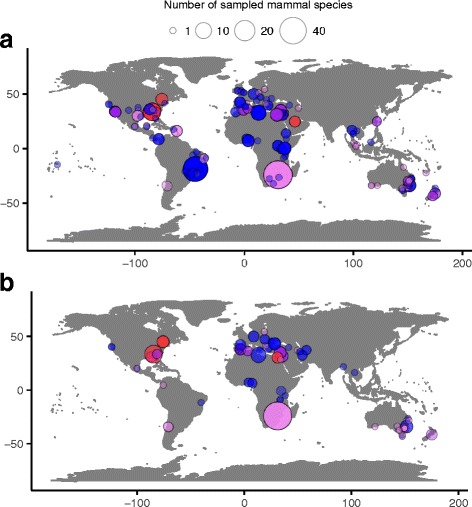
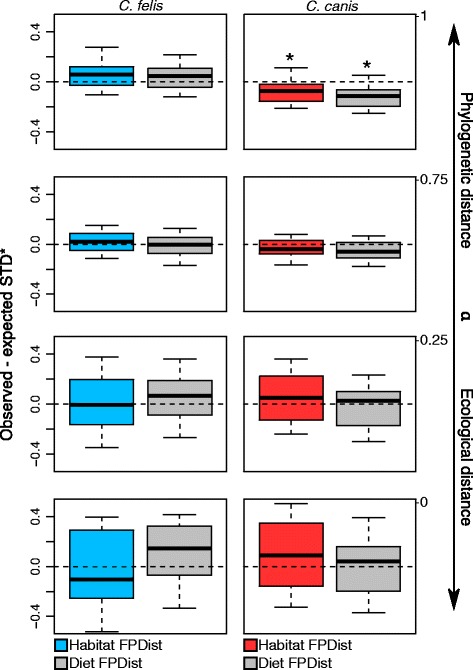
Spillover of parasites at the domestic animal - wildlife interface is a pervasive threat to animal health. Cat and dog fleas (Ctenocephalides felis and C. canis) are among the world's most invasive and economically important ectoparasites. Although both species are presumed to infest a diversity of host species across the globe, knowledge on their distributions in wildlife is poor. We built a global dataset of wild mammal host associations for cat and dog fleas, and used Bayesian hierarchical models to identify traits that predict wildlife infestation probability. We complemented this by calculating functional-phylogenetic host specificity to assess whether fleas are restricted to hosts with similar evolutionary histories, diet or habitat niches.
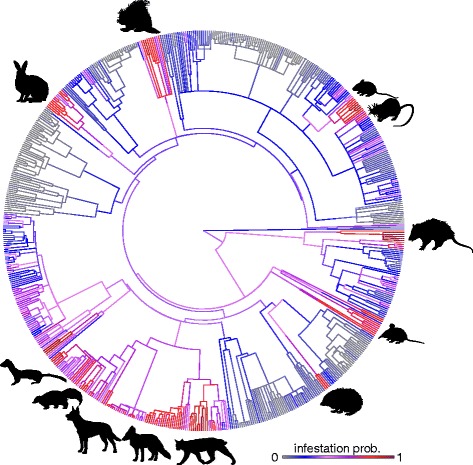
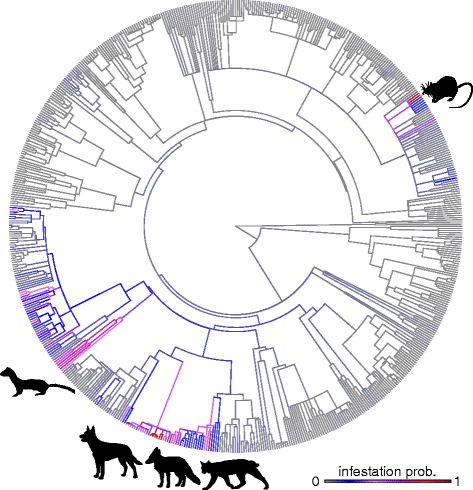
Over 130 wildlife species have been found to harbour cat fleas, representing nearly 20% of all mammal species sampled for fleas. Phylogenetic models indicate cat fleas are capable of infesting a broad diversity of wild mammal species through ecological fitting. Those that use anthropogenic habitats are at highest risk. Dog fleas, by contrast, have been recorded in 31 mammal species that are primarily restricted to certain phylogenetic clades, including canids, felids and murids. Both flea species are commonly reported infesting mammals that are feral (free-roaming cats and dogs) or introduced (red foxes, black rats and brown rats), suggesting the breakdown of barriers between wildlife and invasive reservoir species will increase spillover at the domestic animal - wildlife interface.
Our empirical evidence shows that cat fleas are incredibly host-generalist, likely exhibiting a host range that is among the broadest of all ectoparasites. Reducing wild species' contact rates with domestic animals across natural and anthropogenic habitats, together with mitigating impacts of invasive reservoir hosts, will be crucial for reducing invasive flea infestations in wild mammals.
在动物-野生动物界面上,寄生虫的溢出是对动物健康的普遍威胁。猫和狗跳蚤(Ctenocephalides felis 和 C. canis)是世界上最具入侵性和经济重要性的外寄生虫之一。尽管这两个物种都被认为在全球范围内寄生在多种宿主物种上,但它们在野生动物中的分布情况知之甚少。我们构建了一个关于猫和狗跳蚤的野生动物宿主关联的全球数据集,并使用贝叶斯层次模型来确定预测野生动物感染概率的特征。我们通过计算功能-进化宿主特异性来补充这一点,以评估跳蚤是否仅限于具有相似进化历史、饮食或栖息地小生境的宿主。
超过 130 种野生动物被发现携带猫跳蚤,占所有被采样跳蚤的哺乳动物物种的近 20%。系统发育模型表明,猫跳蚤能够通过生态适应感染广泛的野生哺乳动物物种。那些使用人为栖息地的跳蚤风险最高。相比之下,狗跳蚤已在 31 种哺乳动物中被记录,这些哺乳动物主要局限于某些进化枝,包括犬科、猫科和鼠科。这两种跳蚤都常见于野生动物和入侵储存宿主之间的屏障被打破,这将增加动物-野生动物界面的溢出风险。
我们的经验证据表明,猫跳蚤是非常宿主特化的,可能表现出最广泛的宿主范围之一。减少自然和人为栖息地中野生动物与家畜的接触率,同时减轻入侵储存宿主的影响,对于减少野生动物中入侵跳蚤的感染将是至关重要的。