Bakker Robbert C, van Es Robert J J, Rosenberg Antoine J W P, van Nimwegen Sebastiaan A, Bastiaannet Remco, de Jong Hugo W A M, Nijsen Johannes F W, Lam Marnix G E H
Department of Radiology and Nuclear Medicine.
Department of Oral and Maxillofacial Surgery, University Medical Center Utrecht.
Nucl Med Commun. 2018 Mar;39(3):213-221. doi: 10.1097/MNM.0000000000000792.
Limited treatment options exist for patients with locoregional recurrences of head and neck squamous cell carcinoma (HNSCC). In the palliative setting, a single session, minimally invasive, and relatively safe therapy is desirable. This case series illustrates the feasibility of a direct intratumoral injection of radioactive holmium-166 microspheres (HoMS) in patients as a palliative treatment for recurrent HNSCC.
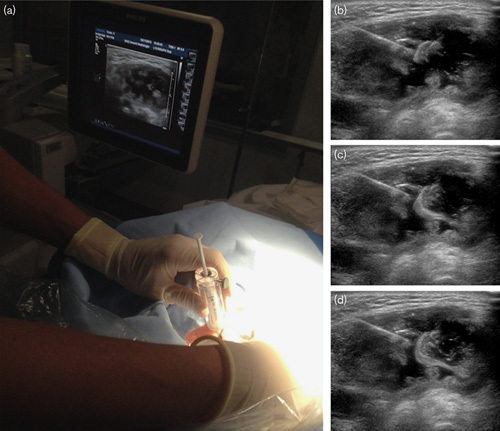
In this retrospective analysis, patients with already reirradiated irresectable recurrent HNSCC, for whom palliative chemotherapy was unsuccessful or impossible, were offered microbrachytherapy with HoMS. The intratumoral injection was administered manually under ultrasound guidance. Parameters scored were technical feasibility (i.e. administration, leakage, and distribution), clinical response (response evaluation criteria in solid tumors 1.1), and complications (Common Terminology Criteria for Adverse Events 4.3).
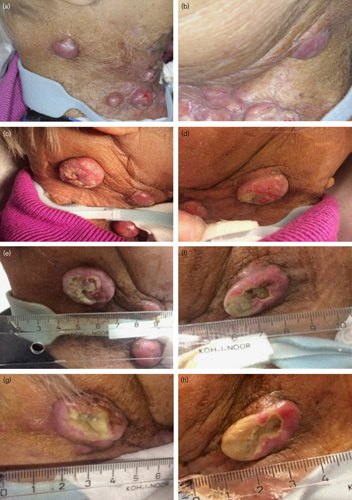
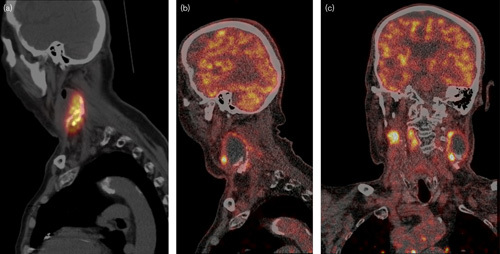
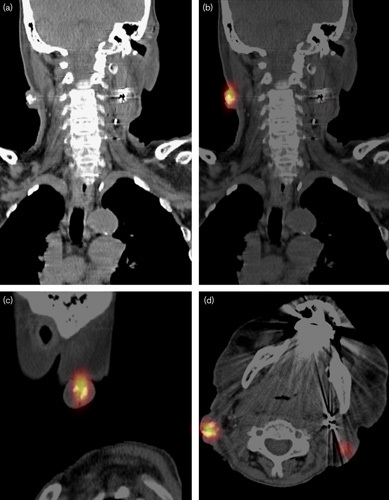
From 2015 to 2017, three patients were treated. None of the patients experienced adverse events; however, therapeutic effects were minimal. Technical difficulties, including precipitating of microspheres and high intratumoral pressure, resulted in suboptimal distribution of the microspheres.
Intratumoral injections with HoMS are minimally invasive and relatively safe in palliation of HNSCC patients. Careful patient selection and improved administration techniques are required to provide a more effective treatment. Further investigation of this novel treatment modality should be carried out because of the absence of side effects and lack of other treatment options.
头颈部鳞状细胞癌(HNSCC)局部区域复发的患者治疗选择有限。在姑息治疗中,需要一种单次、微创且相对安全的治疗方法。本病例系列说明了对复发性HNSCC患者直接瘤内注射放射性钬 - 166微球(HoMS)作为姑息治疗的可行性。
在这项回顾性分析中,对于已经接受过再程放疗且不可切除的复发性HNSCC患者,若姑息化疗不成功或无法进行,则为其提供HoMS近距离放疗。瘤内注射在超声引导下手动进行。记录的参数包括技术可行性(即给药、渗漏和分布)、临床反应(实体瘤疗效评价标准1.1)和并发症(不良事件通用术语标准4.3)。
2015年至2017年,治疗了3例患者。所有患者均未出现不良事件;然而,治疗效果甚微。技术困难,包括微球沉淀和瘤内压力高,导致微球分布不理想。
HoMS瘤内注射在HNSCC患者的姑息治疗中微创且相对安全。需要仔细选择患者并改进给药技术以提供更有效的治疗。鉴于没有副作用且缺乏其他治疗选择,应对这种新型治疗方式进行进一步研究。