Infectious Diseases Research Laboratory, Department of Cellular and Molecular Sciences, Universidad Peruana Cayetano Heredia, Lima, Peru.
Department of International Health, Johns Hopkins University Bloomberg School of Public Health, Baltimore, Maryland.
Clin Infect Dis. 2018 Jun 1;66(12):1858-1863. doi: 10.1093/cid/cix1103.
Sapovirus is one of the primary viral causes of acute gastroenteritis (AGE), especially where rotavirus vaccination has been implemented. The characteristics and impact of natural infection at the community level, however, have not been well documented.
Stool samples were analyzed from 100 children randomly selected from a community-based birth cohort study in Peru. All diarrheal and 1 nondiarrheal stools collected trimonthly from children up to age 2 years (n = 1669) were tested for sapovirus detection. Viral shedding duration was determined by testing additional weekly samples (n = 440) collected before and after a sapovirus-positive sample.
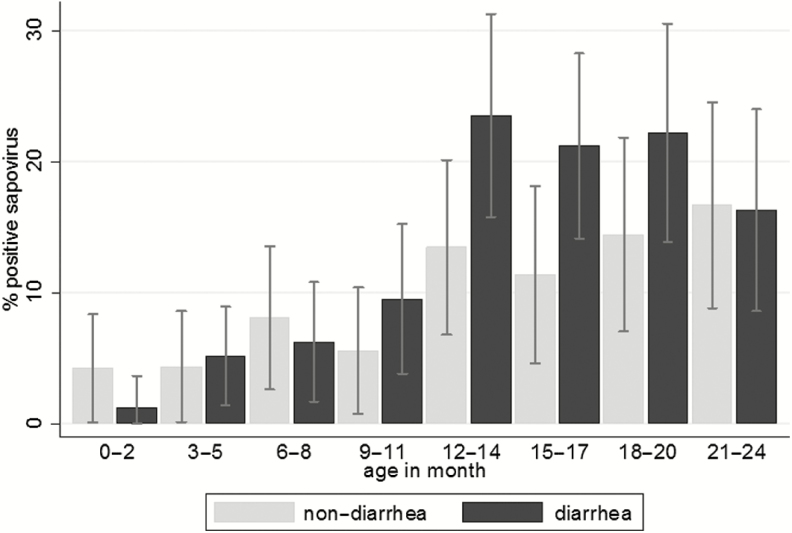
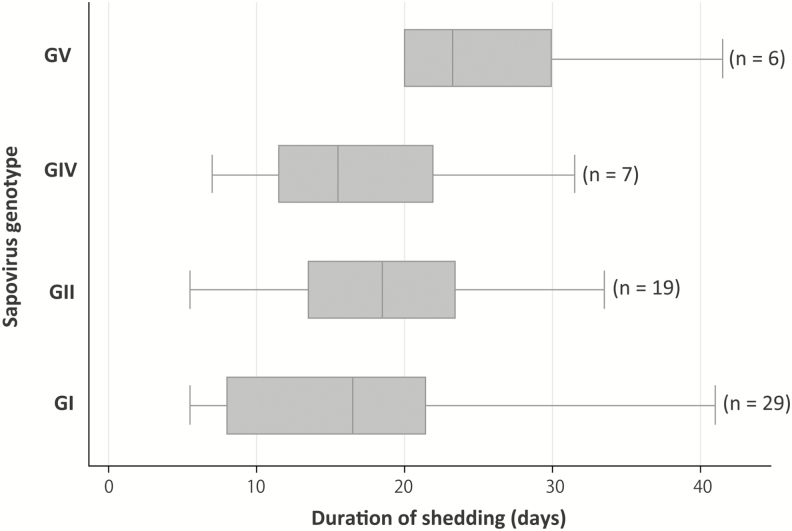
The incidence of sapovirus infection in the first and second years of life was 4.3 and 11.1 per 100 child-months, respectively. By age 2 years, 82% of children had at least 1 sapovirus infection, and 64% had at least 1 sapovirus-associated diarrhea episode. The median shedding period was 18.5 days. In 112 of 175 infections, 14 genotypes from 4 genogroups (GI, GII, GIV, and GV) were determined. Among genogroups, GI were more frequently found in symptomatic infections than in asymptomatic infections (odds ratio, 3.1; 95% confidence interval, 1.3-7.4). Fifty-nine children had serial sapovirus infections, but only 3 had repeated infection of the same genotype.
Sapovirus was frequently detected in children with AGE at the community level during the first 2 years of life. Serial sapovirus infections by multiple genotypes in a child suggest genotype-specific immunity from each infection, which needs to be taken into account for vaccine development.
肠病毒是急性肠胃炎(AGE)的主要病毒病因之一,尤其是在轮状病毒疫苗接种实施后。然而,在社区层面上,自然感染的特征和影响尚未得到很好的记录。
从秘鲁一项基于社区的出生队列研究中随机选择的 100 名儿童的粪便样本进行分析。从 0 至 2 岁的儿童中每三个月收集一次腹泻和 1 次非腹泻粪便(n=1669),用于检测肠病毒。通过测试在肠病毒阳性样本之前和之后额外收集的每周样本(n=440)来确定病毒脱落持续时间。
在生命的头 2 年中,肠病毒感染的发病率分别为每 100 名儿童-月 4.3 和 11.1。到 2 岁时,82%的儿童至少有 1 次肠病毒感染,64%的儿童至少有 1 次肠病毒相关腹泻发作。中位脱落期为 18.5 天。在 175 次感染中的 112 次中,确定了 4 个基因群(GI、GII、GIV 和 GV)的 14 种基因型。在基因群中,GI 在有症状感染中比无症状感染中更为常见(比值比,3.1;95%置信区间,1.3-7.4)。59 名儿童有肠病毒的连续感染,但只有 3 名儿童重复感染同一基因型。
在生命的头 2 年中,在社区层面上经常在患有 AGE 的儿童中检测到肠病毒。儿童中由多种基因型引起的连续肠病毒感染表明每次感染都具有特定的基因型免疫力,这需要在疫苗开发中加以考虑。