Saito Mayuko, Goel-Apaza Sonia, Espetia Susan, Velasquez Daniel, Cabrera Lilia, Loli Sebastian, Crabtree Jean E, Black Robert E, Kosek Margaret, Checkley William, Zimic Mirko, Bern Caryn, Cama Vitaliano, Gilman Robert H
Laboratorios de Investigación y Desarrollo, Facultad de Ciencias y Filosofía, Universidad Peruana Cayetano Heredia, Lima, Peru.
Clin Infect Dis. 2014 Feb;58(4):483-91. doi: 10.1093/cid/cit763. Epub 2013 Dec 2.
Human noroviruses are among the most common enteropathogens globally, and are a leading cause of infant diarrhea in developing countries. However, data measuring the impact of norovirus at the community level are sparse.
We followed a birth cohort of children to estimate norovirus infection and diarrhea incidence in a Peruvian community. Stool samples from diarrheal episodes and randomly selected nondiarrheal samples were tested by polymerase chain reaction for norovirus genogroup and genotype. Excretion duration and rotavirus coinfection were evaluated in a subset of episodes.
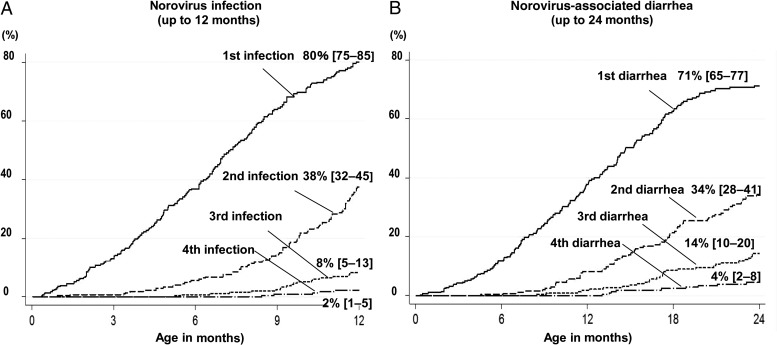
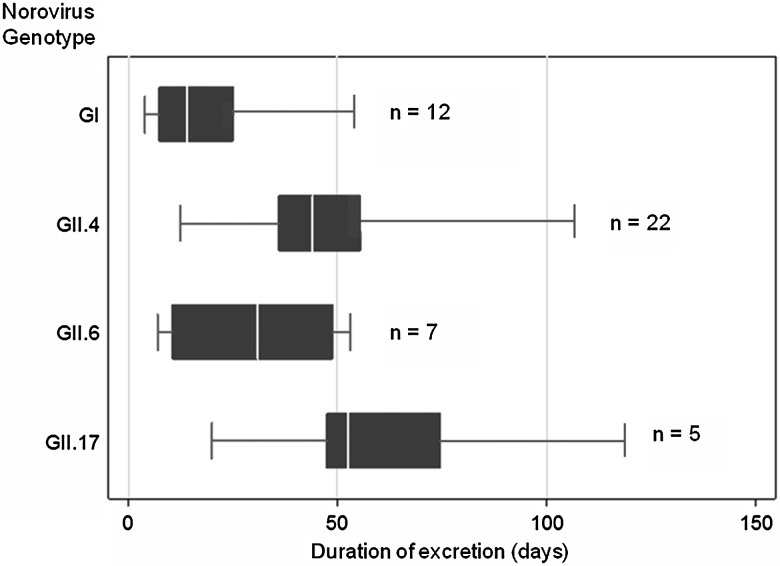
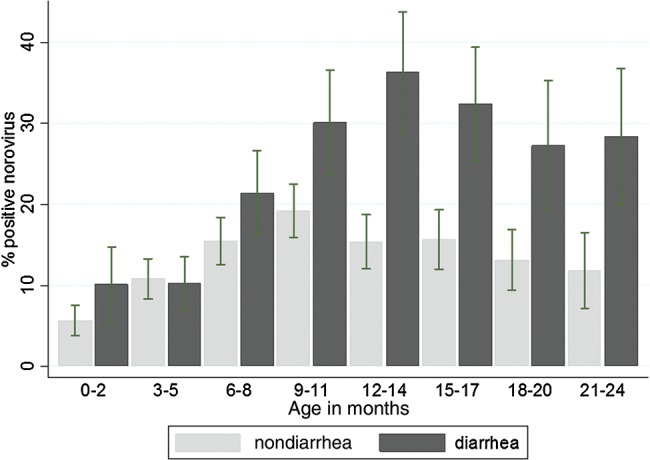
Two hundred twenty and 189 children were followed to 1 and 2 years of age, respectively. By 1 year, 80% (95% confidence interval [CI], 75%-85%) experienced at least 1 norovirus infection and by 2 years, 71% (95% CI, 65%-77%) had at least 1 episode of norovirus-associated diarrhea. Genogroup II (GII) infections were 3 times more frequent than genogroup 1 (GI) infections. Eighteen genotypes were found; GII genotype 4 accounted for 41%. Median excretion duration was 34.5 days for GII vs 8.5 days for GI infection (P = .0006). Repeat infections by the same genogroup were common, but repeat infections by the same genotype were rare. Mean length-for-age z score at 12 months was lower among children with prior norovirus infection compared to uninfected children (coefficient: -0.33 [95% CI, -.65 to -.01]; P = .04); the effect persisted at 24 months.
Norovirus infection occurs early in life and children experience serial infections with multiple genotypes, suggesting genotype-specific immunity. An effective vaccine would have a substantial impact on morbidity, but may need to target multiple genotypes.
人诺如病毒是全球最常见的肠道病原体之一,是发展中国家婴儿腹泻的主要原因。然而,衡量诺如病毒在社区层面影响的数据很少。
我们追踪了一个儿童出生队列,以估计秘鲁一个社区中诺如病毒感染和腹泻的发病率。对腹泻发作时采集的粪便样本以及随机选取的非腹泻样本进行聚合酶链反应检测,以确定诺如病毒基因组群和基因型。在一部分发作病例中评估病毒排泄持续时间和轮状病毒合并感染情况。
分别对220名和189名儿童追踪至1岁和2岁。到1岁时,80%(95%置信区间[CI],75%-85%)的儿童至少经历过1次诺如病毒感染,到2岁时,71%(95%CI,65%-77%)的儿童至少有1次诺如病毒相关腹泻发作。基因组群II(GII)感染的频率是基因组群I(GI)感染的3倍。共发现18种基因型;GII基因型4占41%。GII感染的病毒排泄持续时间中位数为34.5天,而GI感染为8.5天(P = .0006)。同一基因组群的重复感染很常见,但同一基因型的重复感染很少见。与未感染诺如病毒的儿童相比,既往有诺如病毒感染的儿童在12个月时的年龄别身长Z评分较低(系数:-0.33[95%CI,-.65至-.01];P = .04);这种影响在24个月时仍然存在。
诺如病毒感染在生命早期就会发生,儿童会经历多种基因型的连续感染,提示存在基因型特异性免疫。一种有效的疫苗将对发病率产生重大影响,但可能需要针对多种基因型。