Lee Banghyun, Kim Kidong, Choi Jin Young, Suh Dong Hoon, No Jae Hong, Lee Ho-Young, Eom Keun-Yong, Kim Haeryoung, Hwang Sung Il, Lee Hak Jong, Kim Yong Beom
Department of Obstetrics and Gynecology, Hallym University Kangdong Sacred Heart Hospital, Gangdong-gu, Seoul Department of Obstetrics and Gynecology Department of Nuclear Medicine Department of Radiation Oncology Department of Pathology Department of Radiology, Seoul National University Bundang Hospital, Bundang-gu, Seongnam-si, Gyeonggi-do College of Medicine, Seoul National University, Jongno-gu, Seoul, Republic of Korea.
Medicine (Baltimore). 2017 Dec;96(48):e8089. doi: 10.1097/MD.0000000000008089.
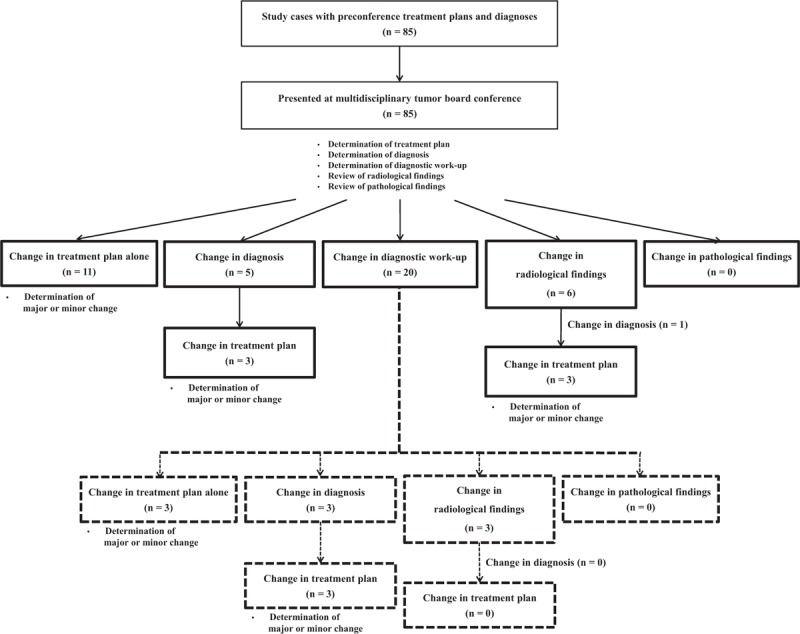
Evidence has shown that multidisciplinary tumor board conferences (MTBCs) improve patient management for various cancer types. However, few retrospective studies have investigated MTBC efficacy for patients with gynecologic cancers. Here, we prospectively aimed to evaluate how MTBCs influence patient management in gynecologic oncology. This prospective study included 85 consecutive cases that were presented at gynecologic oncology MTBCs in our tertiary university hospital between January 2015 and April 2016. The primary endpoint was treatment plan change rate, which included both major and minor changes. Major changes were defined as exchange, addition, or subtraction of treatment modality. Minor changes included all other, such as intramodality changes or treatment time changes. The secondary endpoints were the change rates of diagnosis, diagnostic work-up, and radiological and pathological findings.The treatment plan change rate, irrespective of changes in diagnostic work-up, was 27.1%, which included 10.6% major and 16.5% minor changes. Among the treatment plan changes, changes in the treatment plan change rate alone were noted in 16.5% of cases, and changes in diagnosis and radiological findings occurred in 7.1% and 3.5% of cases, respectively. Diagnosis and radiological findings, irrespective of changes in diagnostic work-up, were also changed in 9.4% and 10.6% of cases, respectively. However, there were no changes in pathological findings. Moreover, there was a change of diagnostic method for further work-up in 23.5% of cases. The implementation rate of MTBC-determined treatment changes was 91.8%. Gynecologic oncology MTBCs resulted in considerable changes in treatment plans. Diagnosis, diagnostic work-up, and radiological findings were influenced by MTBCs. The data emphasize the importance of adopting a multidisciplinary team approach for gynecologic cancer management.
有证据表明,多学科肿瘤病例讨论会(MTBCs)可改善各种癌症类型患者的管理。然而,很少有回顾性研究调查MTBCs对妇科癌症患者的疗效。在此,我们前瞻性地旨在评估MTBCs如何影响妇科肿瘤学中患者的管理。这项前瞻性研究纳入了2015年1月至2016年4月期间在我们的三级大学医院妇科肿瘤MTBCs上呈现的85例连续病例。主要终点是治疗计划改变率,包括主要和次要改变。主要改变定义为治疗方式的更换、增加或减少。次要改变包括所有其他情况,如模式内改变或治疗时间改变。次要终点是诊断、诊断检查以及影像学和病理结果的改变率。无论诊断检查有无变化,治疗计划改变率为27.1%,其中主要改变为10.6%,次要改变为16.5%。在治疗计划改变中,仅治疗计划改变率发生变化的病例占16.5%,诊断和影像学结果改变的病例分别占7.1%和3.5%。无论诊断检查有无变化,诊断和影像学结果分别在9.4%和10.6%的病例中也发生了改变。然而,病理结果没有变化。此外,23.5%的病例在进一步检查中有诊断方法的改变。MTBC确定的治疗改变的实施率为91.8%。妇科肿瘤MTBCs导致治疗计划发生了相当大的改变。诊断、诊断检查以及影像学结果受到MTBCs的影响。这些数据强调了采用多学科团队方法进行妇科癌症管理的重要性。