2nd Department of Internal Medicine, Research Unit and Diabetes Center, Attikon University Hospital, National and Kapodistrian University of Athens, Medical School, Rimini 1, Haidari, 12462, Athens, Greece.
2nd Cardiology Department, Attikon Hospital, National and Kapodistrian University of Athens, Medical School, Rimini 1 str, Haidari, 12462, Athens, Greece.
Cardiovasc Diabetol. 2018 Jan 8;17(1):8. doi: 10.1186/s12933-017-0646-z.
Incretin-based therapies are used in the treatment of type 2 diabetes mellitus (T2DM) and obesity. We investigated the changes in arterial stiffness and left ventricular (LV) myocardial deformation after 6-month treatment with the GLP-1 analogue liraglutide in subjects with newly diagnosed T2DM.
We randomized 60 patients with newly diagnosed and treatment-naive T2DM to receive either liraglutide (n = 30) or metformin (n = 30) for 6 months. We measured at baseline and after 6-month treatment: (a) carotid-femoral pulse wave velocity (PWV) (b) LV longitudinal strain (GLS), and strain rate (GLSR), peak twisting (pTw), peak twisting velocity (pTwVel) and peak untwisting velocity (pUtwVel) using speckle tracking echocardiography. LV untwisting was calculated as the percentage difference between peak twisting and untwisting at MVO (%dpTw-Utw), at peak (%dpTw-Utw) and end of early LV diastolic filling (%dpTw-Utw) (c) Flow mediated dilatation (FMD) of the brachial artery and percentage difference of FMD (FMD%) (d) malondialdehyde (MDA), protein carbonyls (PCs) and NT-proBNP.
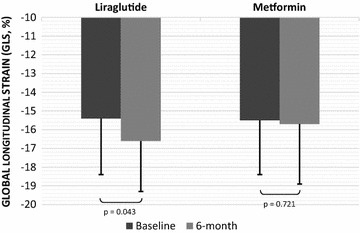
After 6-months treatment, subjects that received liraglutide presented with a reduced PWV (11.8 ± 2.5 vs. 10.3 ± 3.3 m/s), MDA (0.92 [0.45-2.45] vs. 0.68 [0.43-2.08] nM/L) and NT-proBNP (p < 0.05) in parallel with an increase in GLS (- 15.4 ± 3 vs. - 16.6 ± 2.7), GLSR (0.77 ± 0.2 vs. 0.89 ± 0.2), pUtwVel (- 97 ± 49 vs. - 112 ± 52°, p < 0.05), %dpTw-Utw (31 ± 10 vs. 40 ± 14), %dpTw-Utw (43 ± 19 vs. 53 ± 22) and FMD% (8.9 ± 3 vs. 13.2 ± 6, p < 0.01). There were no statistically significant differences of the measured markers in subjects that received metformin except for an improvement in FMD. In all subjects, PCs levels at baseline were negatively related to the difference of GLS (r = - 0.53) post-treatment and the difference of MDA was associated with the difference of PWV (r = 0.52) (p < 0.05 for all associations) after 6-month treatment.
Six-month treatment with liraglutide improves arterial stiffness, LV myocardial strain, LV twisting and untwisting and NT-proBNP by reducing oxidative stress in subjects with newly diagnosed T2DM. ClinicalTrials.gov Identifier NCT03010683.
肠降血糖素类似物利拉鲁肽被用于治疗 2 型糖尿病(T2DM)和肥胖症。我们研究了新诊断的 T2DM 患者接受利拉鲁肽治疗 6 个月后,其动脉僵硬度和左心室(LV)心肌变形的变化。
我们将 60 例新诊断且未经治疗的 T2DM 患者随机分为利拉鲁肽(n=30)或二甲双胍(n=30)组,分别接受治疗 6 个月。我们在基线和 6 个月治疗后测量:(a)颈股脉搏波速度(PWV);(b)LV 纵向应变(GLS)和应变率(GLSR)、峰值扭转(pTw)、峰值扭转速度(pTwVel)和峰值解旋速度(pUtwVel),使用斑点追踪超声心动图;LV 解旋通过峰值扭转和解旋之间的百分比差异(%dpTw-Utw)计算,包括 MVO 时(%dpTw-Utw)、早期 LV 舒张末期(%dpTw-Utw);(c)肱动脉血流介导的扩张(FMD)和 FMD 的百分比差异(FMD%);(d)丙二醛(MDA)、蛋白羰基(PCs)和 N 末端 pro-B 型利钠肽(NT-proBNP)。
接受利拉鲁肽治疗 6 个月后,患者的 PWV(11.8±2.5 比 10.3±3.3 m/s)、MDA(0.92[0.45-2.45]比 0.68[0.43-2.08]nM/L)和 NT-proBNP(p<0.05)降低,同时 GLS(-15.4±3 比-16.6±2.7)、GLSR(0.77±0.2 比 0.89±0.2)、pUtwVel(-97±49 比-112±52°,p<0.05)、%dpTw-Utw(31±10 比 40±14)、%dpTw-Utw(43±19 比 53±22)和 FMD%(8.9±3 比 13.2±6)增加(p<0.01)。接受二甲双胍治疗的患者中,除 FMD 改善外,其他测量标志物的水平均无统计学差异。在所有患者中,基线时的 PCs 水平与治疗后 GLS 的差异呈负相关(r=-0.53),治疗后 MDA 的差异与 PWV 的差异呈正相关(r=0.52)(所有关联均 p<0.05)。
新诊断的 T2DM 患者接受利拉鲁肽治疗 6 个月可降低氧化应激,改善动脉僵硬度、LV 心肌应变、LV 扭转和解旋以及 NT-proBNP。临床试验注册号 NCT03010683。