Centre for Cognitive Ageing and Cognitive Epidemiology, University of Edinburgh, Edinburgh, UK.
Centre for Genomic and Experimental Medicine, Institute of Genetics and Molecular Medicine, University of Edinburgh, Edinburgh, UK.
Mol Psychiatry. 2018 Nov;23(11):2133-2144. doi: 10.1038/s41380-017-0008-y. Epub 2018 Jan 8.
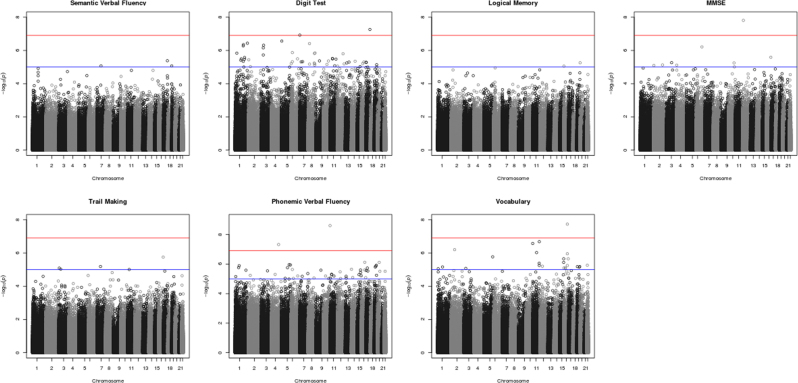
Cognitive functions are important correlates of health outcomes across the life-course. Individual differences in cognitive functions are partly heritable. Epigenetic modifications, such as DNA methylation, are susceptible to both genetic and environmental factors and may provide insights into individual differences in cognitive functions. Epigenome-wide meta-analyses for blood-based DNA methylation levels at 420,000 CpG sites were performed for seven measures of cognitive functioning using data from 11 cohorts. CpGs that passed a Bonferroni correction, adjusting for the number of CpGs and cognitive tests, were assessed for: longitudinal change; being under genetic control (methylation QTLs); and associations with brain health (structural MRI), brain methylation and Alzheimer's disease pathology. Across the seven measures of cognitive functioning (meta-analysis n range: 2557-6809), there were epigenome-wide significant (P < 1.7 × 10) associations for global cognitive function (cg21450381, P = 1.6 × 10), and phonemic verbal fluency (cg12507869, P = 2.5 × 10). The CpGs are located in an intergenic region on chromosome 12 and the INPP5A gene on chromosome 10, respectively. Both probes have moderate correlations (0.4) with brain methylation in Brodmann area 20 (ventral temporal cortex). Neither probe showed evidence of longitudinal change in late-life or associations with white matter brain MRI measures in one cohort with these data. A methylation QTL analysis suggested that rs113565688 was a cis methylation QTL for cg12507869 (P = 5 × 10 and 4 × 10 in two lookup cohorts). We demonstrate a link between blood-based DNA methylation and measures of phonemic verbal fluency and global cognitive ability. Further research is warranted to understand the mechanisms linking genomic regulatory changes with cognitive function to health and disease.
认知功能是整个生命周期中健康结果的重要相关因素。认知功能的个体差异部分是遗传的。表观遗传修饰,如 DNA 甲基化,易受遗传和环境因素的影响,可能为认知功能的个体差异提供见解。使用来自 11 个队列的数据,对 7 种认知功能测量的血液中基于 DNA 的甲基化水平进行了全基因组元分析,共涉及 420,000 个 CpG 位点。通过 Bonferroni 校正,对通过校正 CpG 数量和认知测试的 420,000 个 CpG 进行了以下评估:纵向变化;受遗传控制(甲基化 QTL);与大脑健康(结构 MRI)、大脑甲基化和阿尔茨海默病病理的关联。在七种认知功能测量(元分析 n 范围:2557-6809)中,整体认知功能(cg21450381,P = 1.6×10)和音素言语流畅性(cg12507869,P = 2.5×10)存在全基因组显著关联(P<1.7×10)。CpG 分别位于 12 号染色体的基因间区域和 10 号染色体的 INPP5A 基因上。这两个探针与 Brodmann 区 20(腹侧颞叶皮层)的大脑甲基化具有中度相关性(~0.4)。在具有这些数据的一个队列中,这两个探针都没有在晚年出现纵向变化的证据,也没有与白质脑 MRI 测量值相关的证据。甲基化 QTL 分析表明,rs113565688 是 cg12507869 的顺式甲基化 QTL(在两个查找队列中 P = 5×10 和 4×10)。我们证明了血液中基于 DNA 的甲基化与音素言语流畅性和整体认知能力测量值之间存在联系。需要进一步的研究来了解基因组调节变化与认知功能与健康和疾病之间的联系的机制。