Scarante Franciele F, Vila-Verde Carla, Detoni Vinícius L, Ferreira-Junior Nilson C, Guimarães Francisco S, Campos Alline C
Department of Pharmacology, School of Medicine of Ribeirão Preto, Centre for Interdisciplinary Research on Applied Neurosciences (NAPNA), Cannabinoid Research Institute, University of São Paulo, São Paulo, Brazil.
Front Mol Neurosci. 2017 Dec 19;10:411. doi: 10.3389/fnmol.2017.00411. eCollection 2017.
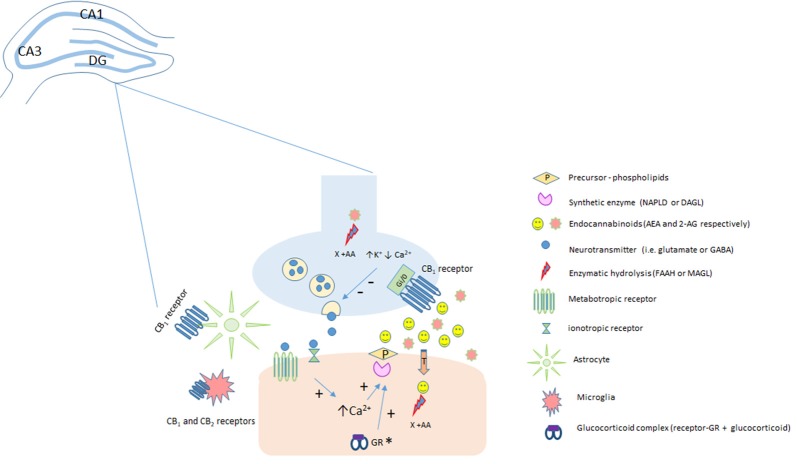
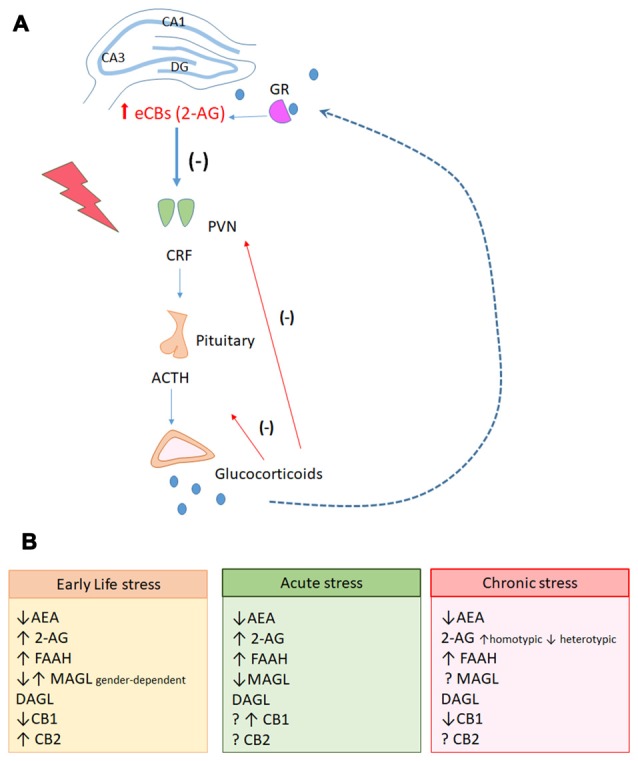
Exposure to stressful situations is one of the risk factors for the precipitation of several psychiatric disorders, including Major Depressive Disorder, Posttraumatic Stress Disorder and Schizophrenia. The hippocampal formation is a forebrain structure highly associated with emotional, learning and memory processes; being particularly vulnerable to stress. Exposure to stressful stimuli leads to neuroplastic changes and imbalance between inhibitory/excitatory networks. These changes have been associated with an impaired hippocampal function. Endocannabinoids (eCB) are one of the main systems controlling both excitatory and inhibitory neurotransmission, as well as neuroplasticity within the hippocampus. Cannabinoids receptors are highly expressed in the hippocampus, and several lines of evidence suggest that facilitation of cannabinoid signaling within this brain region prevents stress-induced behavioral changes. Also, chronic stress modulates hippocampal CB receptors expression and endocannabinoid levels. Moreover, cannabinoids participate in mechanisms related to synaptic plasticity and adult neurogenesis. Here, we discussed the main findings supporting the involvement of hippocampal cannabinoid neurotransmission in stress-induced behavioral and neuroplastic changes.
暴露于应激状态是引发多种精神疾病的危险因素之一,这些疾病包括重度抑郁症、创伤后应激障碍和精神分裂症。海马结构是一种与情绪、学习和记忆过程高度相关的前脑结构;特别容易受到应激的影响。暴露于应激刺激会导致神经可塑性变化以及抑制性/兴奋性网络之间的失衡。这些变化与海马功能受损有关。内源性大麻素(eCB)是控制海马体内兴奋性和抑制性神经传递以及神经可塑性的主要系统之一。大麻素受体在海马中高度表达,并且有几条证据表明,促进该脑区内的大麻素信号传导可预防应激诱导的行为变化。此外,慢性应激会调节海马CB受体的表达和内源性大麻素水平。而且,大麻素参与与突触可塑性和成年神经发生相关的机制。在此,我们讨论了支持海马大麻素神经传递参与应激诱导的行为和神经可塑性变化的主要发现。