Bauch Eva M, Andreou Christina, Rausch Vanessa H, Bunzeck Nico
Department of Systems Neuroscience, University Medical Center Hamburg-Eppendorf, Hamburg, Germany.
Medical School Hamburg (MSH), University of Applied Science and Medical University, Hamburg, Germany.
Front Hum Neurosci. 2017 Dec 21;11:630. doi: 10.3389/fnhum.2017.00630. eCollection 2017.
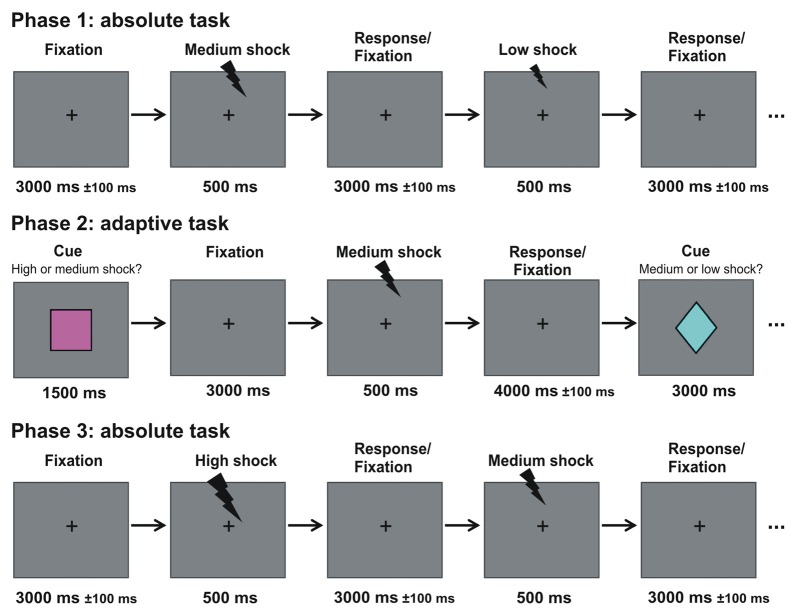
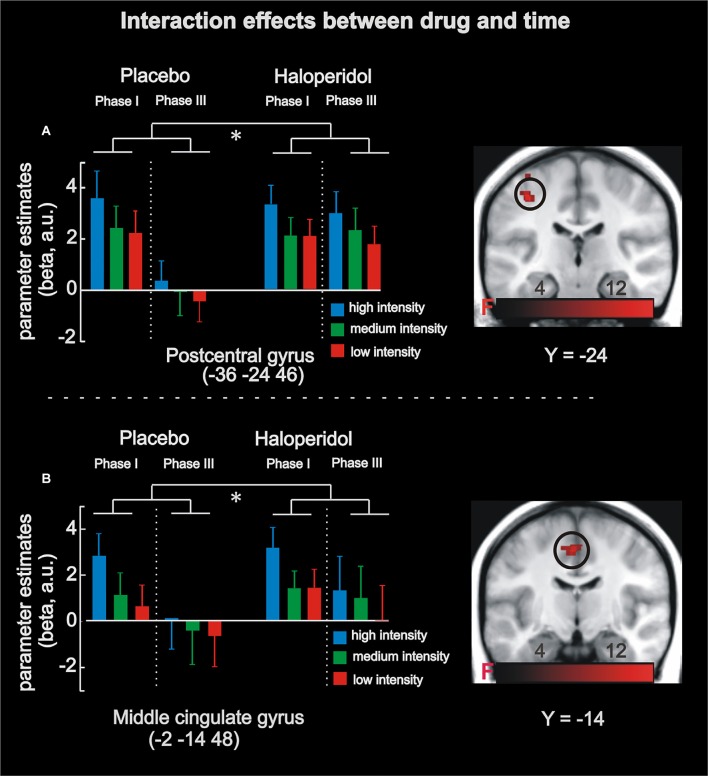
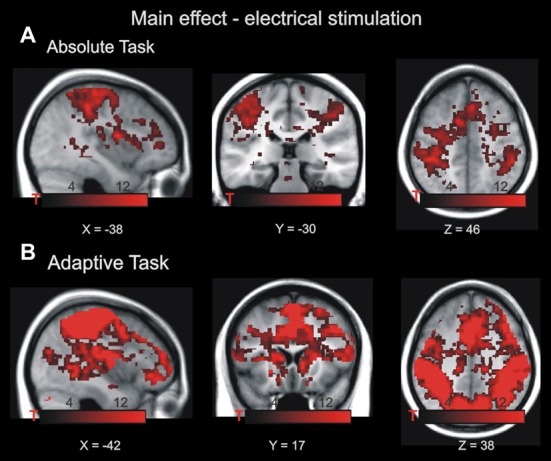
In constantly changing environments, it is crucial to adaptively respond to threatening events. In particular, painful stimuli are not only processed in terms of their absolute intensity, but also with respect to their context. While contextual pain processing can simply entail the repeated processing of information (i.e., habituation), it can, in a more complex form, be expressed through predictions of magnitude before the delivery of nociceptive information (i.e., adaptive coding). Here, we investigated the brain regions involved in the adaptation to nociceptive electrical stimulation as well as their link to dopaminergic neurotransmission (placebo/haloperidol). The main finding is that haloperidol changed the habituation to the absolute pain intensity over time. More precisely, in the placebo condition, activity in left postcentral gyrus and midcingulate cortex increased linearly with pain intensity only in the beginning of the experiment and subsequently habituated. In contrast, when the dopaminergic system was blocked by haloperidol, a linear increase with pain intensity was present throughout the entire experiment. Finally, there were no adaptive coding effects in any brain regions. Together, our findings provide novel insights into the nature of pain processing by suggesting that dopaminergic neurotransmission plays a specific role for the habituation to painful stimuli over time.
在不断变化的环境中,适应性应对威胁性事件至关重要。特别是,疼痛刺激不仅根据其绝对强度进行处理,还会考虑其背景。虽然情境性疼痛处理可能仅仅涉及信息的重复处理(即习惯化),但它也可以以更复杂的形式,通过在伤害性信息传递之前对强度的预测来表达(即适应性编码)。在这里,我们研究了参与适应伤害性电刺激的脑区及其与多巴胺能神经传递(安慰剂/氟哌啶醇)的联系。主要发现是,氟哌啶醇随着时间的推移改变了对绝对疼痛强度的习惯化。更确切地说,在安慰剂条件下,仅在实验开始时,左中央后回和扣带中部皮质的活动随疼痛强度呈线性增加,随后出现习惯化。相比之下,当多巴胺能系统被氟哌啶醇阻断时,在整个实验过程中,活动随疼痛强度呈线性增加。最后,在任何脑区都没有适应性编码效应。总之,我们的研究结果通过表明多巴胺能神经传递在随着时间的推移对疼痛刺激的习惯化中起特定作用,为疼痛处理的本质提供了新见解。