Lin Min-Jie, Dai Wen, Scott Melanie J, Li Rong, Zhang Yi-Qi, Yang Yang, Chen Lu-Zhu, Huang Xian-Sheng
Clinical Skills Training Center, The Second Xiangya Hospital, Central South University, Changsha, Hunan, 410011, China.
Department of Cardiovascular Medicine, The Second Xiangya Hospital, Central South University, Changsha, Hunan, 410011, China.
Oncotarget. 2017 Oct 30;8(65):108802-108809. doi: 10.18632/oncotarget.22163. eCollection 2017 Dec 12.
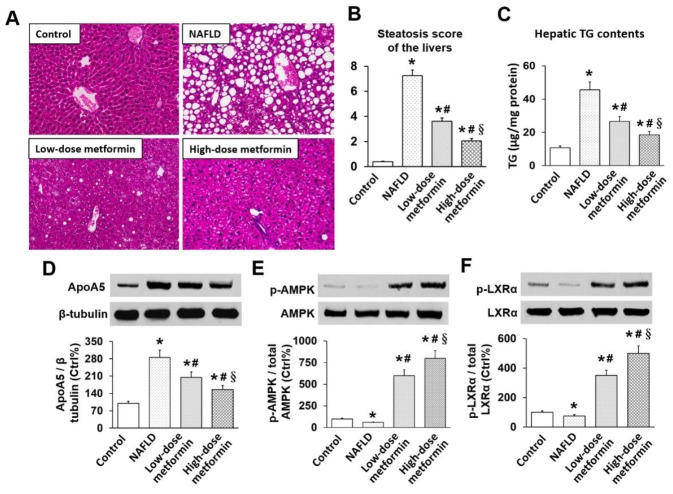
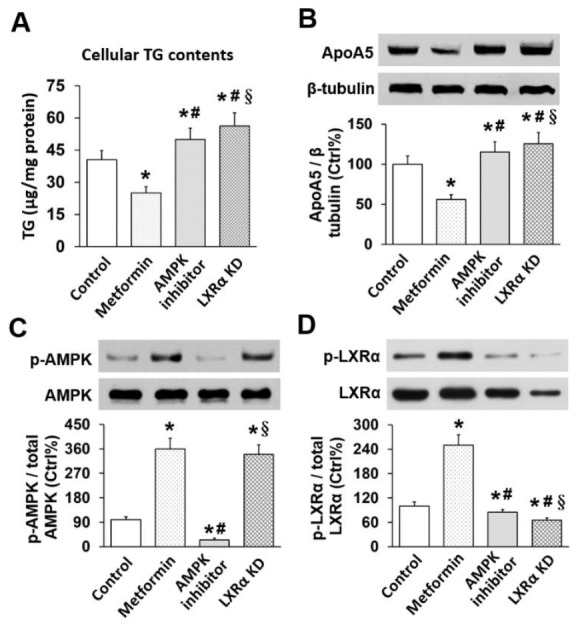
Apolipoprotein A5 (apoA5) has been implicated in the formation of hepatocyte lipid droplets, a histological hallmark of non-alcoholic fatty liver disease (NAFLD). Recent evidence demonstrated that liver X receptor α (LXRα), a transcription factor involved in down-regulation of mRNA, is activated by AMP-activated protein kinase (AMPK) that contributes to metformin-related antihyperglycemic effects. In this study we investigated the role of apoA5 and AMPK/LXRα signaling pathway in metformin-related improvement of NAFLD. Leptin-deficient () obese mice with NAFLD were treated with metformin, and signaling pathways were compared with non-metformin treated mice. Additionally, we determined cellular apoA5 and triglyceride (TG) levels in mouse hepatocytes and the effects of metformin, with or without an AMPK inhibitor or LXRα siRNA, on these levels. We found that metformin dose-dependently ameliorated hepatosteatosis and liver dysfunction in mice, with a significant reduction in hepatic apoA5 expression and TG level. Metformin also dose-dependently increased phosphorylation of hepatic AMPK and LXRα in mice. Similarly, metformin decreased apoA5 expression and TG level in mouse hepatocytes, with increased phosphorylation of cellular AMPK and LXRα. Addition of AMPK inhibitor or siRNA knockdown of LXRα significantly attenuated metformin-induced down-regulation of cellular apoA5 expression and TG level. AMPK inhibitor also significantly inhibited metformin-induced LXRα phosphorylation in these hepatocytes. Therefore, our findings indicate that metformin improves obesity-related NAFLD via inhibition of hepatic apoA5 synthesis as part of the AMPK/LXRα signaling pathway.
载脂蛋白A5(apoA5)与肝细胞脂质滴的形成有关,而脂质滴是非酒精性脂肪性肝病(NAFLD)的组织学特征。最近的证据表明,肝脏X受体α(LXRα)是一种参与mRNA下调的转录因子,它被AMP激活的蛋白激酶(AMPK)激活,而AMPK有助于二甲双胍的降糖作用。在本研究中,我们调查了apoA5和AMPK/LXRα信号通路在二甲双胍改善NAFLD中的作用。用二甲双胍治疗瘦素缺乏的肥胖NAFLD小鼠,并将其信号通路与未用二甲双胍治疗的小鼠进行比较。此外,我们测定了小鼠肝细胞中细胞apoA5和甘油三酯(TG)水平,以及有或没有AMPK抑制剂或LXRα siRNA的情况下二甲双胍对这些水平的影响。我们发现,二甲双胍剂量依赖性地改善了ob/ob小鼠的肝脂肪变性和肝功能障碍,肝apoA5表达和TG水平显著降低。二甲双胍还剂量依赖性地增加了ob/ob小鼠肝脏中AMPK和LXRα的磷酸化。同样地,二甲双胍降低了小鼠肝细胞中apoA5表达和TG水平,同时细胞AMPK和LXRα的磷酸化增加。添加AMPK抑制剂或LXRα的siRNA敲低显著减弱了二甲双胍诱导的细胞apoA5表达下调和TG水平降低。AMPK抑制剂也显著抑制了二甲双胍诱导的这些肝细胞中LXRα的磷酸化。因此,我们的研究结果表明,二甲双胍通过抑制肝脏apoA5合成作为AMPK/LXRα信号通路的一部分来改善肥胖相关的NAFLD。