Hagiwara Yoshihiko, Niimi Atsuko, Isono Mayu, Yamauchi Motohiro, Yasuhara Takaaki, Limsirichaikul Siripan, Oike Takahiro, Sato Hiro, Held Kathryn D, Nakano Takashi, Shibata Atsushi
Education and Research Support Center (ERSC), Gunma University, Maebashi 371-8511, Japan.
Department of Radiation Oncology, Gunma University Graduate School of Medicine, Maebashi 371-8511, Japan.
Oncotarget. 2017 Nov 25;8(65):109370-109381. doi: 10.18632/oncotarget.22679. eCollection 2017 Dec 12.
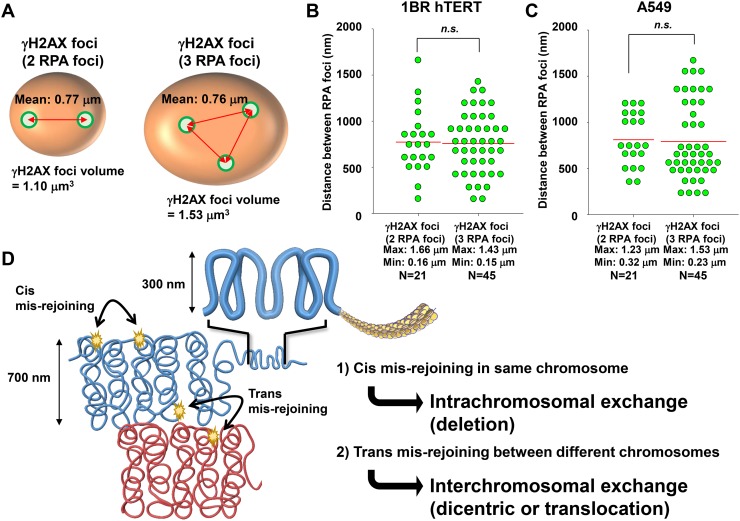
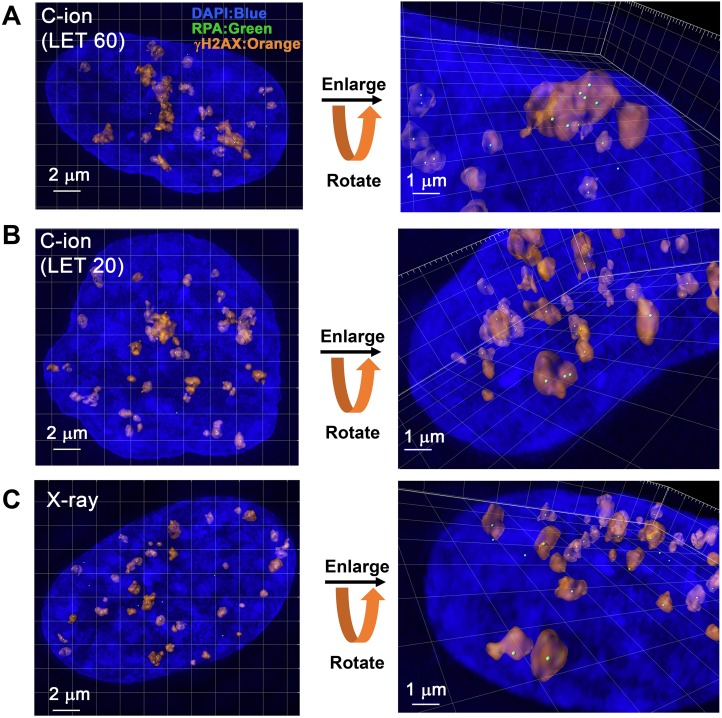
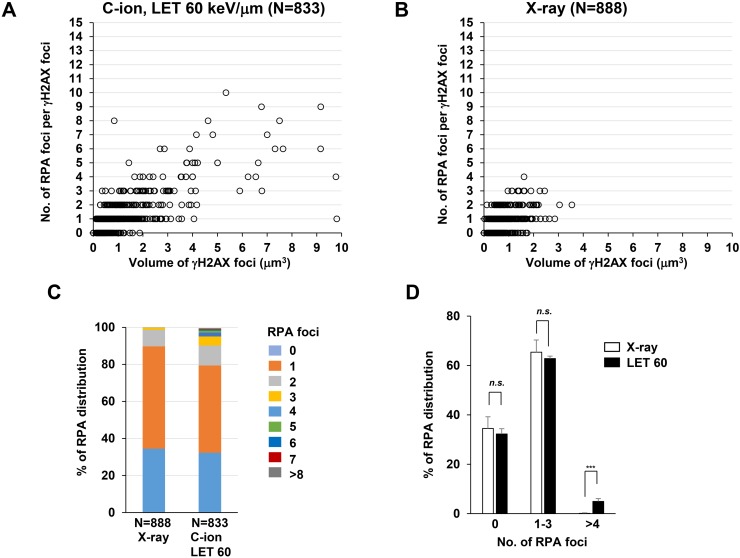
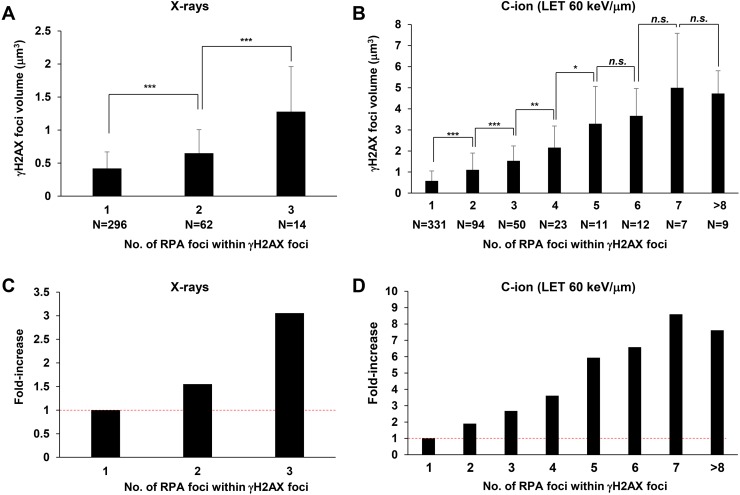
DNA double-strand breaks (DSBs) induced by ionising radiation are considered the major cause of genotoxic mutations and cell death. While DSBs are dispersed throughout chromatin after X-rays or γ-irradiation, multiple types of DNA damage including DSBs, single-strand breaks and base damage can be generated within 1-2 helical DNA turns, defined as a complex DNA lesion, after high Linear Energy Transfer (LET) particle irradiation. In addition to the formation of complex DNA lesions, recent evidence suggests that multiple DSBs can be closely generated along the tracks of high LET particle irradiation. Herein, by using three dimensional (3D)-structured illumination microscopy, we identified the formation of 3D widespread γH2AX foci after high LET carbon-ion irradiation. The large γH2AX foci in G-phase cells encompassed multiple foci of replication protein A (RPA), a marker of DSBs undergoing resection during homologous recombination. Furthermore, we demonstrated by 3D analysis that the distance between two individual RPA foci within γH2AX foci was approximately 700 nm. Together, our findings suggest that high LET heavy-ion particles induce clustered DSB formation on a scale of approximately 1 μm. These closely localised DSBs are considered to be a risk for the formation of chromosomal rearrangement after heavy-ion irradiation.
电离辐射诱导的DNA双链断裂(DSB)被认为是遗传毒性突变和细胞死亡的主要原因。虽然在X射线或γ射线照射后DSB分散在整个染色质中,但在高线性能量传递(LET)粒子照射后,在1-2个螺旋DNA匝内可产生包括DSB、单链断裂和碱基损伤在内的多种类型的DNA损伤,这被定义为复杂DNA损伤。除了复杂DNA损伤的形成外,最近的证据表明,沿着高LET粒子照射轨迹可紧密产生多个DSB。在此,通过使用三维(3D)结构光照显微镜,我们确定了高LET碳离子照射后3D广泛γH2AX焦点的形成。G期细胞中的大γH2AX焦点包含多个复制蛋白A(RPA)焦点,RPA是同源重组过程中正在进行切除的DSB的标志物。此外,我们通过3D分析证明,γH2AX焦点内两个单独的RPA焦点之间的距离约为700nm。总之,我们的研究结果表明,高LET重离子粒子在约1μm的尺度上诱导簇状DSB形成。这些紧密定位的DSB被认为是重离子照射后染色体重排形成的一个风险因素。