Qiao Zhiwei, Shiozawa Kumiko, Kondo Tadashi
Division of Rare Cancer Research, National Cancer Center Research Institute, Chuo-ku, Tokyo 104-0045, Japan.
Oncotarget. 2017 Nov 28;8(65):109587-109595. doi: 10.18632/oncotarget.22730. eCollection 2017 Dec 12.
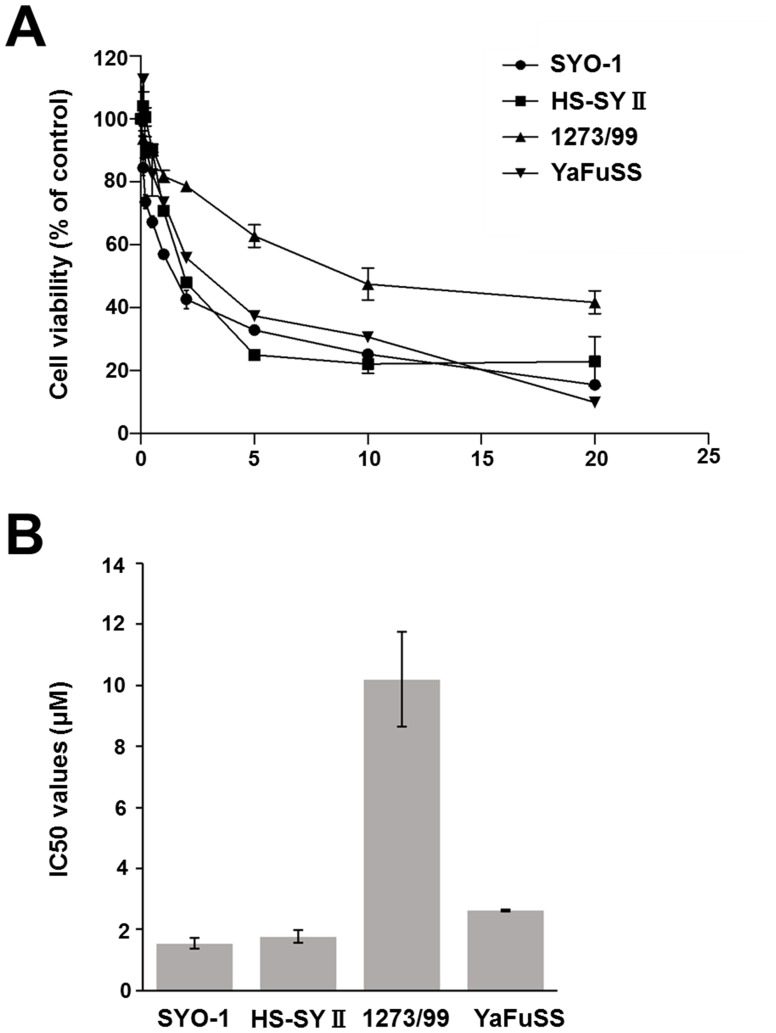
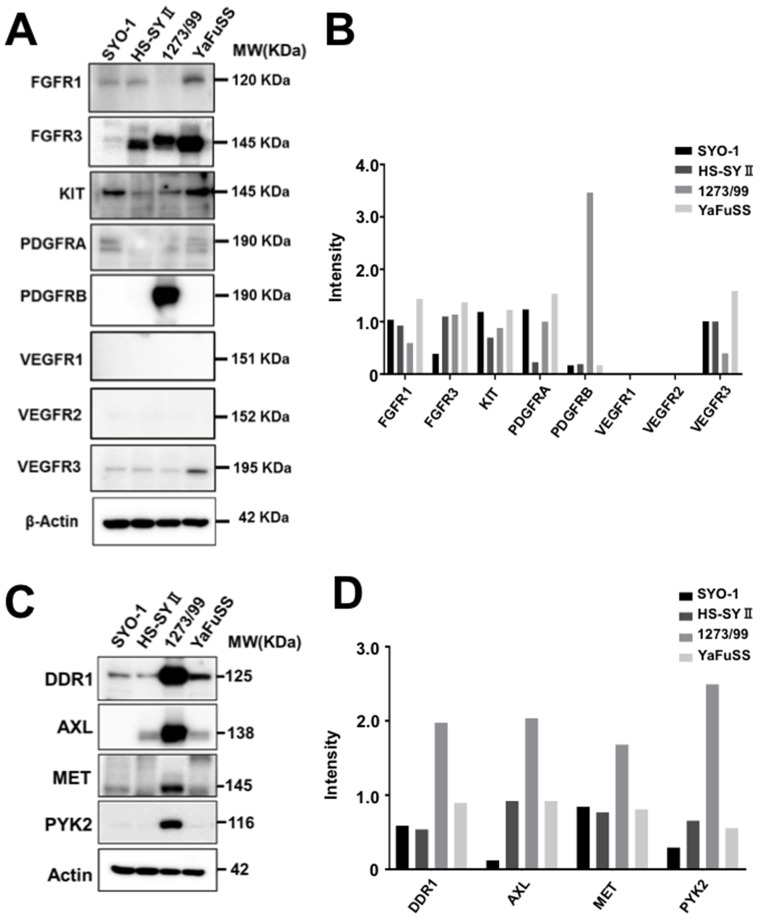
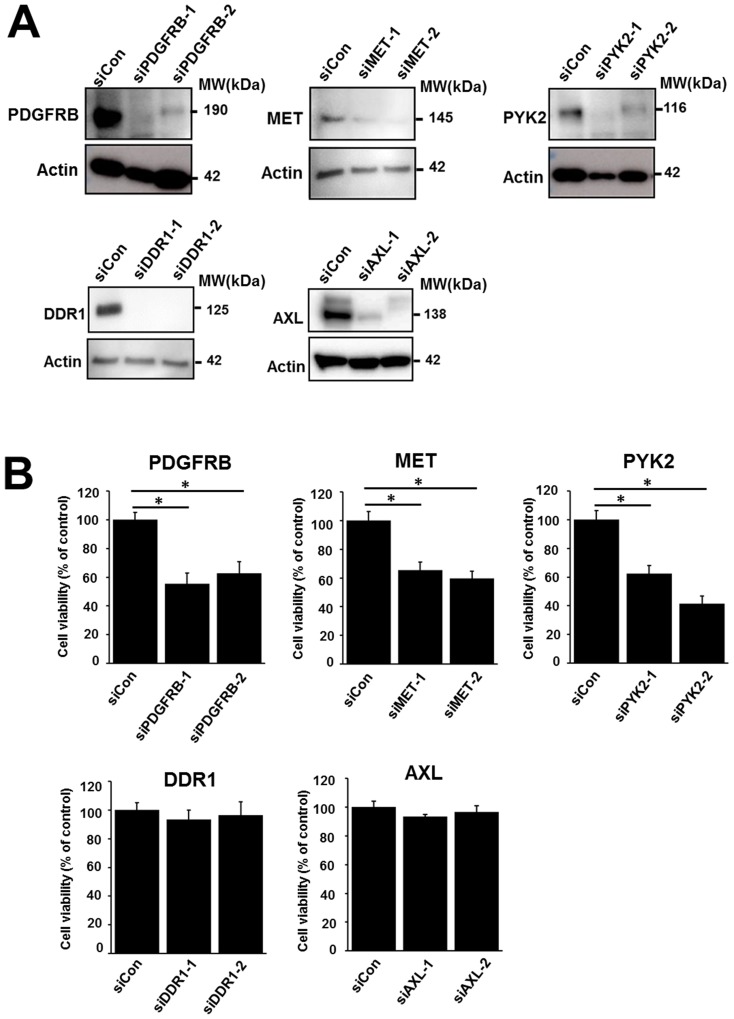
Pazopanib, a multitarget tyrosine kinase (TK) inhibitor, has been approved for treatment of soft tissue sarcoma. Elucidation of the molecular background of pazopanib resistance should lead to improved clinical outcomes in sarcomas; accordingly, we investigated this in synovial sarcoma using a proteomic approach. Pazopanib sensitivity was examined in four synovial sarcoma cell lines: SYO-1, HS-SYII, 1273/99, and YaFuSS. The 1273/99 cell line showed significantly higher IC values than the others for pazopanib. Expression levels of 90 TKs in the cell lines were examined by western blotting. Among these, the levels of PDGFRB, DDR1, AXL, MET, and PYK2 were higher, and those of FGFR1 and VEGFR3 were lower in the 1273/99 cell line than the other cell lines. Gene silencing analysis of the TKs upregulated in 1273/99 cells showed differing effects on cell growth: , and knockdown induced cell growth inhibition, whereas and knockdown did not influence cell growth. Using the PamChip peptide microarray, we found that 18 peptide substrates were highly phosphorylated in the 1273/99 cell line compared with other cell lines. Using the PhosphoNet database, we found that kinases FGFR3, RET, VEGFR1, EPHA2, EPHA4, TRKA, and SRC phosphorylated these 18 peptide substrates. Moreover, the results for overexpressed and aberrantly activated TKs in pazopanib-resistant cells showed no overlap. Taken together, our study indicates that identification of comprehensive TK profiles represents an essential approach to determining the molecular background of pazopanib resistance in synovial sarcoma.
帕唑帕尼是一种多靶点酪氨酸激酶(TK)抑制剂,已被批准用于治疗软组织肉瘤。阐明帕唑帕尼耐药的分子背景应能改善肉瘤的临床治疗效果;因此,我们采用蛋白质组学方法在滑膜肉瘤中对此进行了研究。在四种滑膜肉瘤细胞系中检测了帕唑帕尼敏感性:SYO-1、HS-SYII、1273/99和YaFuSS。1273/99细胞系对帕唑帕尼的IC值显著高于其他细胞系。通过蛋白质印迹法检测了细胞系中90种酪氨酸激酶的表达水平。其中,1273/99细胞系中血小板衍生生长因子受体β(PDGFRB)、盘状结构域受体1(DDR1)、AXL受体酪氨酸激酶(AXL)、肝细胞生长因子受体(MET)和脯氨酸酪氨酸激酶2(PYK2)的水平较高,而成纤维细胞生长因子受体1(FGFR1)和血管内皮生长因子受体3(VEGFR3)的水平低于其他细胞系。对1273/99细胞中上调的酪氨酸激酶进行基因沉默分析,结果显示对细胞生长的影响不同:PDGFRB、DDR1和AXL敲低诱导细胞生长抑制,而MET和PYK2敲低不影响细胞生长。使用PamChip肽微阵列,我们发现与其他细胞系相比,1273/99细胞系中有18种肽底物高度磷酸化。使用PhosphoNet数据库,我们发现激酶FGFR3、转染重排(RET)、VEGFR1、红细胞生成素受体A2(EPHA2)、红细胞生成素受体A4(EPHA4)、神经营养酪氨酸激酶受体1(TRKA)和原癌基因酪氨酸蛋白激酶(SRC)使这18种肽底物磷酸化。此外,帕唑帕尼耐药细胞中过表达和异常激活的酪氨酸激酶的结果没有重叠。综上所述,我们的研究表明,确定全面的酪氨酸激酶谱是确定滑膜肉瘤中帕唑帕尼耐药分子背景的重要方法。