Yasui Youichi, Ramponi Laura, Seow Dexter, Hurley Eoghan T, Miyamoto Wataru, Shimozono Yoshiharu, Kennedy John G
2 Department of Orthopaedic Surgery, Teikyo University School of Medicine, Tokyo 173-8606, Japan.
Hospital for Special Surgery, New York, NY 10021, United States.
World J Orthop. 2017 Dec 18;8(12):956-963. doi: 10.5312/wjo.v8.i12.956.
To clarify the quality of the studies indicating lesion size and/or containment as prognostic indicators of bone marrow stimulation (BMS) for osteochondral lesions of the talus (OLT).
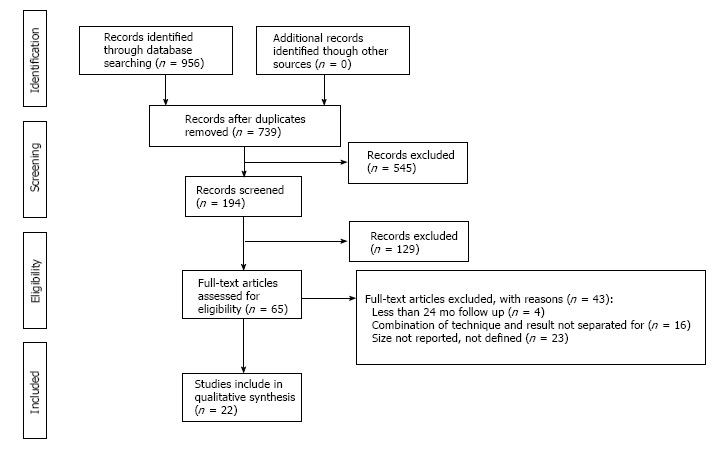
Two reviewers searched the PubMed/MEDLINE and EMBASE databases using specific terms on March 2015 in accordance with the Preferred Reporting Items for Systemic Reviews and Meta-Analyses guidelines. Predetermined variables were extracted for all the included studies. Level of evidence (LOE) was determined using previously published criteria by the Journal of Bone and Joint Surgery and methodological quality of evidence (MQOE) was evaluated using the Modified Coleman Methodology Score.
This review included 22 studies. Overall, 21 of the 22 (95.5%) included studies were level IV or level III evidences. The remaining study was a level II evidence. MQOE analysis revealed 14 of the 22 (63.6%) included studies having fair quality, 7 (31.8%) studies having poor quality and only 1 study having excellent quality.
The evidence supporting the use of lesion size and containment as prognostic indicators of BMS for OLTs has been shown to be of low quality.
阐明表明损伤大小和/或损伤范围作为距骨骨软骨损伤(OLT)骨髓刺激(BMS)预后指标的研究质量。
两名评价者按照系统评价和Meta分析的首选报告项目指南,于2015年3月使用特定术语检索了PubMed/MEDLINE和EMBASE数据库。为所有纳入研究提取预定变量。使用《骨与关节外科杂志》先前公布的标准确定证据等级(LOE),并使用改良的科尔曼方法评分评估证据的方法学质量(MQOE)。
本综述纳入22项研究。总体而言,22项纳入研究中的21项(95.5%)为IV级或III级证据。其余1项研究为II级证据。MQOE分析显示,22项纳入研究中有14项(63.6%)质量一般,7项(31.8%)质量较差,只有1项研究质量优秀。
支持将损伤大小和损伤范围作为OLT的BMS预后指标的证据质量较低。