Steman Jason A H, Dahmen Jari, Lambers Kaj T A, Kerkhoffs Gino M M J
Department of Orthopaedic Surgery, Academic Medical Center, University of Amsterdam, Amsterdam, the Netherlands.
Academic Center for Evidence-Based Sports Medicine, Amsterdam, the Netherlands.
Orthop J Sports Med. 2019 Oct 22;7(10):2325967119876238. doi: 10.1177/2325967119876238. eCollection 2019 Oct.
Osteochondral defects (OCDs) of the talus are found subsequent to ankle sprains and ankle fractures. With many surgical treatment strategies available, there is no clear evidence on return-to-sport (RTS) times and rates.
To summarize RTS times and rates for talar OCDs treated by different surgical techniques.
Systematic review; Level of evidence, 4.
The literature from January 1996 to November 2018 was screened, and identified studies were divided into 7 different surgical treatment groups. The RTS rate, with and without associated levels of activity, and the mean time to RTS were calculated per study. When methodologically possible, a simplified pooling method was used to combine studies within 1 treatment group. Study bias was assessed using the MINORS (Methodological Index for Non-Randomized Studies) scoring system.
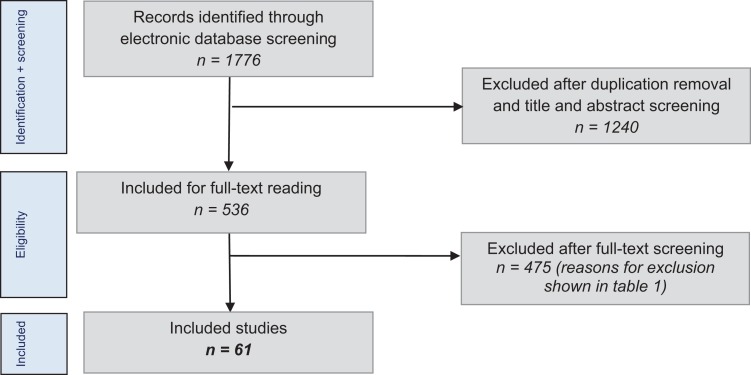
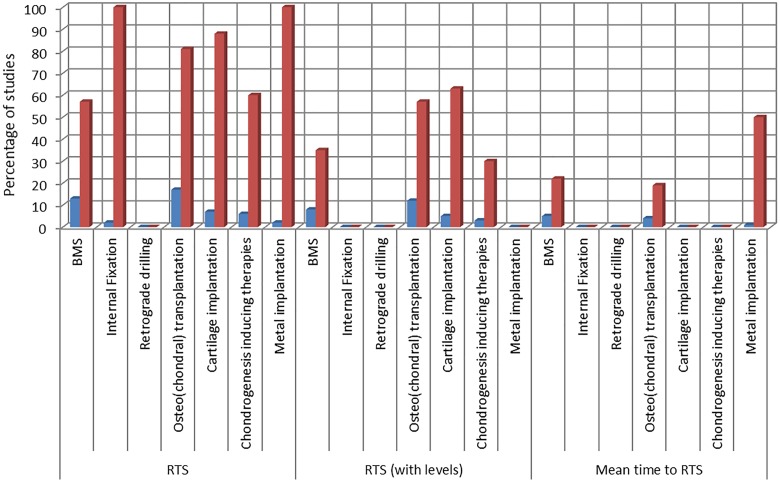
A total of 61 studies including 2347 talar OCDs were included. The methodological quality of the studies was poor. There were 10 retrospective case series (RCSs) that investigated bone marrow stimulation in 339 patients, with a pooled mean rate of RTS at any level of 88% (95% CI, 84%-91%); 2 RCSs investigating internal fixation in 47 patients found a pooled RTS rate of 97% (95% CI, 85%-99%), 5 RCSs in which autograft transplantation was performed in 194 patients found a pooled RTS rate of 90% (95% CI, 86%-94%), and 3 prospective case series on autologous chondrocyte implantation in 39 patients found a pooled RTS rate of 87% (95% CI, 73%-94%). The rate of return to preinjury level of sports was 79% (95% CI, 70%-85%) for 120 patients after bone marrow stimulation, 72% (95% CI, 60%-83%) for 67 patients after autograft transplantation, and 69% (95% CI, 54%-81%) for 39 patients after autologous chondrocyte implantation. The mean time to RTS ranged from 13 to 26 weeks, although no pooling was possible for this outcome measure.
Different surgical treatment options for talar OCDs allow for adequate RTS times and rates. RTS rates decreased when considering patients' return to preinjury levels versus return at any level.
距骨骨软骨损伤(OCDs)继发于踝关节扭伤和踝关节骨折之后。虽然有多种手术治疗策略可供选择,但关于恢复运动(RTS)时间和恢复率尚无明确证据。
总结采用不同手术技术治疗距骨OCDs后的RTS时间和恢复率。
系统评价;证据等级,4级。
筛选1996年1月至2018年11月的文献,将纳入的研究分为7个不同的手术治疗组。计算每项研究的RTS率(包括有无相关活动水平的情况)以及RTS的平均时间。在方法可行的情况下,采用简化合并方法对1个治疗组内的研究进行合并。使用MINORS(非随机研究方法学指数)评分系统评估研究偏倚。
共纳入61项研究,涉及2347例距骨OCDs。这些研究的方法学质量较差。有10项回顾性病例系列研究(RCSs)对339例患者进行了骨髓刺激研究,任何水平下的合并RTS平均率为88%(95%CI,84%-91%);2项RCSs对47例患者进行了内固定研究,合并RTS率为97%(95%CI,85%-99%),5项RCSs对194例患者进行了自体移植,合并RTS率为90%(95%CI,86%-94%),3项关于39例患者自体软骨细胞植入的前瞻性病例系列研究,合并RTS率为87%(95%CI,73%-94%)。骨髓刺激后120例患者恢复到伤前运动水平的比例为79%(95%CI,70%-85%),自体移植后67例患者为72%(95%CI,60%-83%),自体软骨细胞植入后39例患者为69%(95%CI,54%-81%)。RTS的平均时间为13至26周,不过该结局指标无法进行合并。
距骨OCDs的不同手术治疗方案可实现适当的RTS时间和恢复率。考虑患者恢复到伤前水平与任何水平的恢复情况时,RTS率会降低。