Human Dendritic Cell Lab, Institute of Cellular Medicine and NIHR Newcastle Biomedical Research Centre Newcastle upon Tyne Hospitals NHS Foundation Trust and Newcastle University, Newcastle upon Tyne, UK.
Immunology. 2018 May;154(1):3-20. doi: 10.1111/imm.12888. Epub 2018 Feb 27.
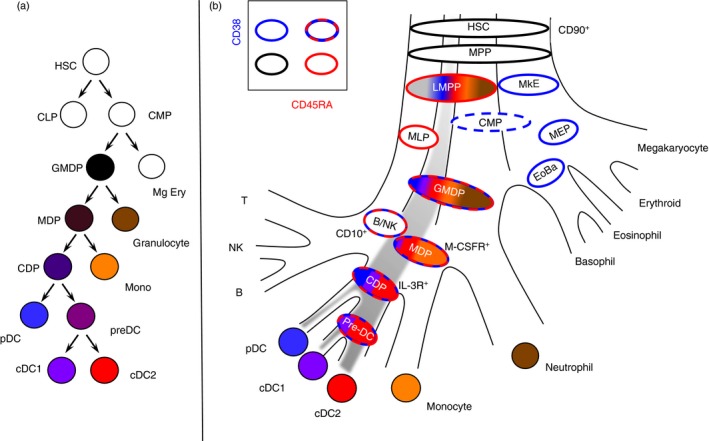
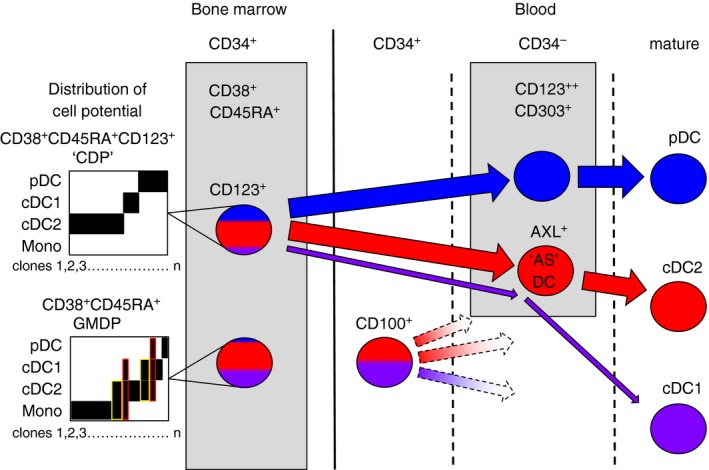
Dendritic cells (DC) are a class of bone-marrow-derived cells arising from lympho-myeloid haematopoiesis that form an essential interface between the innate sensing of pathogens and the activation of adaptive immunity. This task requires a wide range of mechanisms and responses, which are divided between three major DC subsets: plasmacytoid DC (pDC), myeloid/conventional DC1 (cDC1) and myeloid/conventional DC2 (cDC2). Each DC subset develops under the control of a specific repertoire of transcription factors involving differential levels of IRF8 and IRF4 in collaboration with PU.1, ID2, E2-2, ZEB2, KLF4, IKZF1 and BATF3. DC haematopoiesis is conserved between mammalian species and is distinct from monocyte development. Although monocytes can differentiate into DC, especially during inflammation, most quiescent tissues contain significant resident populations of DC lineage cells. An extended range of surface markers facilitates the identification of specific DC subsets although it remains difficult to dissociate cDC2 from monocyte-derived DC in some settings. Recent studies based on an increasing level of resolution of phenotype and gene expression have identified pre-DC in human blood and heterogeneity among cDC2. These advances facilitate the integration of mouse and human immunology, support efforts to unravel human DC function in vivo and continue to present new translational opportunities to medicine.
树突状细胞 (DC) 是一类起源于淋巴-髓样造血的骨髓细胞,在病原体的先天感应和适应性免疫的激活之间形成了一个重要的界面。这一任务需要广泛的机制和反应,这些机制和反应分为三个主要的 DC 子集:浆细胞样 DC (pDC)、髓系/经典 DC1 (cDC1) 和髓系/经典 DC2 (cDC2)。每个 DC 子集在涉及不同水平的 IRF8 和 IRF4 的特定转录因子谱的控制下发育,与 PU.1、ID2、E2-2、ZEB2、KLF4、IKZF1 和 BATF3 合作。哺乳动物物种之间的 DC 造血是保守的,与单核细胞发育不同。虽然单核细胞可以分化为 DC,特别是在炎症期间,但大多数静止组织中都含有大量的 DC 谱系细胞。尽管在某些情况下很难将 cDC2 与单核细胞衍生的 DC 区分开来,但广泛的表面标记有助于识别特定的 DC 子集。最近基于表型和基因表达分辨率不断提高的研究已经在人类血液中鉴定出前 DC,并鉴定出 cDC2 之间的异质性。这些进展促进了小鼠和人类免疫学的整合,支持了在体内阐明人类 DC 功能的努力,并继续为医学带来新的转化机会。