Arthur G. James Comprehensive Cancer Center Cancer Cachexia Program, The Ohio State University, Columbus, OH, 43210, USA.
Department of Cancer Biology and Genetics, The Ohio State University College of Medicine, Columbus, OH, 43210, USA.
J Cachexia Sarcopenia Muscle. 2018 Apr;9(2):358-368. doi: 10.1002/jcsm.12251. Epub 2018 Jan 7.
Cancer-associated wasting, termed cancer cachexia, has a profound effect on the morbidity and mortality of cancer patients but remains difficult to recognize and diagnose. While increases in circulating levels of a number of inflammatory cytokines have been associated with cancer cachexia, these associations were generally made in patients with advanced disease and thus may be associated with disease progression rather than directly with the cachexia syndrome. Thus, we sought to assess potential biomarkers of cancer-induced cachexia in patients with earlier stages of disease.
A custom multiplex array was used to measure circulating levels of 25 soluble factors from 70 pancreatic cancer patients undergoing attempted tumour resections. A high-sensitivity multiplex was used for increased sensitivity for nine cytokines.
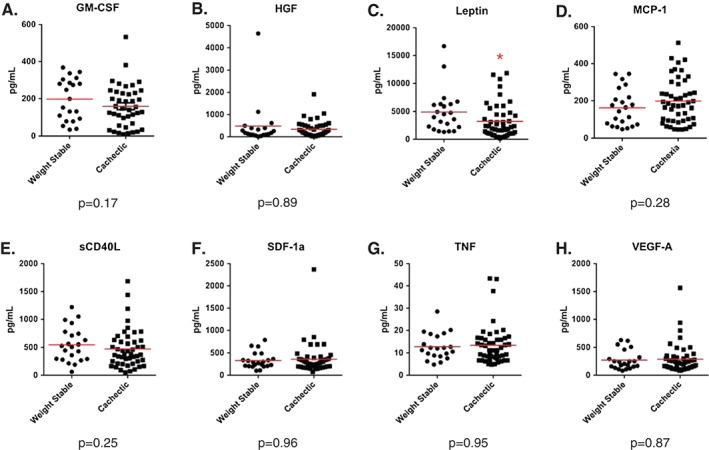
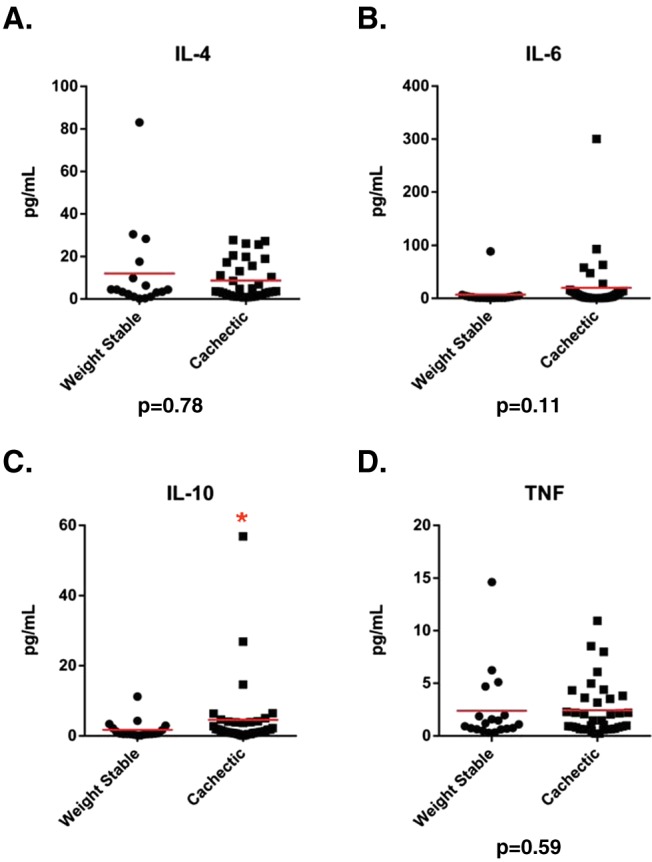
Resectable pancreatic cancer patients with cachexia had low levels of canonical pro-inflammatory cytokines including interleukin-6 (IL-6), interleukin-1β (IL-1β), interferon-γ (IFN-γ), and tumour necrosis factor (TNF). Even in our more sensitive analysis, these cytokines were not associated with cancer cachexia. Of the 25 circulating factors tested, only monocyte chemoattractant protein-1 (MCP-1) was increased in treatment-naïve cachectic patients compared with weight stable patients and identified as a potential biomarker for cancer cachexia. Although circulating levels of leptin and granulocyte-macrophage colony-stimulating factor (GM-CSF) were found to be decreased in the same cohort of treatment-naïve cachectic patients, these factors were closely associated with body mass index, limiting their utility as cancer cachexia biomarkers.
Unlike in advanced disease, it is possible that cachexia in patients with resectable pancreatic cancer is not associated with high levels of classical markers of systemic inflammation. However, cachectic, treatment-naïve patients have higher levels of MCP-1, suggesting that MCP-1 may be useful as a biomarker of cancer cachexia.
癌症相关消耗,又称癌症恶病质,对癌症患者的发病率和死亡率有深远影响,但仍难以识别和诊断。虽然许多循环炎症细胞因子水平的升高与癌症恶病质有关,但这些关联通常是在晚期疾病患者中做出的,因此可能与疾病进展有关,而不是直接与恶病质综合征有关。因此,我们试图在疾病早期阶段的患者中评估癌症引起恶病质的潜在生物标志物。
使用定制的多重分析来测量 70 名接受尝试肿瘤切除的胰腺癌患者的 25 种可溶性因子的循环水平。使用高灵敏度多重分析来提高对 9 种细胞因子的敏感性。
患有恶病质的可切除胰腺癌患者的典型促炎细胞因子(包括白细胞介素 6(IL-6)、白细胞介素 1β(IL-1β)、干扰素 γ(IFN-γ)和肿瘤坏死因子(TNF))水平较低。即使在我们更敏感的分析中,这些细胞因子也与癌症恶病质无关。在测试的 25 种循环因子中,仅单核细胞趋化蛋白 1(MCP-1)在未经治疗的恶病质患者中高于体重稳定的患者,并且被鉴定为癌症恶病质的潜在生物标志物。虽然在同一未经治疗的恶病质患者队列中发现循环瘦素和粒细胞-巨噬细胞集落刺激因子(GM-CSF)水平降低,但这些因子与体重指数密切相关,限制了它们作为癌症恶病质生物标志物的效用。
与晚期疾病不同,可切除胰腺癌患者的恶病质可能与高水平的全身性炎症经典标志物无关。然而,未经治疗的恶病质患者的 MCP-1 水平较高,这表明 MCP-1 可能是癌症恶病质的有用生物标志物。