Department of Neuropsychiatry, School of Medicine, Kurume University, Fukuoka 830-0011, Japan.
Radiation Medical Science Center for the Fukushima Health Management Survey, Fukushima 960-1295, Japan.
Int J Environ Res Public Health. 2018 Jan 6;15(1):82. doi: 10.3390/ijerph15010082.
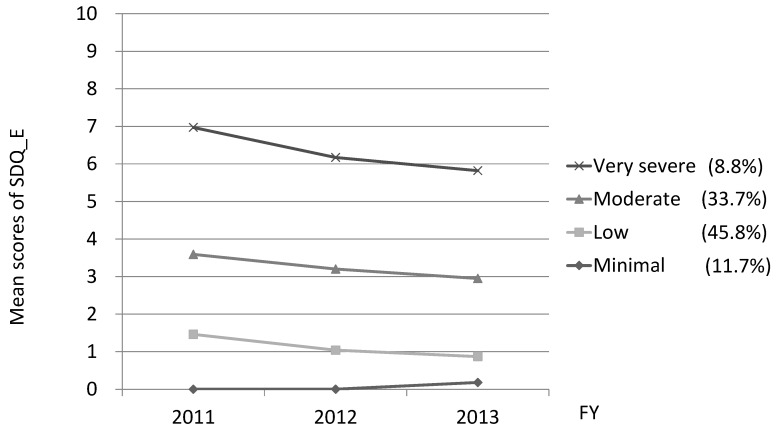
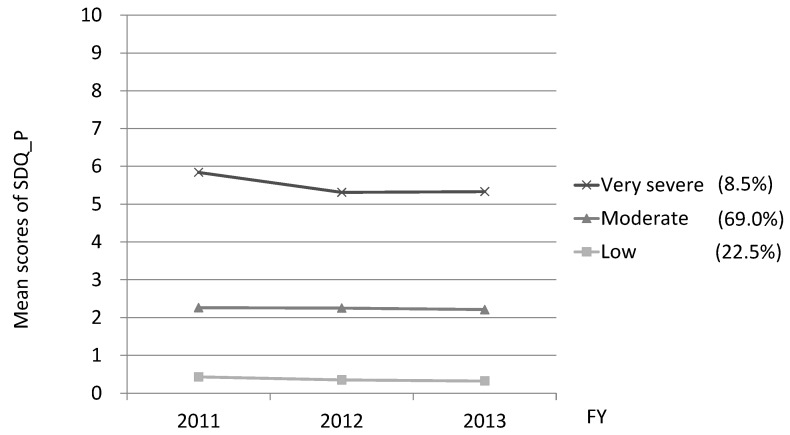
The Fukushima Daiichi Nuclear Power Plant accident, which occurred in March 2011, is having long-term effects on children. We planned this study to describe the trajectories of emotional symptoms and peer relationship problems in children and to examine potential risks and protective factors over the 35 months following the accident. The sample was 11,791 children in the first to sixth elementary grades. We identified four patterns for emotional symptoms and three patterns for peer relationship problems, using group-based trajectory modelling. For emotional symptoms, female gender, experience of tsunami and nuclear plant accident, out-of-prefecture evacuees, and insufficient physical activity were associated with the very severe trajectory. In contrast, for peer relationship problems, male gender, experience of nuclear plant accident, and insufficient physical activity were associated with the very severe trajectory. Different factors might be related to the very severe trajectories of emotional symptoms and peer relationship problems.
福岛第一核电站事故发生于 2011 年 3 月,对儿童产生了长期影响。我们计划开展这项研究,描述事故发生后 35 个月内儿童情绪症状和同伴关系问题的轨迹,并探讨潜在的风险和保护因素。样本为一年级至六年级的 11791 名儿童。我们使用基于群组的轨迹建模方法,确定了情绪症状的四个模式和同伴关系问题的三个模式。对于情绪症状,女性性别、海啸和核电站事故经历、外县疏散者以及体力活动不足与非常严重的轨迹相关。相比之下,对于同伴关系问题,男性性别、核电站事故经历和体力活动不足与非常严重的轨迹相关。不同的因素可能与情绪症状和同伴关系问题的非常严重轨迹有关。