Caputi Francesca Felicia, Acquas Elio, Kasture Sanjay, Ruiu Stefania, Candeletti Sanzio, Romualdi Patrizia
Department of Pharmacy and Biotechnology, Alma Mater Studiorum - University of Bologna, Via Irnerio 48, 40126, Bologna, Italy.
Department of Life & Environmental Sciences, University of Cagliari, Via Ospedale, 72, 09124, Cagliari, Italy.
BMC Complement Altern Med. 2018 Jan 10;18(1):9. doi: 10.1186/s12906-017-2065-9.
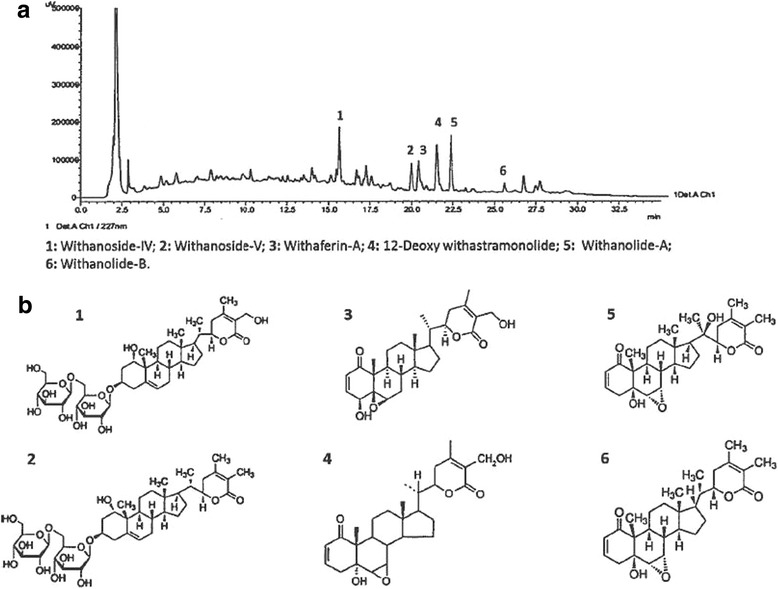
Behavioral studies demonstrated that the administration of Withania somnifera Dunal roots extract (WSE), prolongs morphine-elicited analgesia and reduces the development of tolerance to the morphine's analgesic effect; however, little is known about the underpinning molecular mechanism(s). In order to shed light on this issue in the present paper we explored whether WSE promotes alterations of μ (MOP) and nociceptin (NOP) opioid receptors gene expression in neuroblastoma SH-SY5Y cells.
A range of WSE concentrations was preliminarily tested to evaluate their effects on cell viability. Subsequently, the effects of 5 h exposure to WSE (0.25, 0.50 and 1.00 mg/ml), applied alone and in combination with morphine or naloxone, on MOP and NOP mRNA levels were investigated.
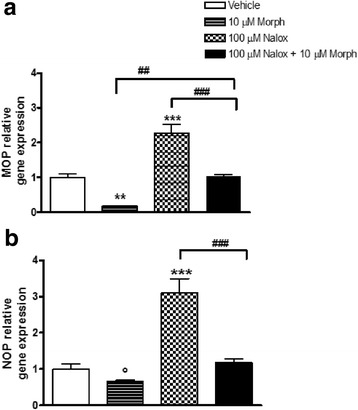
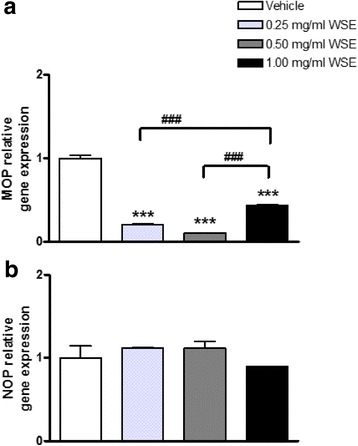
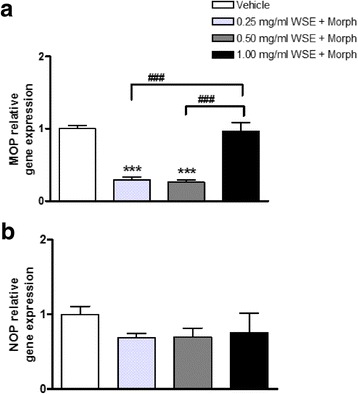
Data analysis revealed that morphine decreased MOP and NOP receptor gene expression, whereas naloxone elicited their up-regulation. In addition, pre-treatment with naloxone prevented the morphine-elicited gene expression alterations. Interestingly, WSE was able to: a) alter MOP but not NOP gene expression; b) counteract, at its highest concentration, morphine-induced MOP down-regulation, and c) hamper naloxone-induced MOP and NOP up-regulation.
Present in-vitro data disclose novel evidence about the ability of WSE to influence MOP and NOP opioid receptors gene expression in SH-SY5Y cells. Moreover, our findings suggest that the in-vivo modulation of morphine-mediated analgesia by WSE could be related to the hindering of morphine-elicited opioid receptors down-regulation here observed following WSE pre-treatment at its highest concentration.
行为学研究表明,给予睡茄根提取物(WSE)可延长吗啡引起的镇痛作用,并减少对吗啡镇痛效果的耐受性形成;然而,其潜在的分子机制尚不清楚。为了阐明这一问题,在本文中我们探究了WSE是否能促进神经母细胞瘤SH-SY5Y细胞中μμ;μ(MOP)和孤啡肽(NOP)阿片受体基因表达的改变。
预先测试了一系列WSE浓度以评估其对细胞活力的影响。随后,研究了单独应用以及与吗啡或纳洛酮联合应用5小时的WSE(0.25、0.50和1.00mg/ml)对MOP和NOP mRNA水平的影响。
数据分析显示,吗啡降低了MOP和NOP受体基因表达,而纳洛酮使其上调。此外,用纳洛酮预处理可防止吗啡引起的基因表达改变。有趣的是,WSE能够:a)改变MOP但不改变NOP基因表达;b)在其最高浓度时抵消吗啡诱导的MOP下调;c)阻碍纳洛酮诱导的MOP和NOP上调。
目前的体外数据揭示了关于WSE影响SH-SY5Y细胞中MOP和NOP阿片受体基因表达能力的新证据。此外,我们的研究结果表明,WSE对吗啡介导的镇痛作用的体内调节可能与在最高浓度的WSE预处理后观察到的阻碍吗啡引起的阿片受体下调有关。