Simon Maciej J K, Halm Henry F H, Quante Markus
Department of Orthopedics, University Medical Center Hamburg-Eppendorf, Martinistrasse 52, 20246, Hamburg, Germany.
Department of Osteology and Biomechanics, University Medical Center Hamburg-Eppendorf, Martinistrasse 52, 20246, Hamburg, Germany.
BMC Musculoskelet Disord. 2018 Jan 10;19(1):10. doi: 10.1186/s12891-017-1925-2.
Degenerative adult de novo (DAD) scoliosis appears characteristically in the sixth or seventh decade with symptoms of severe back pain and radiculopathy or spinal claudication. The aim of this study was to enhance the knowledge of perioperative complications and detect possible risk factors in this selective DAD scoliosis surgery.
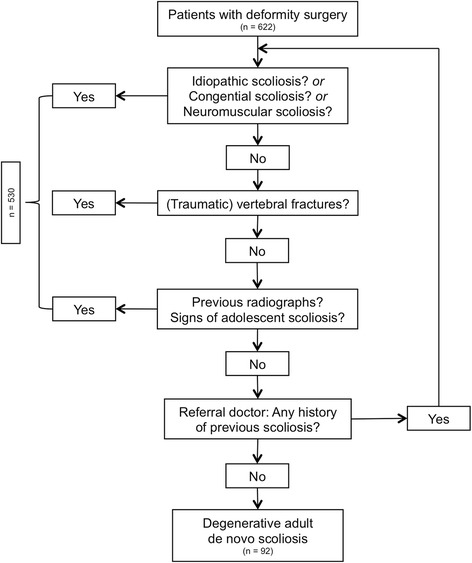
This retrospective study included only patients with DAD scoliosis undergone correction spondylodesis with previous failure of conservative treatment. Excluded were patients with other types of scoliosis and previous fusion surgeries. Patient epidemiological data, medical comorbidities and treatments were included. Intraoperative data and perioperative complications were documented. Analyses regarding early, late and no complications were undertaken.
A total of 92 patients with a mean age of 67.29 ± 7.93 years and clinical follow-up visits of minimum 12 months were included. On average, 5.26 ± 2.24 segments were fused. Early complications (e.g. wound healing defects, paresis, screw loosing) occurred in 23 patients and often required a re-operation. Cardiac arrhythmias, pacemaker and coumarin derivative therapies were associated with increased perioperative complications. The transforaminal lumbar interbody fusion technique was associated with early complications. Adjacent segment failure occurred in 36% and was the major late complication. Twenty patients did not have any complications in the minimum follow-up.
This study analysed a selective DAD scoliosis collective and its' surgical treatment outcomes. It identified numerous perioperative complications (adjacent segment failure, postoperative paresis and epidural hematoma) and multiple possible predisposing risk factors (e.g. operative techniques and anti-coagulation therapies). This here gained information raises awareness in preoperative patient selection and preparation. Further studies in DAD scoliosis and a risk-adjusted patient selection/preparation are needed to improve treatment quality and outcomes.
退行性成人新发(DAD)脊柱侧凸典型地出现在六七十岁,伴有严重背痛、神经根病或脊髓间歇性跛行症状。本研究的目的是增进对围手术期并发症的了解,并检测这种选择性DAD脊柱侧凸手术中可能的风险因素。
这项回顾性研究仅纳入了因保守治疗失败而接受脊柱融合固定术的DAD脊柱侧凸患者。排除了其他类型脊柱侧凸患者和既往有融合手术史的患者。纳入了患者的流行病学数据、内科合并症和治疗情况。记录了术中数据和围手术期并发症。对早期、晚期和无并发症情况进行了分析。
共纳入92例患者,平均年龄67.29±7.93岁,临床随访至少12个月。平均融合5.26±2.24节段。23例患者出现早期并发症(如伤口愈合缺陷、轻瘫、螺钉松动),且常需再次手术。心律失常、起搏器和香豆素衍生物治疗与围手术期并发症增加有关。经椎间孔腰椎椎间融合技术与早期并发症有关。36%发生了邻近节段退变,这是主要的晚期并发症。20例患者在最短随访期内未出现任何并发症。
本研究分析了一组选择性DAD脊柱侧凸患者及其手术治疗结果。确定了众多围手术期并发症(邻近节段退变、术后轻瘫和硬膜外血肿)和多种可能的易感风险因素(如手术技术和抗凝治疗)。此处获得信息提高了术前患者选择和准备方面的认识。需要对DAD脊柱侧凸进行进一步研究,并进行风险调整的患者选择/准备,以提高治疗质量和结果。