Grisham Rachel, Ky Bonnie, Tewari Krishnansu S, Chaplin David J, Walker Joan
Memorial Sloan Kettering Cancer Center and Weil Cornell Medical College, New York, NY USA.
Perelman School of Medicine, University of Pennsylvania, Philadelphia, PA USA.
Gynecol Oncol Res Pract. 2018 Jan 5;5:1. doi: 10.1186/s40661-017-0058-5. eCollection 2018.
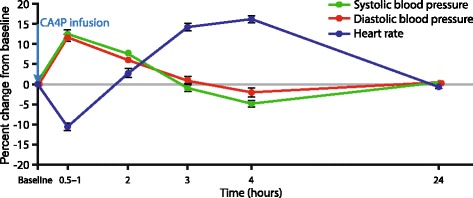
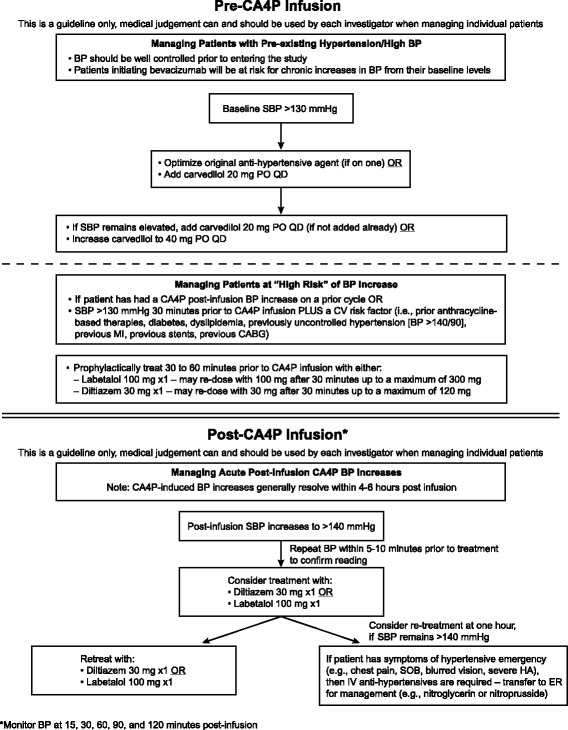
Combretastatin A4-phosphate (CA4P) is a vascular-disrupting agent (VDA) in clinical development for the treatment of ovarian and other cancers. In contrast to antiangiogenic agents, such as bevacizumab, which suppress the development of new tumor vasculature, VDAs target established tumor vasculature. These differing but complementary mechanisms of action are currently being explored in clinical trials combining CA4P and bevacizumab. Clinical experience to date has highlighted an important need to better understand the cardiovascular adverse events of CA4P, both alone and in combination with antiangiogenic agents, which can also be associated with cardiovascular adverse events. An acute but transient increase in blood pressure is often the most clinically relevant toxicity associated with CA4P. Increases in CA4P-related blood pressure typically occur 0.5 to 1 h after initiation of the 10-min infusion, peak by 2 h, and return to baseline 3 to 4 h after the infusion. Post-infusion increases in blood pressure are likely to recur in subsequent treatment cycles; however, the severity does not appear to increase with successive cycles. Other cardiovascular adverse events, such as transient, predominantly grade 1-2 tachycardia, bradycardia, QTc prolongation, and in rare cases myocardial ischemia, have also been observed with CA4P but at markedly lower frequencies than hypertension. The clinical trial experience with CA4P suggests that cardiovascular assessment of patients prior to CA4P treatment and careful management of blood pressure during CA4P treatment can largely mitigate the risk of cardiovascular adverse events. Accordingly, we have developed a blood pressure management algorithm for use in the ongoing phase II/III FOCUS study of the triple combination of CA4P with physician's choice chemotherapy and bevacizumab.
磷酸考布他汀A4(CA4P)是一种正在进行临床开发用于治疗卵巢癌和其他癌症的血管破坏剂(VDA)。与抗血管生成药物(如贝伐单抗)不同,后者抑制新肿瘤血管的形成,而VDA靶向已形成的肿瘤血管。目前正在将CA4P与贝伐单抗联合使用的临床试验中探索这些不同但互补的作用机制。迄今为止的临床经验突出表明,迫切需要更好地了解CA4P单独使用以及与抗血管生成药物联合使用时的心血管不良事件,抗血管生成药物也可能与心血管不良事件相关。血压急性但短暂升高通常是与CA4P相关的最具临床相关性的毒性反应。与CA4P相关的血压升高通常在开始10分钟输注后0.5至1小时出现,2小时达到峰值,并在输注后3至4小时恢复至基线水平。输注后血压升高在随后的治疗周期中可能会再次出现;然而,严重程度似乎不会随着连续周期而增加。还观察到CA4P会引发其他心血管不良事件,如短暂的、主要为1 - 2级心动过速、心动过缓、QTc延长,以及罕见的心肌缺血,但发生频率明显低于高血压。CA4P的临床试验经验表明,在CA4P治疗前对患者进行心血管评估以及在CA4P治疗期间仔细管理血压,可在很大程度上降低心血管不良事件的风险。因此,我们开发了一种血压管理算法,用于正在进行的CA4P与医生选择的化疗药物及贝伐单抗三联组合的II/III期FOCUS研究。