Vina Ernest R, Kallan Michael J, Collier Aliya, Nelson Charles L, Ibrahim Said A
University of Arizona Arthritis Center, University of Arizona School of Medicine, Tucson, AZ, USA.
Center for Clinical Epidemiology and Biostatistics, University of Pennsylvania, Philadelphia, PA, USA.
Geriatr Orthop Surg Rehabil. 2017 Dec;8(4):192-201. doi: 10.1177/2151458517726409. Epub 2017 Sep 8.
Three-quarters of patients who undergo total hip replacement (THR) receive postsurgical rehabilitation care in an inpatient rehabilitation facility (IRF), a skilled nursing facility (SNF), or through a home health agency. The objectives of this study are to examine racial differences where THR recipients receive postsurgical rehabilitation care and determine whether discharge destination is associated with hospital readmission.
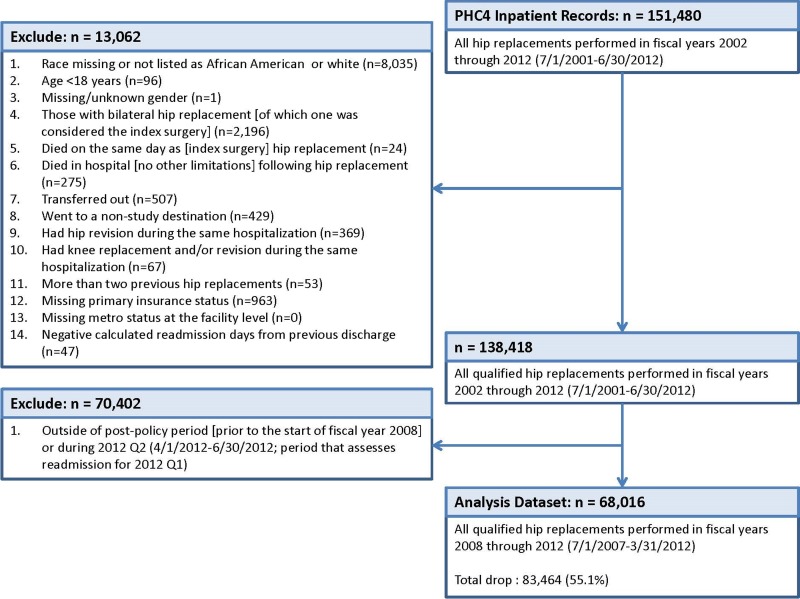
Using the Pennsylvania Health Care Cost Containment Council database, we selected African American (AA) or white adults who underwent THR surgery (n = 68,016). We used multinomial logistic regression models to assess the relationship between race and postsurgical discharge destination. We calculated 90-day hospital readmission as function of discharge destination.
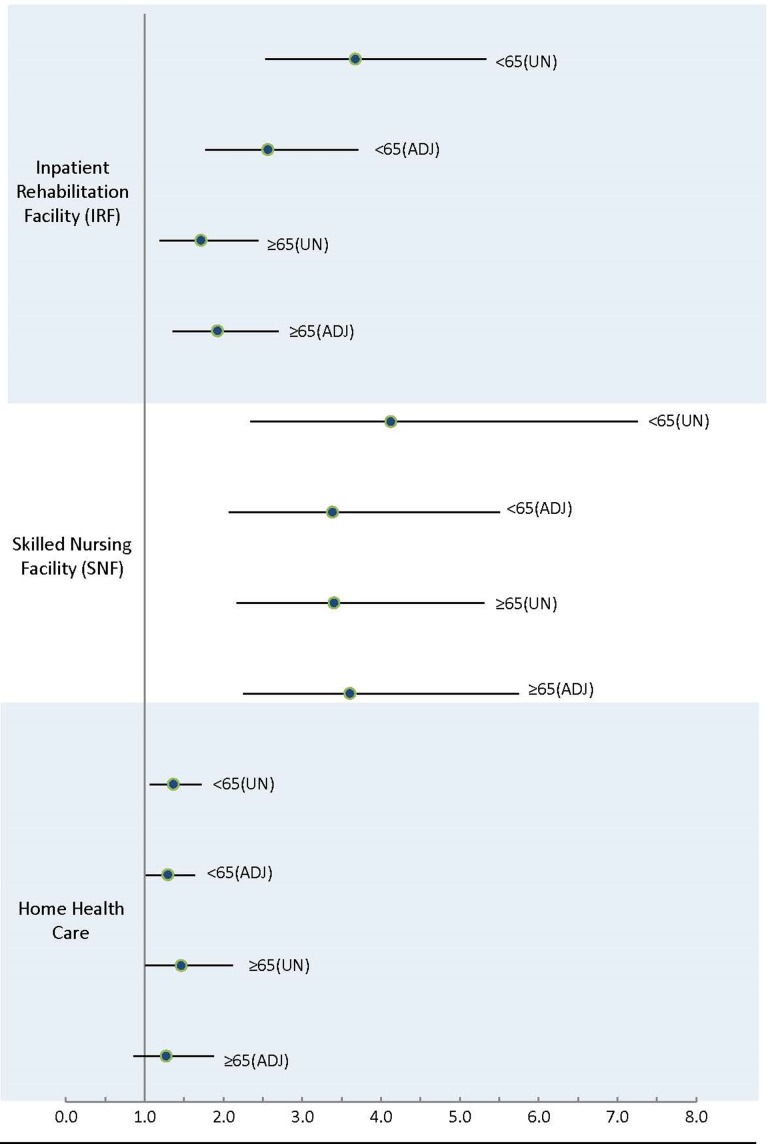
Among patients <65 years, compared to whites, AAs had a higher risk of discharge to an IRF (adjusted relative risk ratio [aRRR]: 2.56, 95% confidence interval [CI]: 1.77-3.71) and a SNF (aRRR 3.37, 95% CI: 2.07-5.49). Among those ≥65 years, AA patients also had a higher risk of discharge to an IRF (aRRR: 1.96, 95% CI: 1.39-2.76) and a SNF (aRRR: 3.66, 95% CI: 2.29-5.84). Discharge to either IRF or SNF, instead of home with self-care, was significantly associated with higher odds of 90-day hospital readmission (<65 years: adjusted odds ratio [aOR]: 4.06, 95% CI: 3.49-4.74; aOR: 2.05, 95% CI: 1.70-2.46, respectively; ≥65 years: aOR: 4.32, 95% CI: 3.67-5.09, respectively; aOR: 1.74, 95% CI: 1.46-2.07, respectively).
Compared to whites, AAs who underwent THR were more likely to be discharged to an IRF or SNF. Discharge to either facility was associated with a higher risk of hospital readmission.
接受全髋关节置换术(THR)的患者中有四分之三在住院康复机构(IRF)、专业护理机构(SNF)或通过家庭健康机构接受术后康复护理。本研究的目的是调查接受THR的患者在接受术后康复护理方面的种族差异,并确定出院目的地是否与医院再入院有关。
利用宾夕法尼亚医疗成本控制委员会数据库,我们选取了接受THR手术的非裔美国人(AA)或白人成年人(n = 68,016)。我们使用多项逻辑回归模型来评估种族与术后出院目的地之间的关系。我们将90天医院再入院率计算为出院目的地的函数。
在65岁以下的患者中,与白人相比,非裔美国人被送往IRF(调整后相对风险比[aRRR]:2.56,95%置信区间[CI]:1.77 - 3.71)和SNF(aRRR 3.37,95% CI:2.07 - 5.49)的风险更高。在65岁及以上的患者中,非裔美国患者被送往IRF(aRRR:1.96,95% CI:1.39 - 2.76)和SNF(aRRR:3.66,95% CI:2.29 - 5.84)的风险也更高。出院前往IRF或SNF,而非回家自理,与90天医院再入院几率显著增加相关(65岁以下:调整后优势比[aOR]:4.06,95% CI:3.49 - 4.74;aOR:2.05,95% CI:1.70 - 2.46;65岁及以上:aOR:4.32,95% CI:3.67 - 5.09;aOR:1.74,95% CI:1.46 - 2.07)。
与白人相比,接受THR的非裔美国人更有可能被送往IRF或SNF。出院前往这两种机构都与医院再入院风险较高相关。