School of Health Science, Faculty of Medicine, University of Iceland, Reykjavík, Iceland.
Department of Molecular and Clinical Medicine, Institute of Medicine, University of Gothenburg, Gothenburg, Sweden.
Diabetologia. 2018 Mar;61(3):599-606. doi: 10.1007/s00125-017-4532-8. Epub 2018 Jan 9.
AIMS/HYPOTHESIS: The reasons underlying a greater association of premature mortality with early-onset type 2 diabetes relative to late-onset disease are unclear. We evaluated the clinical characteristics at type 2 diabetes diagnosis and the broad trajectories in cardiometabolic risk factors over the initial years following diagnosis in relation to age at diagnosis.
Our cohort consisted of 100,606 individuals with newly diagnosed type 2 diabetes enrolled in the Swedish National Diabetes Register from 2002 to 2012. The average follow-up time was 2.8 years. Analyses were performed using a linear mixed-effects model for continuous risk factors and a mixed generalised linear model with a logistic link function for dichotomous risk factors.
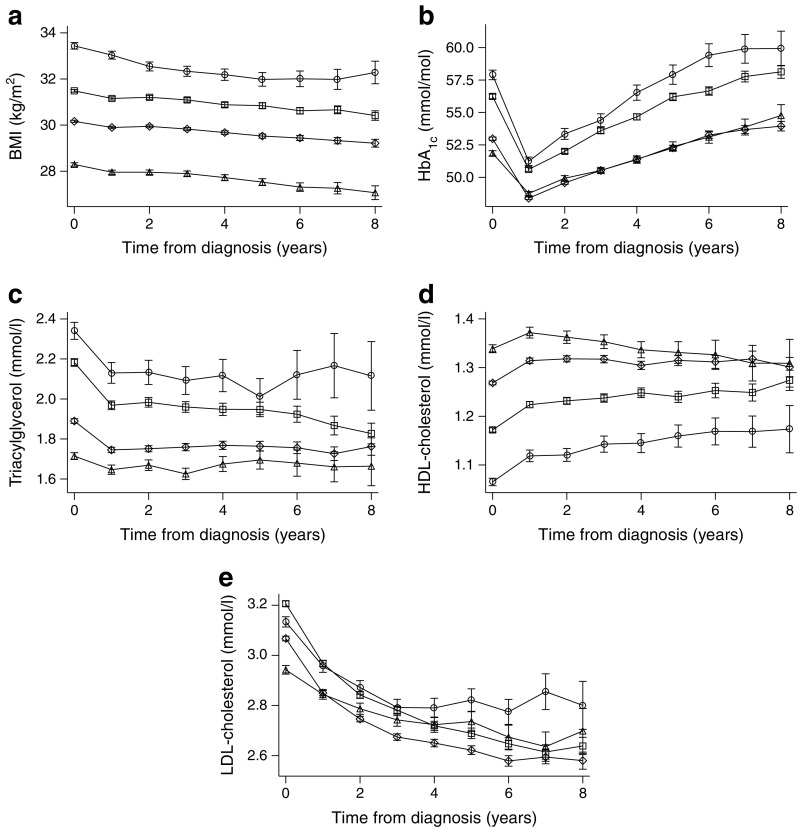
The individuals diagnosed at the youngest age (18-44 years) were more often male and had the highest BMI (mean of 33.4 kg/m) at diagnosis and during follow-up compared with all other groups (those diagnosed at 45-59 years, 60-74 years and ≥75 years; p < 0.05), being ~5 kg/m higher than the oldest group. Although HbA patterns were similar between all age groups, there was a difference of about 5 mmol/mol (0.45%) between the two groups at 8 years post-diagnosis (p < 0.05). Additionally, individuals diagnosed younger had ~0.7 mmol/l higher triacylglycerol, and ~0.2 mmol/l lower HDL-cholesterol levels at diagnosis relative to the oldest group. Such differences continued for several years post diagnosis. Yet, although more of these younger individuals were receiving oral glucose-lowering agents, other cardioprotective therapies were prescribed less often in this group. Differences in BMI, blood glucose and lipid levels remained with adjustment for potential confounders, including marital status, education and country of birth, and, where relevant, differential treatments by age, and in those with at least 5 years of follow-up.
CONCLUSIONS/INTERPRETATION: Individuals who develop type 2 diabetes at a younger age are more frequently obese, display a more adverse lipid profile, have higher HbA and a faster deterioration in glycaemic control compared with individuals who develop diabetes later in life. These differences largely remain for several years after diagnosis and support the notion that early-onset type 2 diabetes may be a more pathogenic condition than late-onset disease.
目的/假设:早发性 2 型糖尿病与晚发性疾病相比,与过早死亡的相关性更强,其背后的原因尚不清楚。我们评估了 2 型糖尿病诊断时的临床特征以及诊断后最初几年中心血管代谢危险因素的广泛变化轨迹与诊断时年龄的关系。
我们的队列包括 2002 年至 2012 年期间在瑞典国家糖尿病登记处登记的 100606 名新诊断的 2 型糖尿病患者。平均随访时间为 2.8 年。使用线性混合效应模型对连续风险因素进行分析,并使用具有逻辑链接函数的混合广义线性模型对二分类风险因素进行分析。
在最年轻的年龄(18-44 岁)诊断的个体更常见于男性,且在诊断时和随访期间的 BMI 最高(平均值为 33.4kg/m),与所有其他组(诊断时为 45-59 岁、60-74 岁和≥75 岁;p<0.05)相比,比最年长的组高约 5kg/m。尽管所有年龄组的 HbA 模式相似,但在诊断后 8 年时,两组之间存在约 5mmol/mol(0.45%)的差异(p<0.05)。此外,与最年长的组相比,年轻诊断的个体在诊断时的三酰甘油水平高约 0.7mmol/l,高密度脂蛋白胆固醇水平低约 0.2mmol/l。这种差异在诊断后持续了几年。然而,尽管这些年轻个体中更多的人正在接受口服降糖药物治疗,但在该组中,其他心脏保护治疗的处方频率较低。在调整了包括婚姻状况、教育程度和出生地在内的潜在混杂因素后,以及在那些至少有 5 年随访的患者中,根据年龄进行差异治疗后,BMI、血糖和血脂水平的差异仍然存在。
结论/解释:与在生命后期发生糖尿病的个体相比,年轻时发生 2 型糖尿病的个体更常肥胖,表现出更不利的血脂谱,HbA 更高,血糖控制恶化更快。这些差异在诊断后几年内仍基本存在,这支持了早发性 2 型糖尿病可能比晚发性疾病更具致病性的观点。