INFIBIOC-FFyB-UBA-Buenos, Aires, Argentina.
IBCN-Facultad de Medicina-UBA-Buenos, Aires-Argentina, Argentina.
Curr Neuropharmacol. 2018;16(10):1484-1498. doi: 10.2174/1570159X16666180110130253.
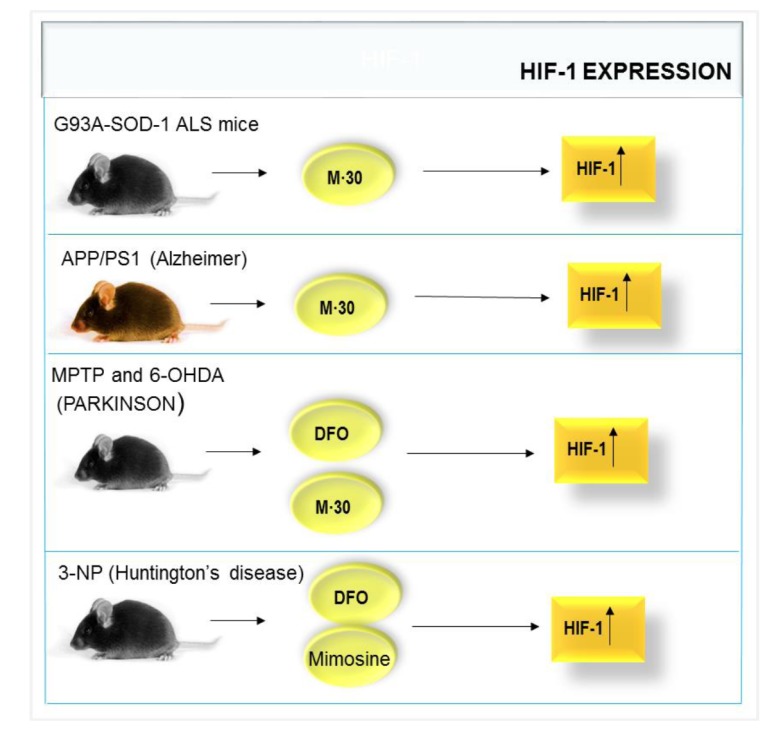
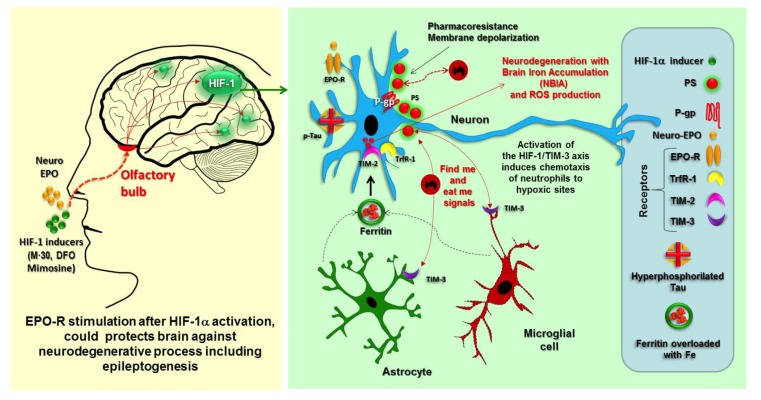
Neurodegeneration (NDG) is linked with the progressive loss of neural function with intellectual and/or motor impairment. Several diseases affecting older individuals, including Alzheimer's disease, Amyotrophic Lateral Sclerosis, Huntington's disease, Parkinson's disease, stroke, Multiple Sclerosis and many others, are the most relevant disorders associated with NDG. Since other pathologies such as refractory epilepsy, brain infections, or hereditary diseases such as "neurodegeneration with brain iron accumulation", also lead to chronic brain inflammation with loss of neural cells, NDG can be said to affect all ages. Owing to an energy and/or oxygen supply imbalance, different signaling mechanisms including MAPK/PI3K-Akt signaling pathways, glutamatergic synapse formation, and/or translocation of phosphatidylserine, might activate some central executing mechanism common to all these pathologies and also related to oxidative stress. Hypoxia inducible factor 1-α (HIF-1α) plays a twofold role through gene activation, in the sense that this factor has to "choose" whether to protect or to kill the affected cells. Most of the afore-mentioned processes follow a protracted course and are accompanied by progressive iron accumulation in the brain. We hypothesize that the neuroprotective effects of iron chelators are acting against the generation of free radicals derived from iron, and also induce sufficient -but not excessive- activation of HIF-1α, so that only the hypoxia-rescue genes will be activated. In this regard, the expression of the erythropoietin receptor in hypoxic/inflammatory neurons could be the cellular "sign" to act upon by the nasal administration of pharmacological doses of Neuro-EPO, inducing not only neuroprotection, but eventually, neurorepair as well.
神经退行性变(NDG)与神经功能的进行性丧失有关,伴有智力和/或运动障碍。几种影响老年人的疾病,包括阿尔茨海默病、肌萎缩性侧索硬化症、亨廷顿病、帕金森病、中风、多发性硬化症和许多其他疾病,是与 NDG 最相关的疾病。由于其他病理情况,如难治性癫痫、脑感染或遗传性疾病,如“伴有脑铁积累的神经退行性变”,也会导致慢性脑炎症和神经细胞丧失,因此可以说 NDG 影响所有年龄段的人。由于能量和/或氧气供应失衡,包括 MAPK/PI3K-Akt 信号通路、谷氨酸能突触形成和/或磷脂酰丝氨酸易位在内的不同信号机制可能会激活所有这些病理情况以及与氧化应激相关的一些共同的中枢执行机制。缺氧诱导因子 1-α(HIF-1α)通过基因激活发挥双重作用,因为该因子必须“选择”是保护还是杀死受影响的细胞。上述大多数过程都遵循一个迁延的过程,并伴有脑内铁的逐渐积累。我们假设铁螯合剂的神经保护作用是针对铁衍生自由基的产生,并且还诱导足够的 -但不过度的-HIF-1α激活,以便仅激活缺氧拯救基因。在这方面,缺氧/炎症神经元中促红细胞生成素受体的表达可能是通过鼻腔给予药理剂量的神经 EPO 作用的细胞“信号”,不仅诱导神经保护,而且最终还诱导神经修复。