Arthritis Research UK Primary Care Centre, Research Institute for Primary Care and Health Sciences, Keele University, Keele, United Kingdom.
Pain. 2018 Apr;159(4):728-738. doi: 10.1097/j.pain.0000000000001147.
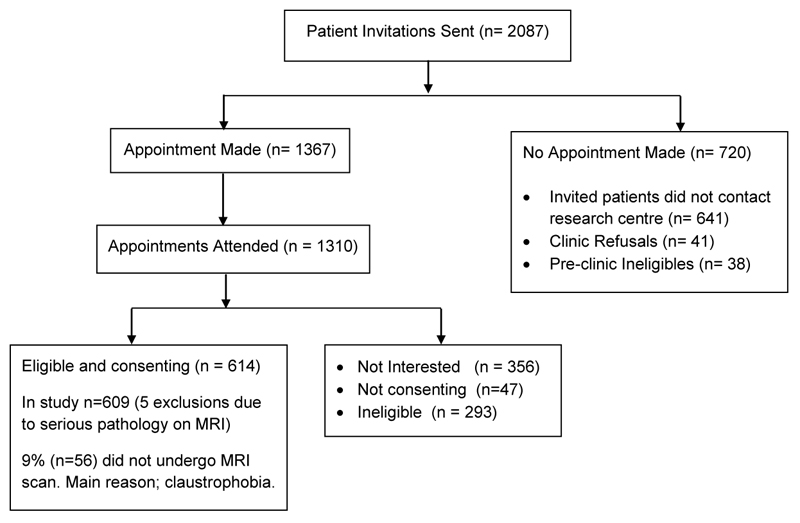
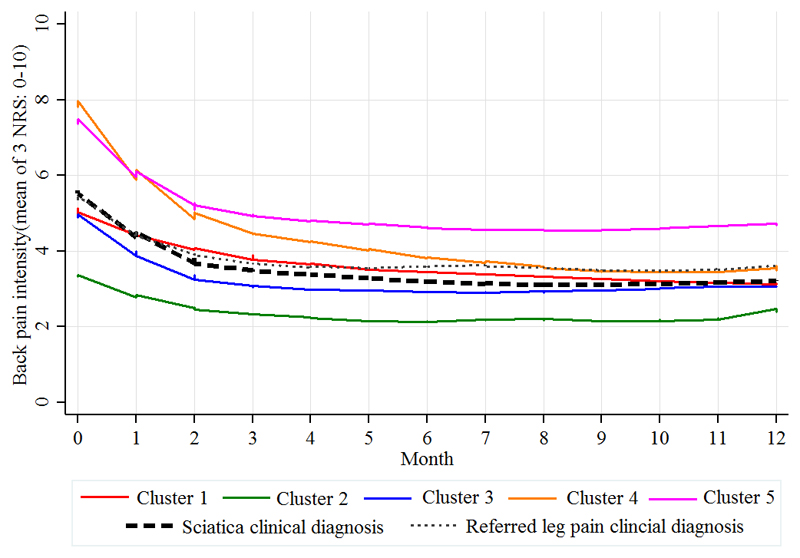
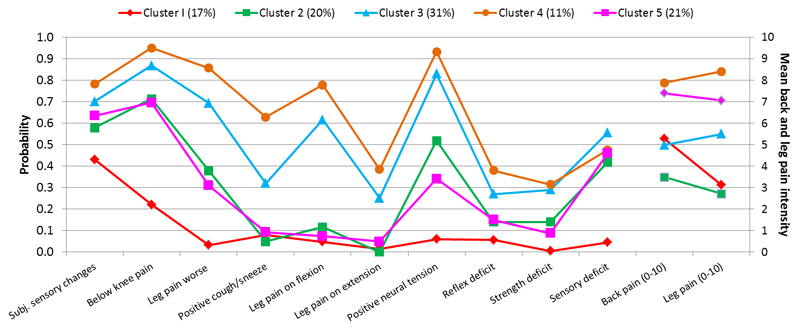
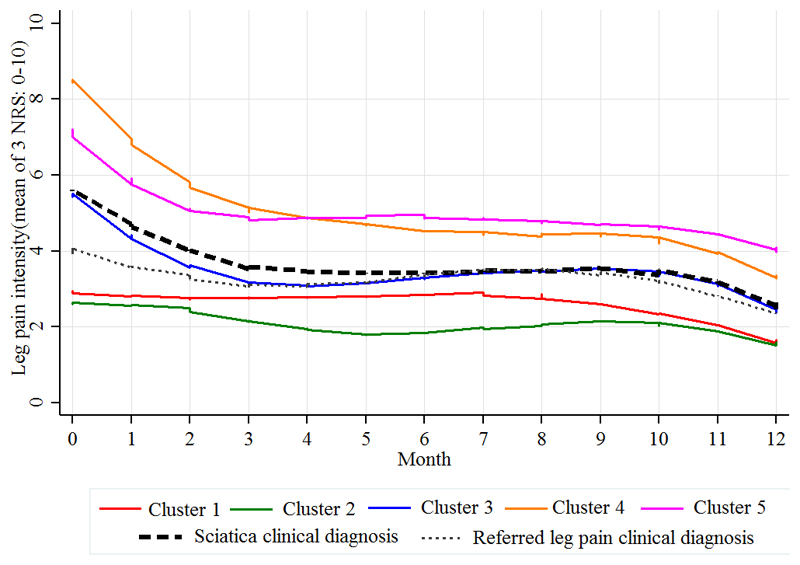
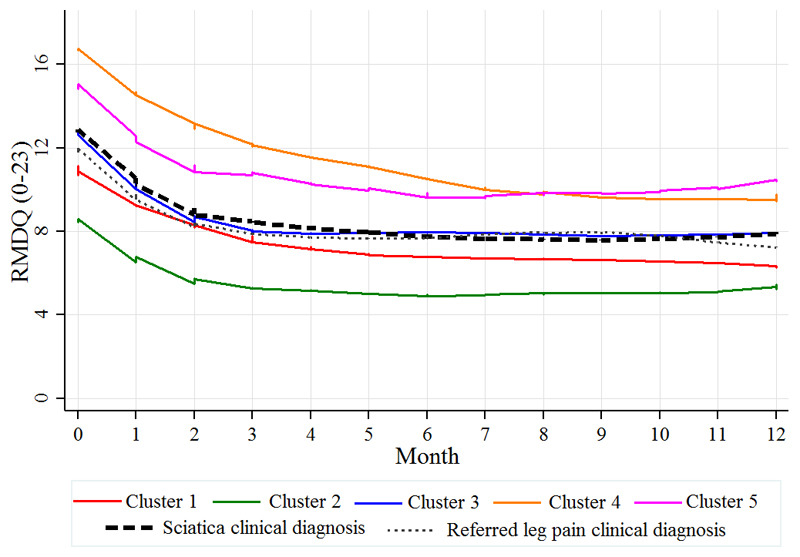
Traditionally, low back-related leg pain (LBLP) is diagnosed clinically as referred leg pain or sciatica (nerve root involvement). However, within the spectrum of LBLP, we hypothesised that there may be other unrecognised patient subgroups. This study aimed to identify clusters of patients with LBLP using latent class analysis and describe their clinical course. The study population was 609 LBLP primary care consulters. Variables from clinical assessment were included in the latent class analysis. Characteristics of the statistically identified clusters were compared, and their clinical course over 1 year was described. A 5 cluster solution was optimal. Cluster 1 (n = 104) had mild leg pain severity and was considered to represent a referred leg pain group with no clinical signs, suggesting nerve root involvement (sciatica). Cluster 2 (n = 122), cluster 3 (n = 188), and cluster 4 (n = 69) had mild, moderate, and severe pain and disability, respectively, and response to clinical assessment items suggested categories of mild, moderate, and severe sciatica. Cluster 5 (n = 126) had high pain and disability, longer pain duration, and more comorbidities and was difficult to map to a clinical diagnosis. Most improvement for pain and disability was seen in the first 4 months for all clusters. At 12 months, the proportion of patients reporting recovery ranged from 27% for cluster 5 to 45% for cluster 2 (mild sciatica). This is the first study that empirically shows the variability in profile and clinical course of patients with LBLP including sciatica. More homogenous groups were identified, which could be considered in future clinical and research settings.
传统上,与下背部相关的腿部疼痛(LBLP)通过临床诊断为放射状腿部疼痛或坐骨神经痛(神经根受累)。然而,在 LBLP 范围内,我们假设可能存在其他未被识别的患者亚组。本研究旨在使用潜在类别分析确定 LBLP 患者的聚类,并描述其临床过程。研究人群为 609 名 LBLP 初级保健咨询者。临床评估中的变量包括在潜在类别分析中。比较统计学上确定的聚类的特征,并描述其在 1 年内的临床过程。5 聚类解决方案是最佳的。聚类 1(n=104)腿部疼痛严重程度较轻,被认为代表无临床体征的放射状腿部疼痛组,提示神经根受累(坐骨神经痛)。聚类 2(n=122)、聚类 3(n=188)和聚类 4(n=69)分别具有轻度、中度和重度疼痛和残疾,对临床评估项目的反应表明轻度、中度和重度坐骨神经痛的类别。聚类 5(n=126)疼痛和残疾程度较高,疼痛持续时间较长,合并症较多,难以进行临床诊断。所有聚类的疼痛和残疾在最初的 4 个月内都有明显改善。在 12 个月时,报告恢复的患者比例从聚类 5 的 27%到聚类 2(轻度坐骨神经痛)的 45%不等。这是第一项实证研究,表明包括坐骨神经痛在内的 LBLP 患者的表型和临床过程存在变异性。确定了更多同质的群体,这些群体可以在未来的临床和研究环境中得到考虑。