Marine Genomics Unit, Okinawa Institute of Science and Technology Graduate University, Onna, Okinawa, Japan.
Mol Biol Evol. 2018 Apr 1;35(4):914-924. doi: 10.1093/molbev/msy002.
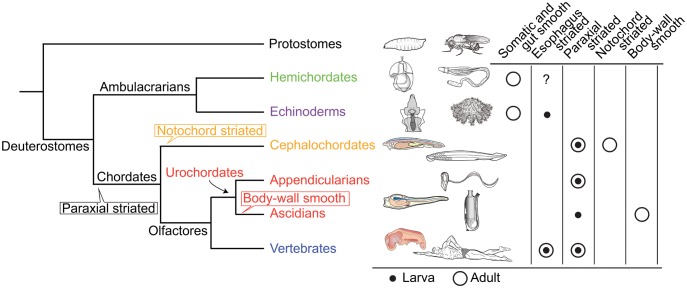
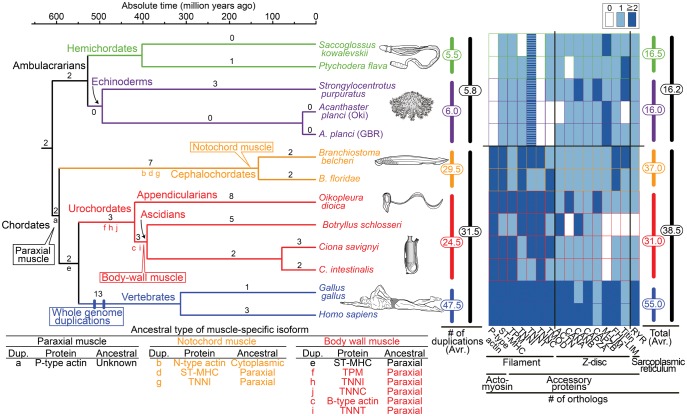
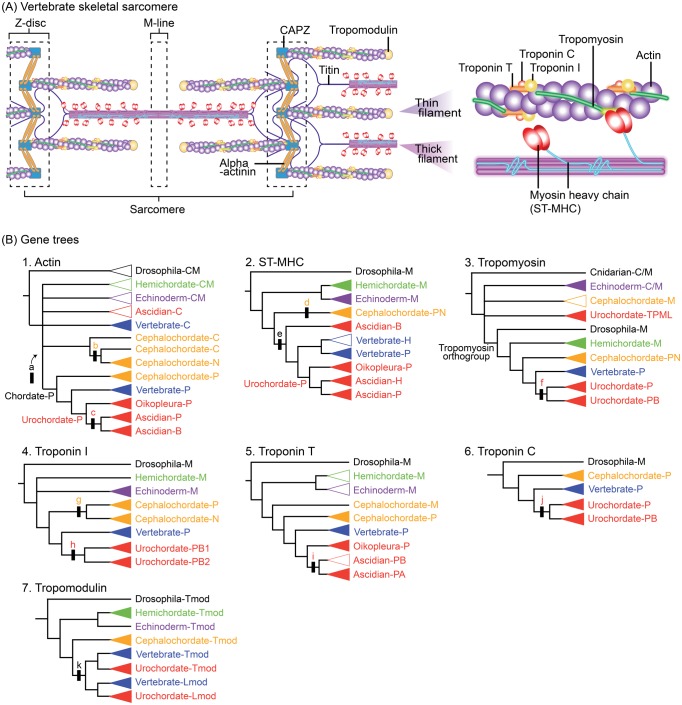
Fish-like larvae were foundational to the chordate body plan, given the basal placement of free-living lancelets. That body plan probably made it possible for chordate ancestors to swim by beating a tail formed of notochord and bilateral paraxial muscles. In order to investigate the molecular genetic basis of the origin and evolution of paraxial muscle, we deduced the evolutionary histories of 16 contractile protein genes from paraxial muscle, based on genomic data from all five deuterostome lineages, using a newly developed orthology identification pipeline and a species tree. As a result, we found that more than twice as many orthologs of paraxial muscle genes are present in chordates, as in nonchordate deuterostomes (ambulacrarians). Orthologs of paraxial-type actin and troponin C genes are absent in ambulacrarians and most paraxial muscle protein isoforms diversified via gene duplications that occurred in each chordate lineage. Analyses of genes with known expression sites indicated that some isoforms were reutilized in specific muscles of nonvertebrate chordates via gene duplications. As orthologs of most paraxial muscle genes were present in ambulacrarians, in addition to expression patterns of related genes and functions of the two protein isoforms, regulatory mechanisms of muscle genes should also be considered in future studies of the origin of paraxial muscle.
鱼形幼虫是脊索动物体式的基础,因为自由生活的文昌鱼位于基干位置。这种体式可能使脊索动物祖先能够通过拍打由脊索和双侧轴旁肌组成的尾巴来游泳。为了研究轴旁肌起源和进化的分子遗传基础,我们根据从所有五个后口动物谱系获得的基因组数据,使用新开发的同源识别管道和物种树,从轴旁肌推断出 16 种收缩蛋白基因的进化历史。结果表明,与非脊索后口动物(腕足类动物)相比,脊索动物中存在的轴旁肌基因的同源物多出两倍以上。轴旁型肌动蛋白和肌钙蛋白 C 基因的同源物在腕足类动物中不存在,大多数轴旁肌蛋白同工型通过发生在每个脊索动物谱系中的基因复制多样化。对具有已知表达部位的基因进行分析表明,一些同工型通过基因复制被重新用于非脊椎动物脊索动物的特定肌肉中。由于大多数轴旁肌基因的同源物存在于腕足类动物中,除了相关基因的表达模式和两种蛋白同工型的功能外,在未来对轴旁肌起源的研究中还应考虑肌肉基因的调控机制。