Department of Pediatric and Adolescent Medicine, Mayo Clinic, Rochester, MN, USA.
Asthma Epidemiology Research Unit, Mayo Clinic, Rochester, MN, USA.
Allergy. 2018 Jun;73(6):1276-1283. doi: 10.1111/all.13403. Epub 2018 Feb 7.
Frequent wheezing in original asthma predictive index (API) was defined by parental report of recurrent wheezing within 1 year during the first 3 years of life. The nature of frequent wheezing in children, particularly aged over 3 years, has not been studied. We aimed to assess the frequency and interval of wheezing to define frequent wheezing in ascertaining asthma for children using medical records.
Among children who participated in a previous study (n = 427), all wheezing episodes documented in medical records were collected for children who had ≥2 wheezing episodes PLUS met one major criterion or two minor criteria of API. We compared the distribution of known risk factors for asthma between subjects having two consecutive wheezing episodes with shorter interval (≤1 year) compared to those with longer interval (1 to 3 years).
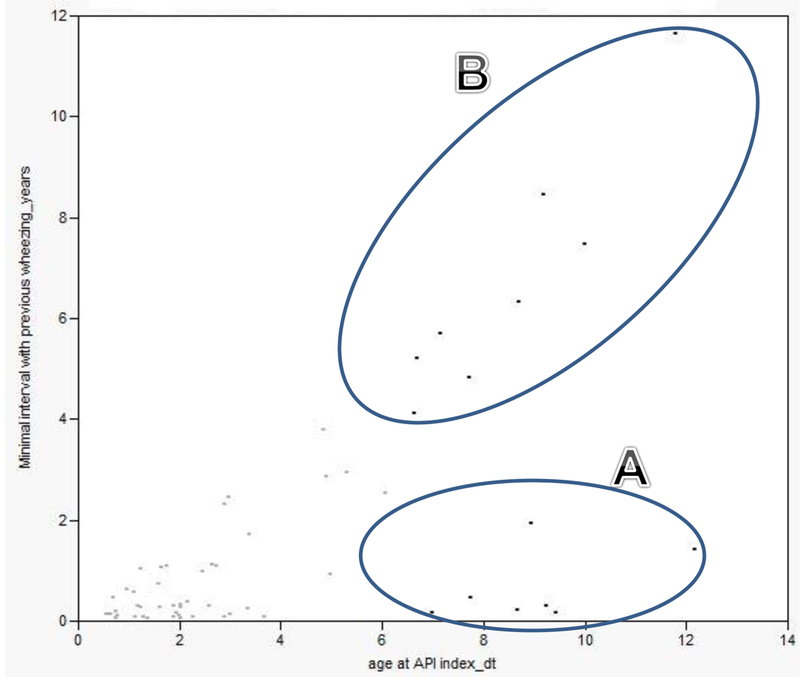
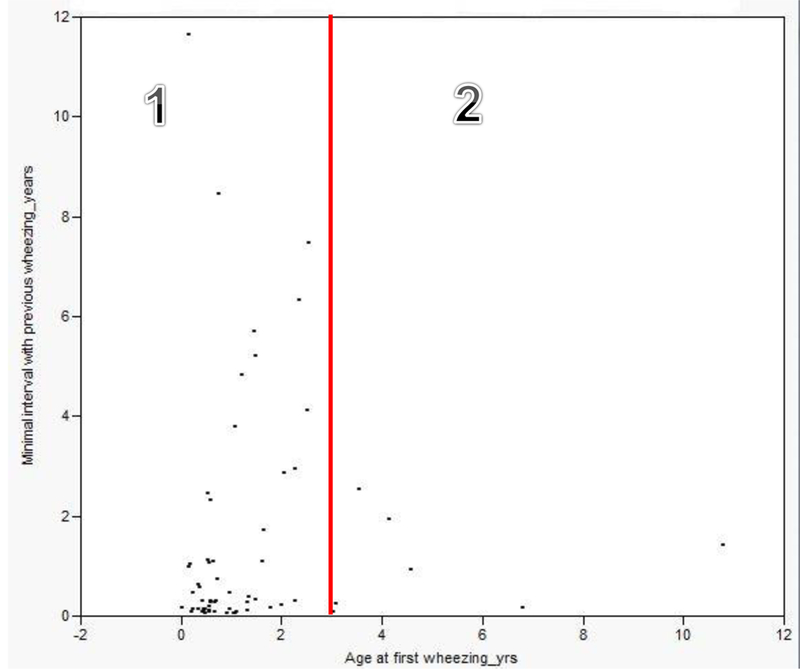
A total of 62 children met API at median age of 2.3 years. During follow-up period (median age: 11.3 years), a total of 198 wheezing episodes were observed. 81% of wheezing intervals were within 3 years from the earlier wheezing episode, including 60% within 1 year. Children who met API based on 1-year interval (n = 40) vs 1- to 3-year interval (n = 13) appeared to be similar in regard to the known risk factors for asthma.
Our exploratory study finding suggests that children who had frequent wheezing episodes with longer interval (<3 years) need to be considered to be determined as asthma cases when API is applied to retrospective medical records. Prospective studies with a larger sample size need to replicate this finding.
原始哮喘预测指数(API)中频繁喘息的定义是父母报告在生命的前 3 年内,1 年内反复出现喘息。年龄超过 3 岁的儿童频繁喘息的性质尚未得到研究。我们旨在评估喘息的频率和间隔,以使用病历确定哮喘儿童的频繁喘息。
在参与先前研究的儿童中(n=427),对于≥2 次喘息发作且符合 API 的一个主要标准或两个次要标准的儿童,从病历中收集所有记录的喘息发作。我们比较了具有较短间隔(≤1 年)的连续两次喘息发作与具有较长间隔(1 至 3 年)的患者的哮喘已知危险因素分布。
共有 62 名儿童在中位年龄为 2.3 岁时符合 API。在随访期间(中位年龄:11.3 岁),共观察到 198 次喘息发作。81%的喘息间隔时间在较早的喘息发作后 3 年内,其中 60%在 1 年内。根据 1 年间隔(n=40)和 1 至 3 年间隔(n=13)符合 API 的儿童在哮喘的已知危险因素方面似乎相似。
我们的探索性研究结果表明,当应用 API 于回顾性病历时,需要考虑具有较长间隔(<3 年)的频繁喘息发作的儿童作为哮喘病例。需要更大样本量的前瞻性研究来复制这一发现。