Department of Obstetrics and Gynaecology, Institute of Clinical Science, Sahlgrenska Academy, University of Gothenburg, Gothenburg, Sweden.
The Regional Cancer Centre, Western Health Care Region, Gothenburg, Sweden.
PLoS One. 2018 Jan 10;13(1):e0190171. doi: 10.1371/journal.pone.0190171. eCollection 2018.
Cervical screening programs are highly protective for cervical cancer, but only for women attending screening procedure.
Identify socio-economic and demographic determinants for non-attendance in cervical screening.
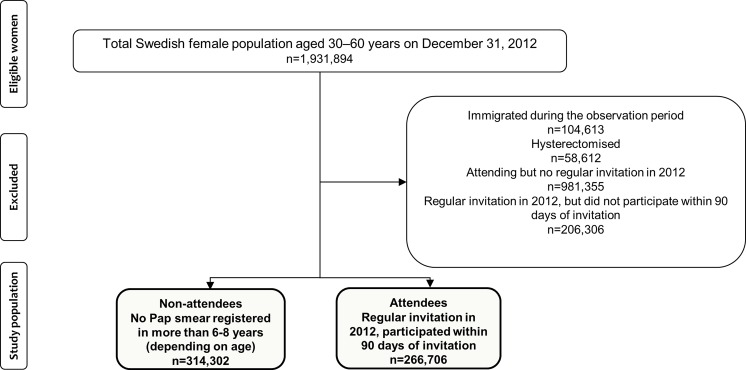
Design: Population-based case-control study. Setting: Sweden. Population: Source population was all women eligible for screening. Based on complete screening records, two groups of women aged 30-60 were compared. The case group, non-attending women, (N = 314,302) had no smear registered for 6-8 years. The control group (N = 266,706) attended within 90 days of invitation. Main outcome measures: Risk of non-attendance by 9 groups of socioeconomic and demographic variables. Analysis: Unadjusted odds ratios (OR) and OR after adjustment for all variables in logistic regression models were calculated.
Women with low disposable family income (adjOR 2.06; 95% confidence interval (CI) 2.01-2.11), with low education (adjOR 1.77; CI 1.73-1.81) and not cohabiting (adjOR 1.47; CI 1.45-1.50) were more likely to not attend cervical screening. Other important factors for non-attendance were being outside the labour force and receiving welfare benefits. Swedish counties are responsible for running screening programs; adjusted OR for non-participation in counties ranged from OR 4.21 (CI 4.06-4.35) to OR 0.54 (CI 0.52-0.57), compared to the reference county. Being born outside Sweden was a risk factor for non-attendance in the unadjusted analysis but this disappeared in certain large groups after adjustment for socioeconomic factors.
County of residence and socio-economic factors were strongly associated with lower attendance in cervical screening, while being born in another country was of less importance. This indicates considerable potential for improvement of cervical screening attendance in several areas if best practice of routines is adopted.
宫颈筛查项目对宫颈癌具有高度保护作用,但仅对接受筛查程序的女性有效。
确定导致宫颈癌筛查不参与的社会经济和人口统计学决定因素。
设计:基于人群的病例对照研究。地点:瑞典。人群:筛查合格的所有女性构成源人群。根据完整的筛查记录,将两组年龄在 30-60 岁的女性进行比较。病例组(未就诊组)为 6-8 年内未进行涂片检查的女性(N=314302 人)。对照组(就诊组)为在邀请后 90 天内就诊的女性(N=266706 人)。主要观察指标:9 组社会经济和人口统计学变量与不参与筛查的风险关系。分析:使用逻辑回归模型计算未调整的优势比(OR)和调整所有变量后的 OR。
家庭可支配收入低(调整 OR 2.06;95%置信区间(CI)2.01-2.11)、教育程度低(调整 OR 1.77;CI 1.73-1.81)和未婚(调整 OR 1.47;CI 1.45-1.50)的女性更有可能不参加宫颈癌筛查。其他不参与筛查的重要因素是不在劳动力市场和领取福利。瑞典各县负责运行筛查项目;与参考县相比,各县参与率的调整 OR 范围为 4.21(CI 4.06-4.35)至 0.54(CI 0.52-0.57)。出生在瑞典以外的国家是未调整分析中不参与筛查的一个危险因素,但在调整社会经济因素后,在某些大群组中这种关联消失。
居住县和社会经济因素与宫颈癌筛查参与率低密切相关,而出生国的影响较小。这表明,如果采用最佳实践常规,在多个领域提高宫颈癌筛查参与率的潜力巨大。