Kunita Kenji, Fujiwara Katsuo, Kiyota Naoe, Yaguchi Chie, Kiyota Takeo
Department of Sports Instruction, Faculty of Sports and Human, Sapporo International University, 4-1-4-1 Kiyota, Kiyota-ku, Sapporo, 004-8602, Japan.
Department of Sports and Health, Kanazawa Gakuin University, 10 Sue-machi, Kanazawa, 920-1392, Japan.
J Physiol Anthropol. 2018 Jan 10;37(1):2. doi: 10.1186/s40101-017-0161-7.
We investigated developmental changes in shortening of pro-saccade reaction time while maintaining neck flexion.
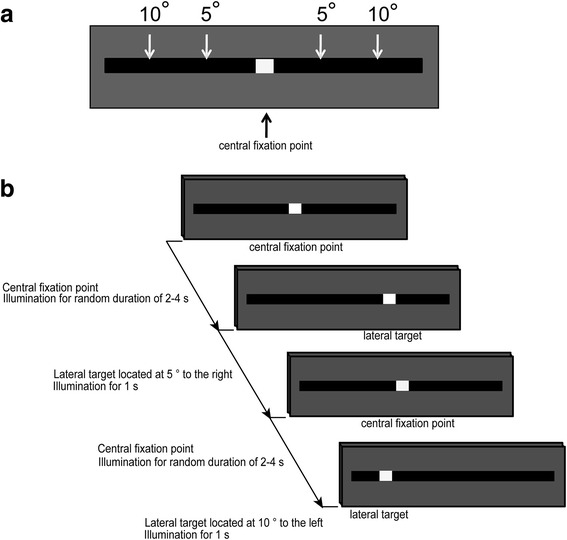
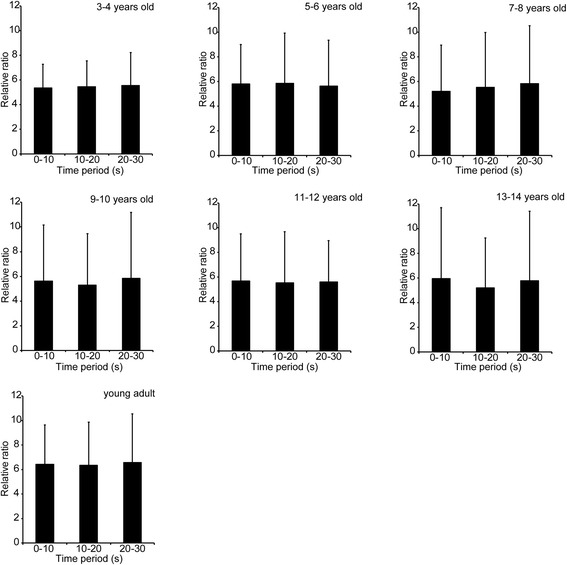
Subjects comprised 135 children (3-14 years) and 29 young adults (19-23 years). Children were divided into six groups in 2-year age strata. Pro-saccade reaction tasks for 30 s were performed in neck rest and flexion positions. Reaction times under each position were averaged in every 10-s period.
Under neck rest position, reaction time in the 0-10 s period was significantly longer in the 3- to 4-year-old group than in the 5- to 6-year-old group and above. No significant age effect was found for reaction time in the 0-10 s period in the 5- to 6-year-old group and above. Although a significant effect of neck flexion was not observed until the 9- to 10-year-old group, significant shortening of reaction time with neck flexion was found in the 11- to 12-year-old group and above. Furthermore, this shortening was maintained until the first 20-s period in the 11- to 12-year-old group and during the entire 30 s in the 13- to 14-year-old and above.
These results suggest that brain activation with the maintenance of neck flexion, related to shortening of the pro-saccade reaction time, was found from a later age of approximately 11 years and above, compared with the age at which information-processing function in the pro-saccade was enhanced. In addition, brain activation with the maintenance of neck flexion was sustained longer with age.
我们研究了在保持颈部屈曲的同时,前扫视反应时间缩短的发育变化。
受试者包括135名儿童(3至14岁)和29名年轻人(19至23岁)。儿童按2岁年龄分层分为六组。在颈部休息和屈曲位置进行30秒的前扫视反应任务。每个位置下的反应时间在每10秒时间段内进行平均。
在颈部休息位置,3至4岁组在0至10秒时间段内的反应时间明显长于5至6岁及以上组。5至6岁及以上组在0至10秒时间段内的反应时间未发现明显的年龄效应。虽然直到9至10岁组才观察到颈部屈曲的显著影响,但在11至12岁及以上组中发现颈部屈曲使反应时间显著缩短。此外,在11至12岁组中,这种缩短持续到前20秒时间段,在13至14岁及以上组中则在整个30秒内保持。
这些结果表明,与前扫视反应时间缩短相关的、在保持颈部屈曲时的大脑激活,与前扫视信息处理功能增强的年龄相比,在大约11岁及以上的较晚年龄才出现。此外,随着年龄增长,保持颈部屈曲时的大脑激活持续时间更长。