Department of Epidemiology and Preventive Medicine, The Alfred Centre, Monash University, 99 Commercial Road, Melbourne, VIC, 3004, Australia.
Ambulance Victoria, Victoria, Australia.
Scand J Trauma Resusc Emerg Med. 2018 Jan 10;26(1):8. doi: 10.1186/s13049-018-0475-4.
Predicting case types that are unlikely to be treated by paramedics can aid in managing demand for emergency ambulances by identifying cases suitable for alternative management pathways. The aim of this study was to identify the patient characteristics and triage outcomes associated with 'no paramedic treatment' for cases referred for emergency ambulance dispatch following secondary telephone triage.
A retrospective cohort analysis was conducted of cases referred for emergency ambulance dispatch following secondary telephone triage between September 2009 and June 2012. Multivariable logistic regression modelling was used to identify explanatory variables associated with 'no paramedic treatment'.
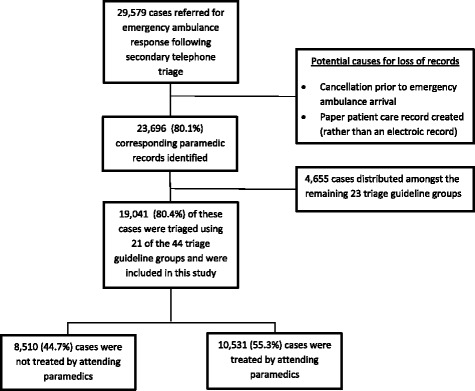
There were 19,041 cases eligible for inclusion in this study over almost three years, of which 8510 (44.7%) were not treated after being sent an emergency ambulance following secondary triage. Age, time of day, pain, triage guideline group, and comorbidities were associated with 'no paramedic treatment'. In particular, cases 0-4 years of age or those with psychiatric conditions were significantly less likely to be treated by paramedics, and increasing pain resulted in higher rates of paramedic treatment.
This study highlights that case characteristics can be used to identify particular case types that may benefit from care pathways other than emergency ambulance dispatch. This process is also useful to identify gaps in the alternative care pathways currently available. These findings offer the opportunity to optimise secondary telephone triage services to support their strategic purpose of minimising unnecessary emergency ambulance demand and to match the right case with the right care pathway.
预测不太可能由护理人员治疗的病例类型可以通过识别适合替代管理途径的病例来帮助管理对紧急救护车的需求。本研究的目的是确定在二次电话分诊后转介紧急救护车派遣的病例中与“无护理人员治疗”相关的患者特征和分诊结果。
对 2009 年 9 月至 2012 年 6 月期间二次电话分诊后转介紧急救护车派遣的病例进行回顾性队列分析。使用多变量逻辑回归模型来确定与“无护理人员治疗”相关的解释变量。
在将近三年的时间里,共有 19041 例病例符合纳入标准,其中 8510 例(44.7%)在二次分诊后派遣紧急救护车后未得到治疗。年龄、一天中的时间、疼痛、分诊指南组和合并症与“无护理人员治疗”相关。特别是 0-4 岁的病例或患有精神疾病的病例不太可能由护理人员治疗,疼痛程度增加会导致更高的护理人员治疗率。
本研究强调了病例特征可用于识别可能受益于除紧急救护车派遣以外的护理途径的特定病例类型。这一过程也有助于发现当前替代护理途径中存在的差距。这些发现为优化二次电话分诊服务提供了机会,以支持其最小化不必要的紧急救护车需求的战略目的,并为正确的病例匹配正确的护理途径。