Biomedical Research Institute, R&D Center, MEDIPOST Co., Ltd, Gyeonggi-do, Republic of Korea.
Department of Genetic Engineering, College of Biotechnology and Bioengineering, Sungkyunkwan University, Suwon, Republic of Korea.
Sci Rep. 2018 Jan 10;8(1):354. doi: 10.1038/s41598-017-18542-0.
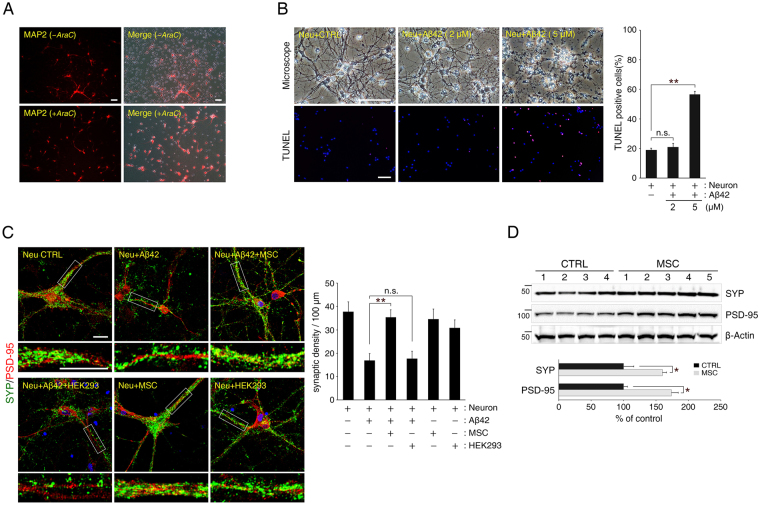
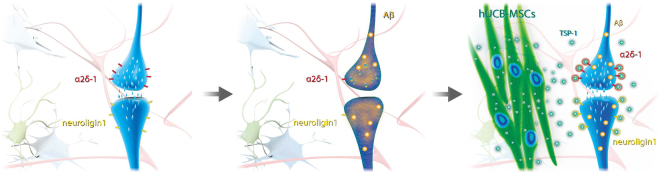
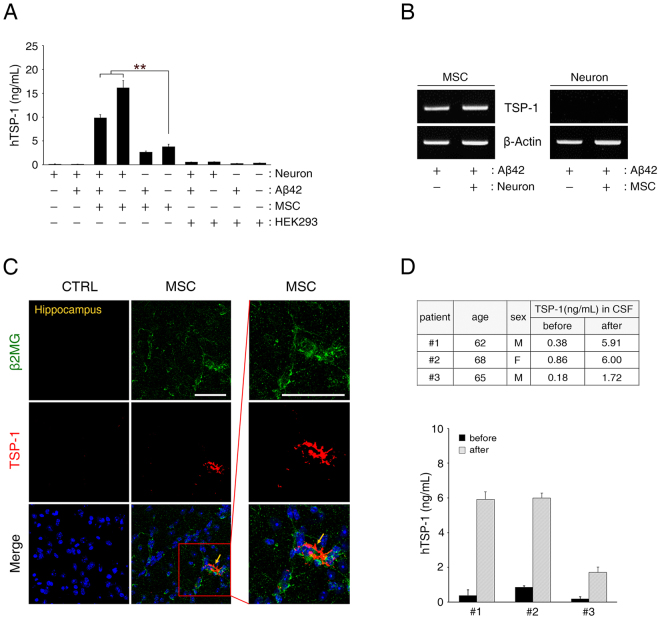
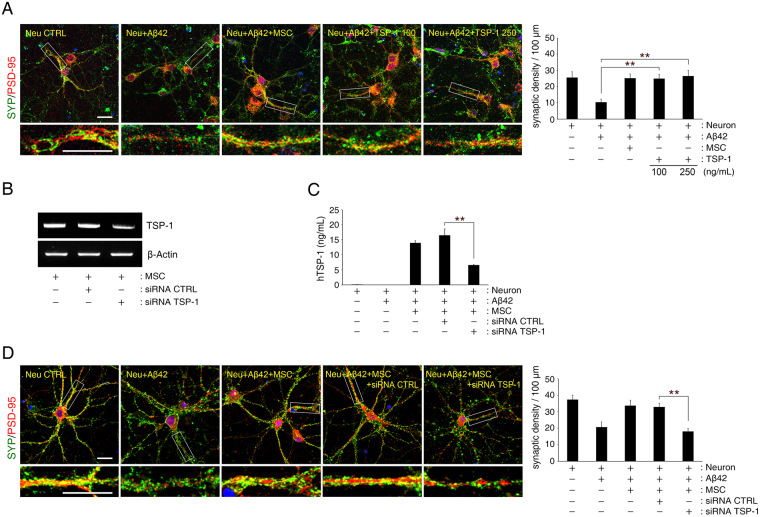
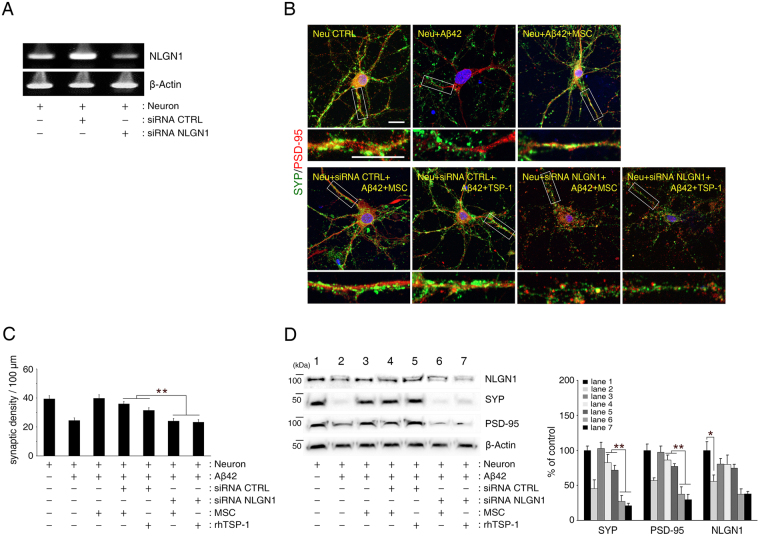
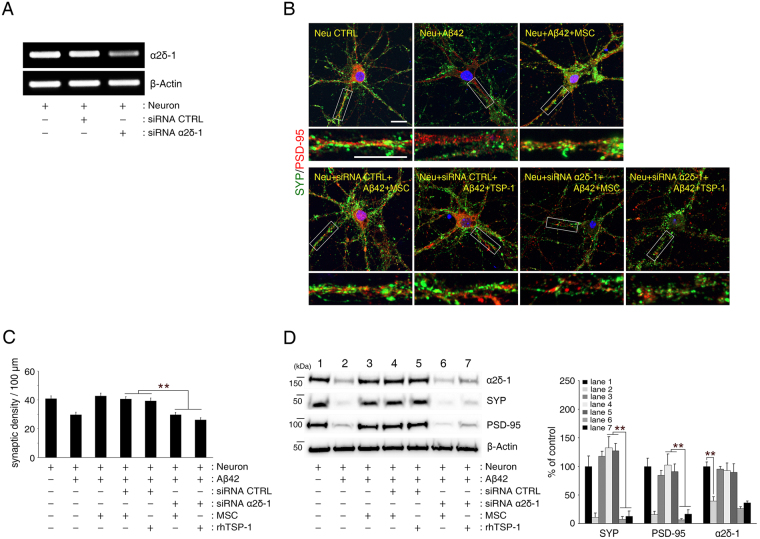
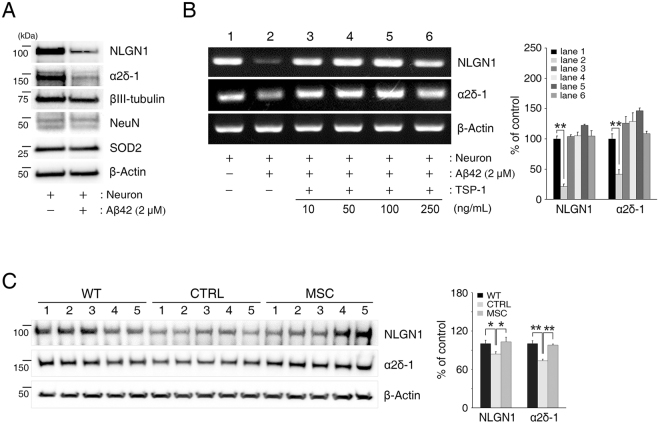
Alzheimer's disease (AD) is an incurable neurodegenerative disease characterised clinically by learning and memory impairments. Amyloid beta (Aβ) peptide-induced synaptic dysfunction is a pathological process associated with early-stage AD. Here, we show that paracrine action of human umbilical cord blood-derived-mesenchymal stem cells (hUCB-MSCs) protects the hippocampus from synaptic-density loss in in vitro and in vivo AD models. To identify paracrine factors underlying this rescue effect, we analysed hUCB-MSCs' secretome co-cultured with Aβ42-treated mouse hippocampal neurons. Thrombospondin-1 (TSP-1), a protein secreted by hUCB-MSCs in in vitro and 5XFAD AD mouse models, was selected for study. Treatment with exogenous recombinant TSP-1 or co-cultures with hUCB-MSCs significantly increased expression of synaptic-density markers, such as synaptophysin (SYP) and post-synaptic density protein-95 (PSD-95) in Aβ42-treated mouse hippocampal neurons. Knockdown of TSP-1 expression in hUCB-MSCs through small interfering RNA (siRNA) abolished the reversal of Aβ42-induced hippocampal synaptic-density loss. We demonstrate that the rescue effect of hUCB-MSC-secreted TSP-1 was mediated by neuroligin-1 (NLGN1) or α2δ-1 receptors. Interestingly, NLGN1 and α2δ-1 expression, which was reduced in Aβ42-treated hippocampal neurons, increased in co-cultures with hUCB-MSCs or exogenous TSP-1. Together, these findings suggest that hUCB-MSCs can attenuate Aβ42-induced synaptic dysfunction by regulating TSP-1 release, thus providing a potential alternative therapeutic option for early-stage AD.
阿尔茨海默病(AD)是一种无法治愈的神经退行性疾病,临床上表现为学习和记忆障碍。淀粉样β(Aβ)肽诱导的突触功能障碍是与 AD 早期阶段相关的病理过程。在这里,我们表明人脐带来源的间充质干细胞(hUCB-MSCs)的旁分泌作用可保护海马体免受体外和体内 AD 模型中突触密度丧失的影响。为了确定这种挽救作用的旁分泌因子,我们分析了与人 Aβ42 处理的海马神经元共培养的 hUCB-MSCs 的分泌组。血栓素-1(TSP-1)是 hUCB-MSCs 在体外和 5XFAD AD 小鼠模型中分泌的一种蛋白质,被选为研究对象。外源性重组 TSP-1 处理或与 hUCB-MSCs 共培养可显著增加 Aβ42 处理的海马神经元中突触密度标志物的表达,如突触小泡蛋白(SYP)和突触后密度蛋白-95(PSD-95)。通过小干扰 RNA(siRNA)敲低 hUCB-MSCs 中的 TSP-1 表达可消除 Aβ42 诱导的海马突触密度丧失的逆转。我们证明 hUCB-MSC 分泌的 TSP-1 的挽救作用是通过神经粘连蛋白-1(NLGN1)或α2δ-1 受体介导的。有趣的是,在 Aβ42 处理的海马神经元中减少的 NLGN1 和α2δ-1 表达在与 hUCB-MSCs 或外源性 TSP-1 的共培养中增加。总之,这些发现表明 hUCB-MSCs 可以通过调节 TSP-1 的释放来减轻 Aβ42 诱导的突触功能障碍,从而为早期 AD 提供一种潜在的替代治疗选择。